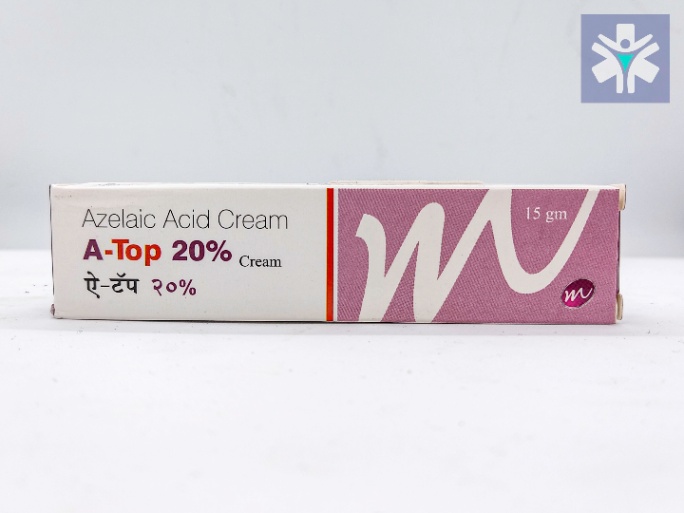
A-TOP 20%
Price: Rs.440.00
10% off
In stock
Loose stock: 0
Description
A-TOP 20% CREAM 15GM
Details
Composition
AZELAIC ACID 20 % W/W
# AZELAIC ACID 20% W/W
## Short Description
**Azelaic Acid 20% W/W** is a topical dermatological medicine used primarily to manage **acne vulgaris and inflammatory skin conditions such as rosacea**, depending on the formulation and local approval. It has antimicrobial, anti-inflammatory, and skin-cell-normalizing properties.
Azelaic acid can also help reduce the appearance of **post-inflammatory hyperpigmentation and uneven skin tone** by reducing abnormal melanin production.
## Key Benefits
* Helps manage **mild to moderate acne**.
* Helps reduce acne-associated inflammation and redness.
* Helps reduce the growth of acne-associated bacteria.
* Helps keep pores from becoming blocked.
* May help improve **post-acne dark spots** and uneven pigmentation.
* May help reduce redness and inflammatory lesions associated with rosacea.
* Generally suitable for long-term topical use when tolerated and medically appropriate.
## Uses / Indications
Azelaic Acid 20% W/W may be used for:
* **Acne vulgaris**
* Inflammatory acne lesions such as papules and pustules
* Certain forms of **rosacea**, depending on the formulation
* Post-inflammatory hyperpigmentation or acne-related dark marks, where recommended by a healthcare professional
* Uneven skin tone associated with increased pigmentation
> Approved indications may differ between products and countries. Use the specific product according to its approved labeling or your dermatologist's advice.
## How It Works
Azelaic acid works through several mechanisms:
* **Antimicrobial action:** Helps reduce the number and activity of acne-associated bacteria.
* **Anti-inflammatory action:** Helps reduce inflammation and redness.
* **Keratolytic/comedolytic effects:** Helps normalize the shedding of skin cells within hair follicles, reducing pore blockage.
* **Pigment-regulating activity:** Inhibits tyrosinase and can reduce abnormal melanin production, which may help improve certain forms of hyperpigmentation.
## Dosage & Administration
* Cleanse the affected skin gently and allow it to dry before application.
* Apply a **thin layer of Azelaic Acid 20% W/W** to the affected areas as directed by your doctor or product label.
* Avoid applying it to the eyes, lips, inside of the nose, and other mucous membranes.
* Wash your hands after application unless the hands are the treated area.
* Avoid applying excessive amounts; using more will not necessarily produce faster results and may increase irritation.
* If irritation occurs, your healthcare professional may recommend reducing the frequency temporarily.
* Consistent use is important because improvement may take **several weeks**.
* Use sunscreen during the daytime, particularly when treating pigmentation or acne marks.
### Important Application Advice
Avoid applying azelaic acid to severely irritated, broken, or sunburned skin unless advised by your dermatologist.
## Side Effects
### Common Side Effects
* Burning or stinging
* Itching
* Tingling
* Dryness
* Peeling or scaling
* Redness
* Skin irritation
These effects are often mild and may improve as the skin becomes accustomed to treatment.
### Less Common Effects
* Contact dermatitis
* Increased sensitivity or irritation
* Changes in skin color at the application site
### Seek Medical Attention
Stop using the product and seek medical advice if you develop **severe swelling, blistering, intense burning, widespread rash, or signs of a serious allergic reaction**.
## Precautions & Warnings
* For **external use only**.
* Avoid contact with the eyes and mucous membranes. If accidental contact occurs, rinse thoroughly with water.
* Do not apply to severely damaged or irritated skin unless directed by a healthcare professional.
* Individuals with very sensitive skin should start cautiously and monitor for irritation.
* Avoid using multiple strong or irritating topical products simultaneously unless recommended by a dermatologist.
* Inform your doctor about any known allergy to azelaic acid or any ingredient in the formulation.
* Keep away from children.
* During pregnancy or breastfeeding, consult a healthcare professional before use.
* If treating pigmentation, consistent sun protection is important to prevent further darkening.
* Do not expect immediate results; several weeks of regular use may be necessary.
## Drug Interactions
Azelaic acid has **limited systemic absorption**, so clinically significant drug interactions are uncommon.
However:
* Tell your dermatologist about all topical medicines and skincare products you use.
* Combining azelaic acid with **strong exfoliating acids, retinoids, benzoyl peroxide, or other irritating acne treatments** may increase skin dryness and irritation.
* Avoid using multiple irritating products on the same area unless advised by a healthcare professional.
* No significant interactions are generally expected with most oral medicines when azelaic acid is used topically as directed.
## Storage Information
* Store according to the manufacturer's instructions.
* Keep at **room temperature** unless the product label specifies otherwise.
* Protect from excessive heat and direct sunlight.
* Keep the container tightly closed when not in use.
* Do not freeze unless specifically stated on the product label.
* Keep out of reach and sight of children.
* Do not use after the expiry date.
* Do not use the product if the container is damaged or the formulation has changed significantly in appearance or smell.
## Prescription Status
**Azelaic Acid 20% W/W may be prescription-only or available without a prescription depending on the country, product, and formulation.**
Always follow local regulations and the instructions provided by your doctor, pharmacist, or product label.
## Genuine Medicine Assurance
When purchasing Azelaic Acid 20% W/W, obtain it from a **licensed pharmacy or authorized medicine supplier**.
Before use, check:
* Product name and concentration
* Manufacturer details
* Batch/lot number
* Manufacturing and expiry dates
* Packaging integrity
* Regulatory/registration information where applicable
* Proper labeling and instructions
Avoid products with damaged packaging, missing information, or an unclear source.
## Frequently Asked Questions (FAQ)
### 1. What is Azelaic Acid 20% W/W used for?
Azelaic Acid 20% is a topical treatment commonly used for **acne** and, depending on the formulation, inflammatory skin conditions such as rosacea. It may also help improve certain types of post-inflammatory hyperpigmentation.
### 2. Is Azelaic Acid 20% good for acne?
Yes. Azelaic acid can help reduce acne by addressing **bacterial activity, inflammation, and abnormal buildup of skin cells inside pores**.
### 3. Does Azelaic Acid 20% remove dark spots?
It may help fade **post-inflammatory hyperpigmentation and acne-related dark marks** by reducing excessive melanin production. Results generally develop gradually with consistent use.
### 4. How long does Azelaic Acid 20% take to work?
Some improvement may become noticeable after several weeks. Acne and pigmentation often require **consistent treatment for several months** for more substantial improvement.
### 5. Can Azelaic Acid 20% be used every day?
It can often be used regularly, but the appropriate frequency depends on skin sensitivity and the product instructions. If irritation occurs, your dermatologist may recommend using it less frequently.
### 6. Can Azelaic Acid 20% cause skin irritation?
Yes. Burning, stinging, itching, dryness, redness, and peeling can occur, particularly when treatment is started. These effects are often mild and may improve with continued use.
### 7. Can I use azelaic acid with retinol?
They may sometimes be used together, but combining azelaic acid with retinoids can increase irritation. If you are using both, introduce products gradually and follow your dermatologist's advice.
### 8. Can I use Azelaic Acid 20% with benzoyl peroxide?
Azelaic acid and benzoyl peroxide may be used in some acne treatment routines, but the combination can increase dryness and irritation. Follow your dermatologist's recommended schedule.
### 9. Can I use Azelaic Acid 20% with vitamin C?
They can potentially be included in the same skincare routine, but combining multiple active ingredients may increase irritation in sensitive skin. Introduce products gradually and use them according to professional advice.
### 10. Can Azelaic Acid 20% be used for sensitive skin?
Azelaic acid is generally considered well tolerated, but the **20% concentration can cause irritation** in some people. Start cautiously and discontinue or reduce use if significant irritation develops.
### 11. Does Azelaic Acid 20% lighten skin?
Azelaic acid can reduce **excess pigmentation** and help even out skin tone. It is not intended to bleach normal skin and should not be used to achieve an unnaturally lighter complexion.
### 12. Can Azelaic Acid 20% be used during pregnancy?
Azelaic acid has relatively low systemic absorption when applied topically, but pregnant or breastfeeding individuals should still **consult a healthcare professional before starting treatment**.
### 13. Should I use sunscreen with Azelaic Acid 20%?
Yes. Daily broad-spectrum sunscreen is especially important when treating **dark spots or uneven pigmentation**, because ultraviolet exposure can worsen hyperpigmentation.
### 14. Can Azelaic Acid 20% be used for rosacea?
Azelaic acid is used in certain formulations for **inflammatory lesions associated with rosacea**. The appropriate concentration and formulation depend on the product and medical advice.
### 15. Can I apply Azelaic Acid 20% to my entire face?
If the product is intended for facial use, it can generally be applied as a thin layer to the affected areas as directed. Avoid the eyes, lips, nostrils, and broken skin.
### 16. What should I do if Azelaic Acid 20% burns my skin?
Mild tingling or burning can occur initially. If burning is severe, persistent, or accompanied by swelling, blistering, or significant redness, stop using the product and seek medical advice.
### 17. Can Azelaic Acid 20% cause purging?
Some people may experience temporary changes in acne when starting active skincare treatments, but significant worsening should not automatically be considered "purging." Persistent or severe worsening should be discussed with a dermatologist.
### 18. Is Azelaic Acid 20% available without a prescription?
Availability varies by country and formulation. Some azelaic acid products are available without a prescription, while **20% preparations may require a prescription in some markets**.
## Medical Disclaimer
This information about **Azelaic Acid 20% W/W** is provided for general educational purposes only and is **not a substitute for professional medical advice, diagnosis, or treatment**.
Use topical medicines according to the product instructions or advice from a qualified healthcare professional. Individual response can vary, and persistent, severe, or worsening acne, rosacea, pigmentation, or skin irritation should be evaluated by a dermatologist.