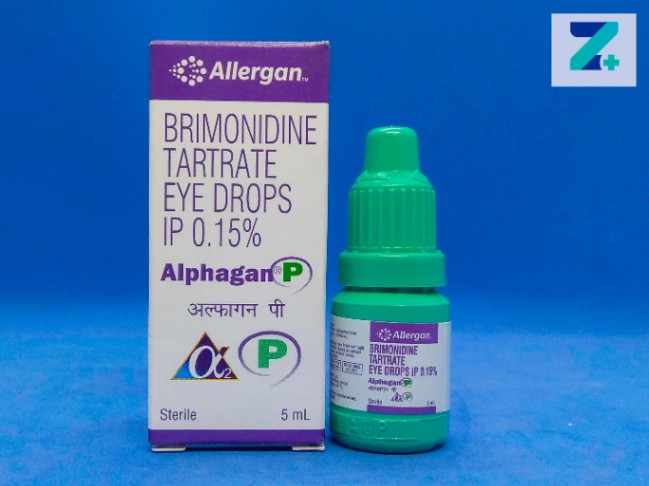
ALPHAGAN P
Price: Rs.776.65
10% off
In stock
Loose stock: 0
Description
ALPHAGAN P EYE DROPS 5ML
Details
Composition
BRIMONIDINE TARTRATE 0.15 %
# Brimonidine Tartrate 0.15%
## Short Description
**Brimonidine Tartrate 0.15%** is an ophthalmic medicine used to reduce **elevated intraocular pressure (IOP)**. It is an alpha-2 adrenergic receptor agonist commonly used in the management of **open-angle glaucoma and ocular hypertension**.
By decreasing the production of aqueous humor and increasing its drainage from the eye, Brimonidine Tartrate helps lower eye pressure and may reduce the risk of further optic nerve damage.
---
## Key Benefits
* Helps **lower elevated intraocular pressure (IOP)**.
* Supports the management of **open-angle glaucoma**.
* Helps control **ocular hypertension**.
* Reduces pressure-related stress on the optic nerve.
* Can be used alone or alongside other glaucoma medicines when prescribed.
* Provides targeted treatment through ophthalmic administration.
---
## Uses / Indications
Brimonidine Tartrate 0.15% eye drops may be prescribed for:
* **Open-angle glaucoma**
* **Ocular hypertension**
* Elevated intraocular pressure
* Additional IOP reduction when other glaucoma treatments do not provide sufficient control
Brimonidine controls eye pressure but **does not reverse existing optic nerve damage**.
---
## How It Works
Brimonidine is a **selective alpha-2 adrenergic receptor agonist**.
After application to the eye, it:
* Reduces the production of **aqueous humor**.
* Increases aqueous humor drainage through the **uveoscleral pathway**.
This decreases the amount of fluid within the eye and lowers **intraocular pressure**.
Maintaining appropriate IOP is important because persistently elevated eye pressure can contribute to optic nerve damage and vision loss in glaucoma.
---
## Dosage & Administration
**Use Brimonidine Tartrate 0.15% exactly as directed by your ophthalmologist or healthcare professional.**
### Typical Adult Use
For many 0.15% ophthalmic formulations, the usual regimen is:
**1 drop in the affected eye(s) three times daily, approximately 8 hours apart.**
However, the exact dose may differ depending on the specific product, medical condition, response to treatment, and other glaucoma medicines.
### How to Apply
1. Wash your hands.
2. Tilt your head backward and look upward.
3. Gently pull down the lower eyelid.
4. Instill **one drop** into the affected eye.
5. Do not allow the dropper tip to touch your eye, eyelid, fingers, or other surfaces.
6. Close your eye gently.
7. Apply gentle pressure to the inner corner of the eye near the nose for approximately **1 minute**.
8. Replace the cap immediately after use.
### With Other Eye Drops
If you use other ophthalmic medicines, generally allow **at least 5 minutes between different eye drops**, unless your doctor gives different instructions.
### Contact Lenses
Remove contact lenses before application when required by the product instructions, particularly if the formulation contains a preservative that may be absorbed by contact lenses. Follow the product-specific instructions for reinsertion.
### Missed Dose
Apply the missed dose when remembered unless it is almost time for the next dose.
**Do not apply extra drops to compensate for a missed dose.**
---
## Side Effects
### Common Side Effects
Possible side effects include:
* Eye redness
* Burning or stinging
* Eye itching
* Dry eyes
* Watery eyes
* Foreign-body sensation
* Temporary blurred vision
* Headache
* Fatigue
* Drowsiness
* Dry mouth
### Eye-Related Reactions
Some patients may experience:
* Allergic conjunctivitis
* Eyelid swelling
* Eye irritation
* Light sensitivity
### Serious Side Effects
Contact a healthcare professional promptly if you develop:
* Severe or persistent eye irritation
* Significant swelling around the eye
* Major or sudden changes in vision
* Severe dizziness
* Fainting
* Very slow or irregular heartbeat
* Difficulty breathing
* Signs of a severe allergic reaction
---
## Precautions & Warnings
* **For ophthalmic use only.**
* Do not swallow the medicine.
* Avoid touching the dropper tip to the eye or any other surface.
* Brimonidine may cause **drowsiness, fatigue, or dizziness**.
* Avoid driving or operating machinery until you know how the medicine affects you.
* Tell your doctor if you have **low blood pressure**.
* Inform your doctor if you have cardiovascular disease or a slow heart rate.
* Tell your healthcare professional if you have cerebrovascular or coronary insufficiency.
* Inform your doctor about kidney or liver problems.
* Brimonidine should be used with particular caution in **young children**, who can be more susceptible to systemic effects.
* Tell your doctor if you are pregnant, planning pregnancy, or breastfeeding.
* Do not discontinue glaucoma treatment without medical advice.
* Persistent eye redness, itching, swelling, or irritation may indicate an allergic reaction and should be evaluated.
---
## Drug Interactions
Brimonidine can interact with medicines that affect the **central nervous system, blood pressure, or heart rate**.
### Medicines That May Increase Drowsiness
* Alcohol
* Sedatives
* Sleeping medicines
* Opioids
* Certain anxiety medicines
* Other medicines that cause central nervous system depression
### Blood Pressure & Cardiovascular Medicines
Use caution with:
* Antihypertensive medicines
* Beta-blockers
* Medicines that lower blood pressure
* Medicines that slow the heart rate
These combinations may increase the risk of **low blood pressure or slow heart rate**.
### Antidepressants
Tell your doctor if you use:
* Tricyclic antidepressants
* MAO inhibitors
* Other medicines affecting adrenergic neurotransmission
### Other Glaucoma Medicines
Brimonidine may be combined with other glaucoma medicines when clinically appropriate. Such combinations should be determined by your ophthalmologist.
Always inform your healthcare professional about all prescription medicines, OTC medicines, vitamins, supplements, and herbal products you take.
---
## Storage Information
* Store according to the manufacturer's instructions.
* Keep the bottle **tightly closed** when not in use.
* Protect from excessive heat, moisture, and direct sunlight.
* Do not freeze unless specifically stated on the product label.
* Keep out of reach and sight of children.
* Do not use after the expiry date.
* Avoid touching the dropper tip to the eye or other surfaces.
* Follow the manufacturer's instructions regarding how long the bottle can be used after opening.
---
## Prescription Status
**Brimonidine Tartrate 0.15% is generally a prescription ophthalmic medicine**, although regulatory requirements can vary by country.
Because glaucoma requires regular monitoring of eye pressure and optic nerve health, treatment should be used under the supervision of an ophthalmologist or qualified healthcare professional.
---
## Genuine Medicine Assurance
When purchasing **Brimonidine Tartrate 0.15%**, obtain it from a **licensed pharmacy or authorized medicine supplier**.
Before using the product, verify:
* Product name and concentration
* Dosage form
* Manufacturer information
* Batch/lot number
* Manufacturing date
* Expiry date
* Bottle and packaging integrity
* Product registration/authorization information where applicable
* Security or authenticity features, if provided
Do not use eye drops if the seal is broken, packaging is damaged, or the solution appears contaminated or otherwise abnormal.
---
# FAQ – Brimonidine Tartrate 0.15%
### 1. What is Brimonidine Tartrate 0.15% used for?
It is an eye drop used to **lower elevated intraocular pressure** in conditions such as open-angle glaucoma and ocular hypertension.
### 2. Is Brimonidine Tartrate used for glaucoma?
Yes. Brimonidine is commonly used to help control eye pressure in **open-angle glaucoma**.
### 3. How does Brimonidine lower eye pressure?
It primarily reduces **aqueous humor production** and also increases aqueous humor drainage through the uveoscleral pathway.
### 4. How often should Brimonidine 0.15% be used?
Many 0.15% formulations are administered as **one drop three times daily**, approximately 8 hours apart. Always follow the specific prescription and product labeling.
### 5. Can Brimonidine cure glaucoma?
No. Brimonidine helps **control intraocular pressure** but does not reverse existing optic nerve damage caused by glaucoma.
### 6. Can I stop Brimonidine when my eye pressure becomes normal?
No. Do not stop treatment without consulting your ophthalmologist. Stopping the medicine may allow eye pressure to rise again.
### 7. Can Brimonidine be used with other glaucoma eye drops?
Yes, it can sometimes be combined with other IOP-lowering medicines when prescribed by an ophthalmologist.
### 8. How long should I wait between Brimonidine and another eye drop?
Generally, allow **at least 5 minutes between different eye drops**, unless your healthcare professional recommends another interval.
### 9. Can Brimonidine cause blurred vision?
Temporary blurred vision can occur after applying eye drops. Persistent or significant vision changes require medical evaluation.
### 10. Can Brimonidine cause eye redness?
Yes. Eye redness and irritation are possible side effects. Persistent redness, itching, or swelling should be assessed by an eye-care professional.
### 11. Does Brimonidine cause drowsiness?
It can. Some people experience **drowsiness, fatigue, or dizziness**.
### 12. Can I drive after using Brimonidine?
Avoid driving until you know how the medicine affects your vision and alertness.
### 13. Can Brimonidine lower blood pressure?
Systemic absorption can occasionally cause **low blood pressure or a slow heart rate**, particularly in susceptible patients or when combined with cardiovascular medicines.
### 14. Can children use Brimonidine 0.15%?
Brimonidine requires particular caution in young children because systemic effects can be serious. Use in children should be specifically recommended and monitored by a healthcare professional.
### 15. Can Brimonidine be used during pregnancy?
Consult your doctor before using Brimonidine Tartrate during pregnancy. Your healthcare professional will assess the potential benefits and risks.
### 16. Can I use Brimonidine while breastfeeding?
Consult your healthcare professional before using brimonidine while breastfeeding.
### 17. Can I wear contact lenses while using Brimonidine?
Follow the instructions for your specific product. Contact lenses may need to be removed before application if the formulation contains a preservative that can be absorbed by the lenses.
### 18. What should I do if I miss a dose?
Apply the missed dose when remembered unless it is nearly time for the next dose. **Do not use additional drops to make up for the missed dose.**
### 19. What happens if I accidentally use too many drops?
Using extra drops may increase irritation and systemic absorption. If you develop significant dizziness, drowsiness, slow heartbeat, breathing difficulty, or other concerning symptoms, seek medical attention.
### 20. What happens if Brimonidine is swallowed accidentally?
Accidental ingestion can cause serious systemic effects, particularly in children, including **drowsiness, low blood pressure, slow heart rate, and breathing problems**. Seek urgent medical attention if ingestion occurs.
---
## Medical Disclaimer
**This information is provided for educational and informational purposes only and is not a substitute for professional medical advice, diagnosis, or treatment.**
Brimonidine Tartrate 0.15% is an ophthalmic medicine used to control elevated intraocular pressure. The appropriate dosing schedule depends on the specific formulation, patient's condition, age, other glaucoma medicines, and medical history.
Glaucoma can progress without obvious symptoms and may cause **irreversible vision loss**. Regular eye examinations and intraocular-pressure monitoring are therefore important. Do not stop prescribed glaucoma treatment without consulting your ophthalmologist.
Seek urgent medical attention for **sudden vision loss, severe eye pain, severe allergic reactions, fainting, difficulty breathing, or significant cardiovascular symptoms**.
**Always read the manufacturer's package insert and follow the approved prescribing information applicable to your country.**