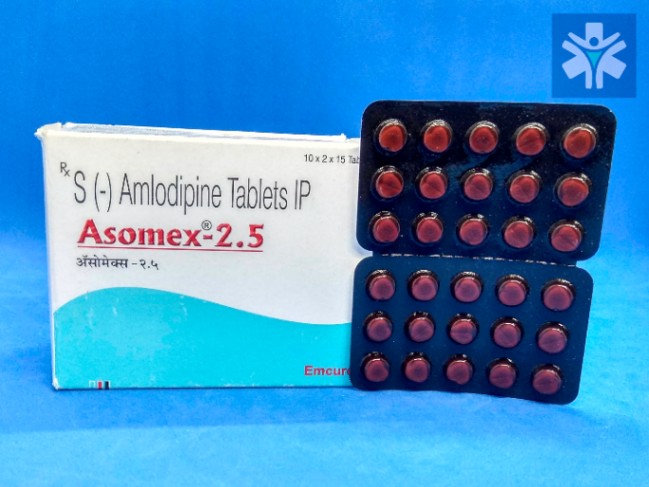
ASOMEX-2.5MG
Price: Rs.145.79
13% off
In stock
Loose stock: 0
Description
ASOMEX-2.5MG TAB 15
Details
Composition
S-AMLODIPINE 2.5 MG
# S-Amlodipine 2.5 mg
## Short Description
**S-Amlodipine 2.5 mg** contains **S-amlodipine (levamlodipine)**, the pharmacologically active S-enantiomer of amlodipine. It belongs to the **calcium-channel blocker (CCB)** class and is used primarily to help control **high blood pressure (hypertension)** and, in appropriate patients, **angina (chest pain)**.
## Key Benefits
* Helps lower **high blood pressure**.
* Helps reduce the workload on the heart.
* Promotes relaxation of blood vessels and improves blood flow.
* May help prevent symptoms of **stable angina** when prescribed for this purpose.
* Provides a long-acting blood-pressure-lowering effect with once-daily administration in many patients.
* The 2.5 mg strength may be useful when a **lower starting or maintenance dose** is appropriate.
## Uses / Indications
S-Amlodipine 2.5 mg may be prescribed for:
* **Hypertension (high blood pressure)**
* **Chronic stable angina**
* Certain forms of vasospastic (Prinzmetal) angina
Treatment should be individualized based on blood pressure, cardiovascular status, age, and response to therapy.
> **Important:** S-amlodipine is not intended to provide immediate relief during an acute attack of chest pain.
## How It Works
S-amlodipine is a **dihydropyridine calcium-channel blocker**.
It blocks calcium entry into the smooth muscle cells of blood vessels. This causes the arteries to **relax and widen (vasodilation)**.
As a result:
* Peripheral vascular resistance decreases.
* Blood pressure is lowered.
* Blood flow to the heart muscle can improve.
* The workload and oxygen demand of the heart may decrease.
The S-enantiomer is primarily responsible for the calcium-channel-blocking activity of amlodipine.
## Dosage & Administration
* Take **S-Amlodipine 2.5 mg exactly as prescribed**.
* It is generally taken **once daily**, preferably at the same time each day.
* It may be taken **with or without food**.
* Swallow the tablet with water.
* Your doctor may adjust the dose according to your blood-pressure response and medical condition.
* Do not change the dose or stop treatment without medical advice.
* If you miss a dose, take it when remembered unless it is nearly time for the next dose. **Do not take two doses at once.**
Blood pressure should be monitored regularly during treatment.
## Side Effects
### Common Side Effects
Possible side effects include:
* Ankle or foot swelling (**peripheral edema**)
* Headache
* Dizziness
* Flushing
* Fatigue
* Palpitations
* Nausea
* Abdominal discomfort
### Serious Side Effects
Serious reactions are uncommon but seek medical attention if you experience:
* Severe dizziness or fainting
* Very low blood pressure
* Significant or worsening chest pain
* Severe allergic reaction
* Swelling of the face, lips, tongue, or throat
* Severe or persistent palpitations
## Precautions & Warnings
### Low Blood Pressure
S-amlodipine can lower blood pressure. Dizziness or lightheadedness may occur, particularly when treatment is started or the dose is increased.
### Liver Disease
S-amlodipine is metabolized by the liver. Patients with significant liver impairment may require careful dose selection and monitoring.
### Heart Conditions
Tell your doctor if you have heart failure, severe aortic stenosis, or other significant cardiovascular disease.
### Peripheral Edema
Ankle and foot swelling is a relatively common effect of amlodipine. Contact your healthcare professional if swelling is severe or persistent.
### Pregnancy and Breastfeeding
Tell your doctor if you are pregnant, planning pregnancy, or breastfeeding. S-amlodipine should be used when considered appropriate by a healthcare professional.
## Drug Interactions
S-amlodipine generally has fewer clinically significant interactions than many other cardiovascular medicines, but it may interact with:
* Other **blood-pressure-lowering medicines** — may produce an additive reduction in blood pressure.
* Other calcium-channel blockers — may increase blood-pressure-lowering effects.
* **CYP3A4 inhibitors**, such as certain macrolide antibiotics or azole antifungals, may increase amlodipine exposure.
* **Simvastatin** — amlodipine can increase simvastatin exposure; dose limitations may apply depending on the product and clinical circumstances.
* Some medicines used for erectile dysfunction — combined blood-pressure-lowering effects may increase dizziness or hypotension.
Always inform your doctor or pharmacist about all prescription medicines, OTC medicines, vitamins, and herbal supplements you take.
## Storage Information
* Store according to the manufacturer's recommended conditions, generally at **room temperature**.
* Keep tablets in their original packaging.
* Protect from excessive heat, moisture, and direct sunlight.
* Keep the container tightly closed when not in use.
* Keep out of reach and sight of children.
* Do not use after the expiry date.
* Dispose of unused medicine according to local pharmacy or healthcare guidance.
## Prescription Status
**S-Amlodipine 2.5 mg is generally a prescription medicine.**
It should be taken under medical supervision, particularly in patients with cardiovascular or liver conditions.
## Genuine Medicine Assurance
When purchasing S-Amlodipine 2.5 mg, obtain it from a **licensed pharmacy or authorized medicine supplier**.
Before using the medicine, verify:
* Manufacturer name
* Active ingredient and strength
* Batch/lot number
* Manufacturing and expiry dates
* Packaging and seal integrity
* Product registration or authorization information where applicable
Avoid medicines from unknown or unverified sources, particularly products with damaged packaging or missing batch information.
# Frequently Asked Questions (FAQs)
### 1. What is S-Amlodipine 2.5 mg used for?
S-Amlodipine 2.5 mg is primarily used to treat **high blood pressure** and may also be prescribed for certain types of **angina**.
### 2. What is S-Amlodipine?
S-Amlodipine, also called **levamlodipine**, is the S-enantiomer of amlodipine and is responsible for most of the calcium-channel-blocking activity of the racemic amlodipine molecule.
### 3. Is S-Amlodipine the same as Amlodipine?
They are closely related but are not identical formulations. **S-amlodipine contains the active S-enantiomer**, while conventional amlodipine products may contain a mixture of S- and R-enantiomers.
### 4. How does S-Amlodipine 2.5 mg lower blood pressure?
It relaxes and widens blood vessels by blocking calcium entry into vascular smooth muscle. This reduces resistance to blood flow and **lowers blood pressure**.
### 5. When should I take S-Amlodipine 2.5 mg?
It is generally taken **once daily**, at approximately the same time each day. It can usually be taken with or without food.
### 6. Can S-Amlodipine 2.5 mg be taken at night?
Yes, it may generally be taken at night if that fits your prescribed schedule. Consistency is more important than a particular time of day unless your doctor has provided specific instructions.
### 7. Does S-Amlodipine cause ankle swelling?
Yes. **Peripheral edema, especially ankle or foot swelling, is one of the more common effects** of amlodipine-type medicines.
### 8. Does S-Amlodipine cause dizziness?
It can. Dizziness may occur because of lowered blood pressure, especially when starting treatment or after a dose increase.
### 9. Can S-Amlodipine be used for chest pain?
S-amlodipine may be prescribed to help **prevent chronic stable or vasospastic angina**, but it is not intended to provide immediate relief during an acute chest-pain attack.
### 10. Does S-Amlodipine cure high blood pressure?
It helps **control** high blood pressure but does not usually cure the underlying tendency toward hypertension. Long-term treatment and lifestyle measures may be required.
### 11. Can I stop S-Amlodipine when my blood pressure becomes normal?
Do not stop it without medical advice. Normal blood pressure may indicate that the treatment is working.
### 12. Can S-Amlodipine be taken with other blood-pressure medicines?
Yes, it is commonly combined with other antihypertensive medicines when clinically appropriate. Your doctor determines the combination and doses.
### 13. Can S-Amlodipine be taken during pregnancy?
Tell your healthcare professional if you are pregnant or planning pregnancy. It should be used during pregnancy only when considered appropriate by your doctor.
### 14. Can S-Amlodipine be taken while breastfeeding?
Discuss its use with your healthcare professional if you are breastfeeding so that the potential benefits and risks can be assessed.
### 15. What should I do if I miss a dose of S-Amlodipine 2.5 mg?
Take the missed dose when remembered unless it is nearly time for your next dose. **Do not take two doses together.**
### 16. Can S-Amlodipine interact with other medicines?
Yes. It may interact with certain blood-pressure medicines, CYP3A4 inhibitors, and some cholesterol-lowering medicines such as **simvastatin**. Always provide your healthcare professional with a complete medication list.
### 17. How long does S-Amlodipine take to work?
Blood-pressure reduction develops gradually. Because S-amlodipine has a long duration of action, its full therapeutic effect may take time to assess after starting or changing the dose.
### 18. Is S-Amlodipine 2.5 mg available without a prescription?
S-Amlodipine is generally a **prescription medicine**, although dispensing regulations can vary between countries.
## Medical Disclaimer
This information about **S-Amlodipine 2.5 mg** is provided for educational and SEO purposes only and does not replace professional medical advice, diagnosis, or treatment. The appropriate dose depends on the patient's blood pressure, cardiovascular condition, age, liver function, and response to treatment. Do not start, stop, or change S-Amlodipine 2.5 mg without consulting a qualified healthcare professional. If you experience severe chest pain, fainting, difficulty breathing, or signs of a serious allergic reaction, seek urgent medical attention.