BACTOLAC
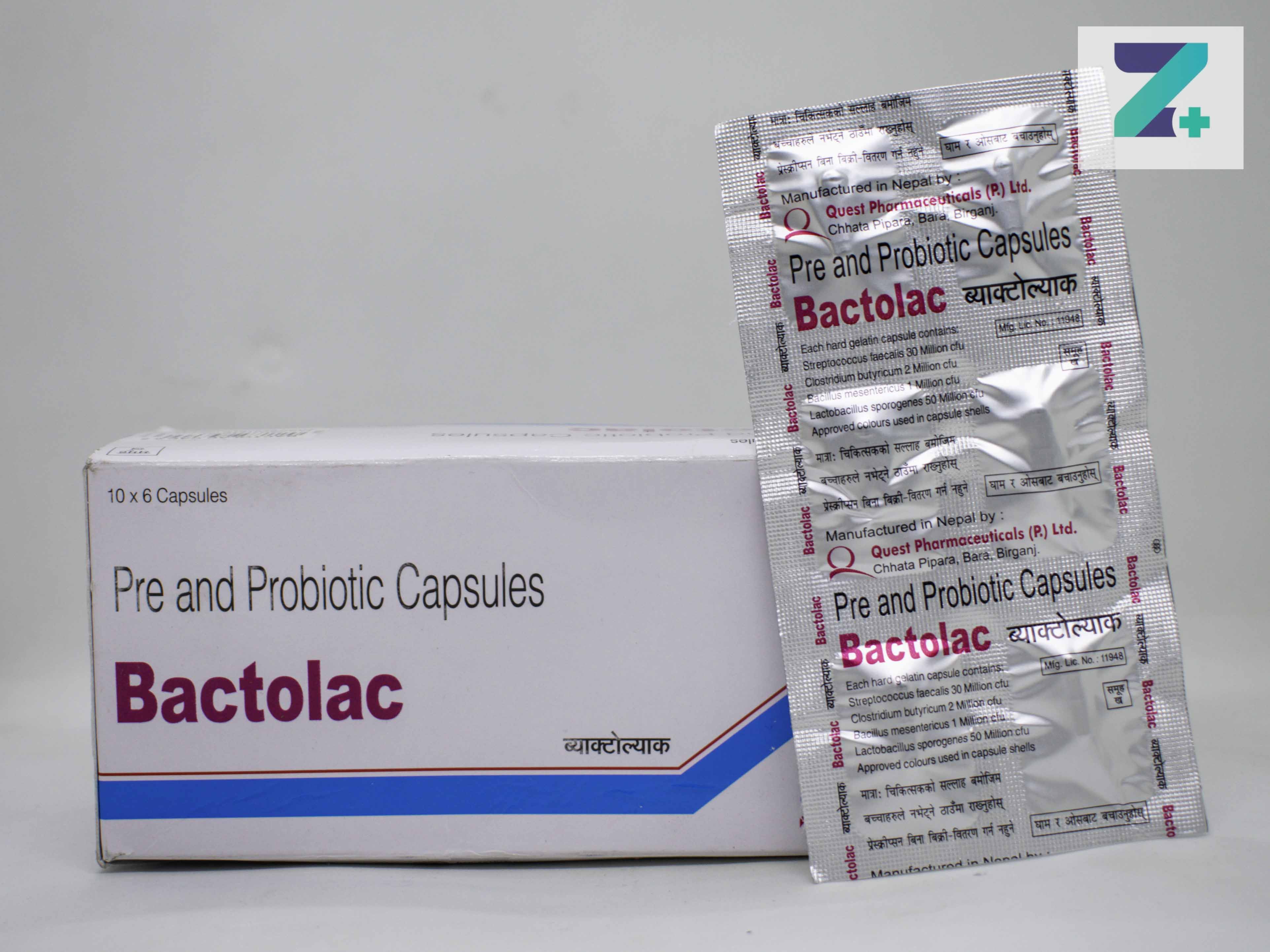
Price: Rs.90.00
10% off
In stock
Loose stock: 0
Description
BACTOLAC CAP 6
Details
Composition
BACILLUS MESENTERICUS 1 MILLION CELLS,CLOSTRIDIUM BUTYRICUM 2 MILLION CELLS,LACTOBACILLUS SPOROGENES 50 MILLION CELLS,STREPTOCOCCUS FAECALIS 30 MILLION CELLS
# BACILLUS MESENTERICUS 1 MILLION CELLS + CLOSTRIDIUM BUTYRICUM 2 MILLION CELLS + LACTOBACILLUS SPOROGENES 50 MILLION CELLS + STREPTOCOCCUS FAECALIS 30 MILLION CELLS
## SHORT DESCRIPTION
**Bacillus Mesentericus 1 Million Cells + Clostridium Butyricum 2 Million Cells + Lactobacillus Sporogenes 50 Million Cells + Streptococcus Faecalis 30 Million Cells** is a **multi-strain probiotic preparation** intended to support and restore the normal balance of intestinal microorganisms.
It may be used as supportive treatment for **diarrhea, intestinal microbial imbalance, and digestive disturbances**, particularly when the normal gut flora has been disrupted.
> **Important:** Older product labels may use names such as *Lactobacillus sporogenes* and *Streptococcus faecalis*. These organisms are now commonly referred to by updated taxonomic names in modern microbiology. The exact strains and viability should be confirmed from the manufacturer's label.
---
## KEY BENEFITS
* Helps support a **healthy intestinal microbial balance**.
* May help restore beneficial bacteria after disruption of gut flora.
* Provides multiple bacterial strains in a single formulation.
* May support normal digestive function.
* Can be used as supportive therapy for certain types of **diarrhea**.
* May help maintain intestinal microbial balance during or after certain antibiotic treatments.
* Supports normal gastrointestinal function.
---
## USES / INDICATIONS
This probiotic combination may be used as supportive treatment for:
1. **Diarrhea associated with intestinal microbial imbalance**.
2. Gastrointestinal disturbances associated with changes in normal gut flora.
3. Support during or after certain **antibiotic treatments**.
4. Digestive disturbances where probiotic supplementation is considered appropriate.
5. Restoration of intestinal microbial balance after certain gastrointestinal illnesses.
The exact approved indications vary by product and country.
> Probiotics are generally supportive products and should not replace appropriate treatment for severe bacterial, parasitic, or other infections.
---
## HOW IT WORKS
This product contains multiple microorganisms intended to support the intestinal microbiome.
### Bacillus Mesentericus
A spore-forming bacterial organism traditionally included in some probiotic preparations. It is intended to support the intestinal microbial environment.
### Clostridium Butyricum
A butyrate-producing organism. Butyrate is a short-chain fatty acid that serves as an important energy source for cells lining the colon and contributes to normal intestinal function.
### Lactobacillus Sporogenes
The term **Lactobacillus sporogenes** has historically been used for a spore-forming lactic-acid-producing bacterium now commonly classified as **Bacillus coagulans**.
It can contribute to the production of lactic acid and support the intestinal microbial environment.
### Streptococcus Faecalis
This is an older name historically used for **Enterococcus faecalis**. Certain preparations containing this organism have traditionally been used to support intestinal microbial balance.
Together, these microorganisms are intended to help maintain or restore a healthy **gut microbial environment**.
---
## DOSAGE & ADMINISTRATION
### Adults
The appropriate dose depends on the **specific formulation, dosage form, viable cell count, and manufacturer's instructions**.
Follow the dose printed on the product label or prescribed by your healthcare professional.
### Administration
* Take the product exactly as directed.
* If supplied as a capsule or tablet, swallow with water unless the product instructions specify otherwise.
* If supplied as a powder or sachet, prepare it according to the manufacturer's instructions.
* Do not mix probiotic preparations with very hot liquids because excessive heat may reduce bacterial viability.
* Maintain adequate fluid intake when treating diarrhea unless your healthcare professional has advised fluid restriction.
### During Antibiotic Treatment
If a probiotic is being used alongside an antibiotic, healthcare professionals may recommend separating administration by **approximately 2 hours** for many bacterial probiotics. Follow the specific product instructions.
### Missed Dose
If a dose is missed, take it when remembered unless it is almost time for the next dose.
**Do not double the dose.**
---
## SIDE EFFECTS
### Common Side Effects
Probiotics are generally well tolerated, but some people may experience:
* Mild bloating
* Gas
* Abdominal discomfort
* Temporary changes in bowel movements
* Nausea
These symptoms are often mild and may improve as the digestive system adjusts.
### Serious Side Effects
Serious adverse reactions are uncommon in healthy individuals.
Seek medical attention if you develop:
* Severe abdominal pain
* Persistent vomiting
* Severe diarrhea
* Blood in the stool
* High fever
* Signs of an allergic reaction
* Severe weakness or dehydration
Rare cases of serious bloodstream infection associated with probiotic organisms have been reported, particularly in **severely immunocompromised or critically ill individuals**.
---
## PRECAUTIONS & WARNINGS
### Immunocompromised Patients
Use caution in people with:
* Severely weakened immune systems
* Serious underlying illness
* Central venous catheters
* Critical illness
* Recent major surgery
Such individuals should consult a healthcare professional before using live bacterial probiotics.
### Severe Diarrhea
Probiotics should not delay medical evaluation when diarrhea is severe or persistent.
Seek medical attention if diarrhea is accompanied by:
* Blood or mucus
* High fever
* Severe abdominal pain
* Significant dehydration
* Persistent vomiting
* Confusion or severe weakness
### Children
Use in infants and young children should follow pediatric medical advice, particularly in premature infants or medically fragile children.
### Pregnancy & Breastfeeding
Consult a healthcare professional before using this combination during pregnancy or breastfeeding, particularly if you have an underlying medical condition.
---
## DRUG INTERACTIONS
Probiotic preparations generally have **few conventional drug interactions**.
However:
* **Antibiotics:** Antibiotics may reduce the viability of bacterial probiotic organisms. When appropriate, separate the probiotic and antibiotic doses according to product or healthcare-professional instructions.
* **Immunosuppressive medicines:** Individuals receiving significant immunosuppressive treatment should seek medical advice before using live bacterial probiotics.
* Other probiotic products may contain overlapping organisms or ingredients.
Always tell your healthcare professional about all **prescription medicines, OTC medicines, supplements, and probiotics** you are taking.
---
## STORAGE INFORMATION
Storage requirements depend on the specific formulation and manufacturer.
* Follow the **storage instructions printed on the product label**.
* Some probiotic products require refrigeration, while others are formulated to remain stable at room temperature.
* Protect from excessive heat, moisture, and direct sunlight.
* Keep the container tightly closed.
* Keep out of reach and sight of children.
* Do not use after the expiry date.
* Do not use the product if the packaging is damaged or the product appears abnormal.
> **Do not assume refrigeration is required unless the manufacturer's label specifically states it.**
---
## PRESCRIPTION STATUS
**Prescription status varies by country and formulation.**
Many probiotic preparations are available **without a prescription**, although certain products may be recommended or supplied under medical supervision.
Follow local pharmacy regulations and the manufacturer's directions.
---
## GENUINE MEDICINE ASSURANCE
When purchasing this probiotic combination, obtain it from a **licensed pharmacy or authorized medicine supplier**.
Before use, verify:
* Product name and bacterial composition
* Viable cell count/strength
* Manufacturer information
* Batch/lot number
* Manufacturing and expiry dates
* Storage requirements
* Packaging integrity
* Applicable regulatory information
Because probiotic viability can decline over time or with improper storage, purchase products from reliable sources and follow the manufacturer's storage instructions carefully.
---
# FAQ – MULTI-STRAIN PROBIOTIC
### 1. What is Bacillus Mesentericus + Clostridium Butyricum + Lactobacillus Sporogenes + Streptococcus Faecalis used for?
This combination is a **multi-strain probiotic preparation** used to support intestinal microbial balance and may be used as supportive treatment for certain types of diarrhea and digestive disturbances.
### 2. Is this medicine a probiotic?
Yes. It contains several bacterial microorganisms intended to support the **intestinal microbiome**.
### 3. Can this probiotic help with diarrhea?
It may help support recovery from certain types of diarrhea, particularly when intestinal microbial balance has been disturbed. However, severe or persistent diarrhea requires medical evaluation.
### 4. Can this probiotic be taken with antibiotics?
Probiotics may sometimes be used alongside antibiotics. For many bacterial probiotics, separating the doses by **about 2 hours** can help reduce direct exposure of the probiotic organisms to the antibiotic.
### 5. What is Lactobacillus Sporogenes?
**Lactobacillus sporogenes** is a historical name commonly used for **Bacillus coagulans**, a spore-forming lactic-acid-producing bacterium used in some probiotic products.
### 6. What is Streptococcus Faecalis?
*Streptococcus faecalis* is an older taxonomic name for **Enterococcus faecalis**. Some traditional probiotic preparations use the older name on their labels.
### 7. What is Clostridium Butyricum?
*Clostridium butyricum* is a bacterium capable of producing **butyrate**, a short-chain fatty acid important for normal colon function.
### 8. Can probiotics restore gut flora after antibiotics?
They may help support the intestinal microbiome after antibiotic exposure, although the effectiveness varies depending on the **specific probiotic strain, dose, and clinical condition**.
### 9. Do probiotics cause gas or bloating?
Some people experience temporary **gas, bloating, or mild abdominal discomfort** when beginning probiotic supplementation.
### 10. Can children take this probiotic?
Children may use certain probiotic preparations, but the appropriate product and dose depend on **age, medical condition, and formulation**. Pediatric advice is recommended for infants and medically vulnerable children.
### 11. Can this probiotic be used during pregnancy?
Consult your healthcare professional before using it during pregnancy, particularly if you have an underlying medical condition.
### 12. Can this probiotic be taken during breastfeeding?
Consult your healthcare professional before use during breastfeeding, especially if the mother or infant has an immune-related or serious medical condition.
### 13. Does this probiotic treat stomach infection?
It may provide supportive gastrointestinal benefits but **does not replace appropriate antimicrobial treatment** when a bacterial, parasitic, or other infection requires specific therapy.
### 14. Should probiotics be refrigerated?
Not necessarily. Storage requirements vary considerably between probiotic products. **Follow the manufacturer's label** because some products require refrigeration while others are stable at room temperature.
### 15. Can I mix probiotic powder with hot water?
Avoid very hot liquids unless the manufacturer specifically permits them. Excessive heat can reduce the viability of live microorganisms.
### 16. How long can I take this probiotic?
Duration depends on the reason for use and the specific product. Follow the manufacturer's instructions or your healthcare professional's recommendation.
### 17. Can probiotics be taken every day?
Some probiotic products are designed for daily use. Follow the recommended dose and consult a healthcare professional if long-term use is being considered for a persistent gastrointestinal problem.
### 18. Are probiotics safe for everyone?
Most healthy people tolerate probiotics well. However, people who are **severely immunocompromised, critically ill, or have certain serious medical conditions** should consult a healthcare professional before using live bacterial probiotics.
### 19. What are the common side effects of probiotics?
Common effects may include **gas, bloating, mild abdominal discomfort, nausea, or temporary changes in bowel habits**.
### 20. Are probiotics a substitute for oral rehydration during diarrhea?
No. During diarrhea, particularly in children, **adequate fluid and electrolyte replacement is essential**. Probiotics should be considered supportive rather than a replacement for appropriate rehydration.
---
## MEDICAL DISCLAIMER
This information about **Bacillus Mesentericus 1 Million Cells + Clostridium Butyricum 2 Million Cells + Lactobacillus Sporogenes 50 Million Cells + Streptococcus Faecalis 30 Million Cells** is provided for general educational and informational purposes only. It does not replace professional medical advice, diagnosis, or treatment.
Probiotic products can differ substantially in **strain identity, viable cell count, formulation, and storage requirements**. Follow the specific manufacturer's instructions and consult a healthcare professional when appropriate.
People who are severely immunocompromised, critically ill, or medically vulnerable should seek professional advice before using live bacterial probiotics. Severe or persistent diarrhea, bloody stools, high fever, significant dehydration, or severe abdominal pain requires medical evaluation rather than relying solely on probiotic supplementation.