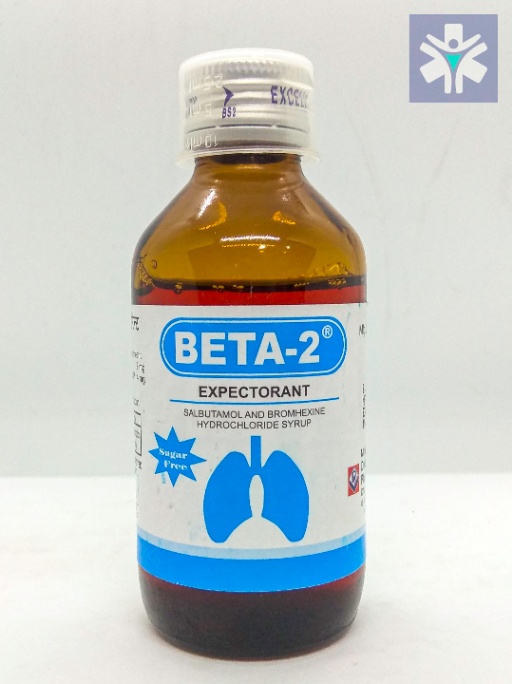
BETA-2 EXP.
Price: Rs.96.00
10% off
In stock
Loose stock: 0
Description
BETA-2 EXP. SYR 100ML
Details
Composition
BROMHEXINE 4 MG,SALBUTAMOL 2 MG
# BROMHEXINE 4 MG + SALBUTAMOL 2 MG
## Short Description
**Bromhexine 4 mg + Salbutamol 2 mg** is a combination medicine commonly used for respiratory conditions associated with **thick mucus, chest congestion, wheezing, and difficulty breathing**.
**Bromhexine** is a mucolytic that helps make thick mucus less sticky and easier to clear, while **salbutamol (albuterol)** is a bronchodilator that relaxes the muscles around the airways and helps improve airflow.
> **Note:** The exact approved indications and dosing may vary depending on the formulation, patient age, and country. Always follow the product label and your healthcare professional's instructions.
## Key Benefits
* Helps loosen and thin **thick respiratory mucus**.
* Makes mucus easier to cough up and clear.
* Helps relieve **wheezing and bronchospasm**.
* Helps relax and open narrowed airways.
* May improve airflow and ease breathing.
* Combines a **mucolytic and bronchodilator** in one formulation.
* May be useful when excessive mucus occurs together with reversible airway narrowing.
## Uses / Indications
Bromhexine 4 mg + Salbutamol 2 mg may be prescribed for respiratory conditions associated with mucus and bronchospasm, such as:
* **Bronchitis** with thick or excessive mucus.
* Respiratory conditions accompanied by **wheezing and mucus congestion**.
* Certain obstructive airway conditions.
* Productive cough associated with excessive or thick respiratory secretions.
* Other respiratory conditions when specifically recommended by a healthcare professional.
It is **not an antibiotic** and does not directly treat bacterial infections.
## How It Works
### Bromhexine 4 mg
Bromhexine is a **mucolytic agent**. It helps reduce the thickness and stickiness of mucus in the respiratory tract, making secretions easier to move and expel through coughing.
### Salbutamol 2 mg
Salbutamol is a **short-acting beta-2 adrenergic agonist (SABA)**. It stimulates beta-2 receptors in the smooth muscles of the airways, causing them to relax.
This produces **bronchodilation**, which can improve airflow and reduce wheezing and breathing difficulty.
### Combined Action
The combination addresses two different problems:
**Thick mucus → Bromhexine helps loosen secretions**
**Narrowed airways → Salbutamol helps relax airway muscles**
## Dosage & Administration
The appropriate dose depends on the **patient's age, formulation, medical condition, and response to treatment**.
* Take exactly as prescribed.
* Follow the dosing instructions on the product label.
* Take the medicine with water.
* Adequate fluid intake may help support mucus clearance unless your doctor has advised fluid restriction.
* Do not exceed the recommended dose.
* Do not use more frequently than prescribed.
* If a dose is missed, take it when remembered unless it is nearly time for the next dose. **Do not double the next dose.**
### Important
The **4 mg bromhexine + 2 mg salbutamol strengths do not by themselves establish the correct dose for every patient**, particularly children. Pediatric dosing should be determined according to the specific formulation and healthcare professional's instructions.
## Side Effects
Possible side effects include:
### Bromhexine-related
* Nausea.
* Vomiting.
* Diarrhea.
* Stomach discomfort.
* Headache.
* Dizziness.
* Increased respiratory secretions.
### Salbutamol-related
* Tremor or shakiness.
* Headache.
* Nervousness.
* Restlessness.
* Palpitations.
* Increased heart rate.
* Muscle cramps.
### Serious Side Effects
Seek medical attention if you experience:
* Severe or worsening difficulty breathing.
* Chest pain.
* Very rapid or irregular heartbeat.
* Severe dizziness or fainting.
* Facial, lip, tongue, or throat swelling.
* Severe skin rash, blistering, or peeling.
* Significant weakness or muscle cramps.
Rarely, salbutamol can cause **low potassium levels**, particularly at high doses or with prolonged/intensive use.
## Precautions & Warnings
* Use cautiously if you have **heart disease, arrhythmias, high blood pressure, hyperthyroidism, diabetes, or low potassium levels**.
* Salbutamol can cause palpitations, tremor, and increased heart rate.
* Excessive use of salbutamol may increase the risk of cardiovascular and metabolic adverse effects.
* Tell your doctor if you have a history of seizures.
* Patients with diabetes may require closer blood-glucose monitoring when using systemic beta-agonists.
* Seek medical advice if breathing symptoms worsen or if you need salbutamol more frequently than prescribed.
* Bromhexine may rarely cause serious allergic or severe skin reactions. Stop the medicine and seek medical attention if a severe rash or mucosal lesions develop.
* Drink adequate fluids unless fluid restriction has been medically advised.
* This combination should not be used as a substitute for emergency treatment of a severe asthma attack.
* If you experience sudden severe breathing difficulty, seek emergency medical care.
## Drug Interactions
Bromhexine + salbutamol may interact with several medicines.
### Important interactions include:
* **Beta-blockers** such as propranolol: may reduce the bronchodilator effect of salbutamol and may worsen bronchospasm in susceptible patients.
* Other **sympathomimetic medicines**: may increase cardiovascular side effects.
* **Diuretics** such as furosemide: may increase the risk of low potassium and cardiovascular effects.
* **Digoxin:** salbutamol-related changes in potassium may potentially affect digoxin-related cardiac effects.
* **MAO inhibitors and tricyclic antidepressants:** may enhance cardiovascular effects of salbutamol.
* **Corticosteroids:** may increase the risk of hypokalemia when combined with beta-agonists.
* Other bronchodilators may increase the effects and adverse reactions of salbutamol.
Tell your healthcare professional about **all prescription medicines, over-the-counter medicines, vitamins, and herbal supplements** you use.
## Storage Information
* Store at room temperature according to the manufacturer's instructions.
* Keep the medicine in its original packaging.
* Protect from excessive heat, moisture, and direct sunlight.
* Keep the container tightly closed.
* Keep out of reach of children.
* Do not use after the expiry date.
* Dispose of expired or unused medicine according to local pharmacy guidance.
## Prescription Status
**Bromhexine 4 mg + Salbutamol 2 mg may be prescription-only or pharmacy-controlled depending on the country and formulation.**
Because salbutamol can affect heart rate, blood pressure, potassium levels, and blood glucose, appropriate medical guidance is recommended, especially for patients with cardiovascular or metabolic conditions.
## Genuine Medicine Assurance
When purchasing Bromhexine 4 mg + Salbutamol 2 mg, obtain it from a **licensed pharmacy or authorized medicine supplier**.
Before use, verify:
* Correct medicine name and strengths.
* Manufacturer information.
* Batch or lot number.
* Manufacturing and expiry dates.
* Intact packaging and seals.
* Clear labeling and dosage instructions.
* Appropriate storage conditions.
Do not use the medicine if the packaging appears damaged, tampered with, incorrectly labeled, or suspicious.
## Frequently Asked Questions (FAQ)
### 1. What is Bromhexine 4 mg + Salbutamol 2 mg used for?
It is used for certain respiratory conditions involving **thick mucus, chest congestion, wheezing, or bronchospasm**. Bromhexine helps loosen mucus, while salbutamol helps open the airways.
### 2. What is bromhexine?
Bromhexine is a **mucolytic medicine** that helps reduce the thickness and stickiness of respiratory mucus, making it easier to cough up.
### 3. What is salbutamol?
Salbutamol is a **bronchodilator** that relaxes airway muscles and helps improve airflow through narrowed airways.
### 4. Can this medicine help with a productive cough?
Yes. Bromhexine can help loosen thick mucus associated with a **productive or mucus-producing cough**, making secretions easier to clear.
### 5. Does Bromhexine + Salbutamol treat asthma?
Salbutamol can relieve bronchospasm associated with asthma, but whether this particular combination is appropriate depends on the patient's condition and product formulation. It should not replace a prescribed long-term asthma-control treatment.
### 6. Is Bromhexine + Salbutamol an antibiotic?
**No.** This combination does not kill bacteria. It is intended to help with mucus clearance and airway opening.
### 7. Can I take Bromhexine + Salbutamol for a common cold?
It may be prescribed when a respiratory illness causes significant mucus or bronchospasm, but it is **not routinely necessary for every common cold**. Follow your healthcare professional's advice.
### 8. Does salbutamol cause a fast heartbeat?
Yes. Salbutamol can cause **increased heart rate, palpitations, or shakiness**, particularly at higher doses.
### 9. Can Bromhexine + Salbutamol cause tremors?
Yes. Tremor or shakiness is a recognized effect of salbutamol and is generally dose-related.
### 10. Can I take this medicine if I have heart disease?
Tell your doctor if you have heart disease, an irregular heartbeat, or high blood pressure. Salbutamol can affect heart rate and blood pressure, so medical supervision may be necessary.
### 11. Can I take salbutamol with propranolol?
Propranolol and other non-selective beta-blockers can reduce the effect of salbutamol and may worsen bronchospasm. **Do not combine them without medical advice.**
### 12. Can this medicine be given to children?
Some bromhexine and salbutamol formulations are used in children, but the appropriate dose depends on **age, weight, formulation, and local prescribing guidance**. Do not give the adult-strength product to a child without professional advice.
### 13. Does bromhexine make you cough more?
As bromhexine loosens mucus, it can make secretions easier to move and cough up. This can sometimes make a productive cough seem more noticeable while mucus is being cleared.
### 14. Should I drink more water while taking bromhexine?
Adequate hydration can support mucus clearance, unless your healthcare professional has advised you to restrict fluids because of another medical condition.
### 15. Can I use this medicine for sudden severe breathing difficulty?
No. Severe or rapidly worsening breathing difficulty requires **urgent medical evaluation**. Do not rely on this combination as emergency treatment unless your healthcare professional has specifically instructed you to do so.
### 16. Can salbutamol lower potassium levels?
Yes. High or repeated doses of salbutamol can lower blood potassium, particularly when combined with certain diuretics or corticosteroids.
### 17. Can I take other cough medicines with bromhexine and salbutamol?
Some combinations may be appropriate, but certain cough medicines can interact with the purpose of mucus clearance. Check with a pharmacist or doctor before adding another cough or cold medicine.
### 18. What should I do if I miss a dose?
Take the missed dose when remembered unless it is nearly time for the next dose. **Do not double the next dose.**
### 19. What happens if I take too much?
An overdose can increase salbutamol-related effects such as **rapid heartbeat, tremor, low potassium, and abnormal heart rhythms**. Seek urgent medical advice if an excessive amount has been taken.
### 20. Is Bromhexine 4 mg + Salbutamol 2 mg available without a prescription?
Prescription requirements vary by **country and formulation**. Obtain this medicine from an authorized pharmacy and follow the product's local dispensing requirements.
## Medical Disclaimer
This information about **Bromhexine 4 mg + Salbutamol 2 mg** is provided for general educational and informational purposes only. It is not a substitute for professional medical advice, diagnosis, or treatment.
The correct dose depends on the specific formulation, age, medical condition, and individual response. Salbutamol can affect **heart rate, blood pressure, blood potassium, and blood glucose**, while bromhexine is intended to assist mucus clearance.
Do not exceed the prescribed dose or use this medicine as a substitute for appropriate treatment of severe asthma or other respiratory emergencies. Seek urgent medical attention for **severe breathing difficulty, chest pain, fainting, severe palpitations, or signs of a serious allergic reaction**.