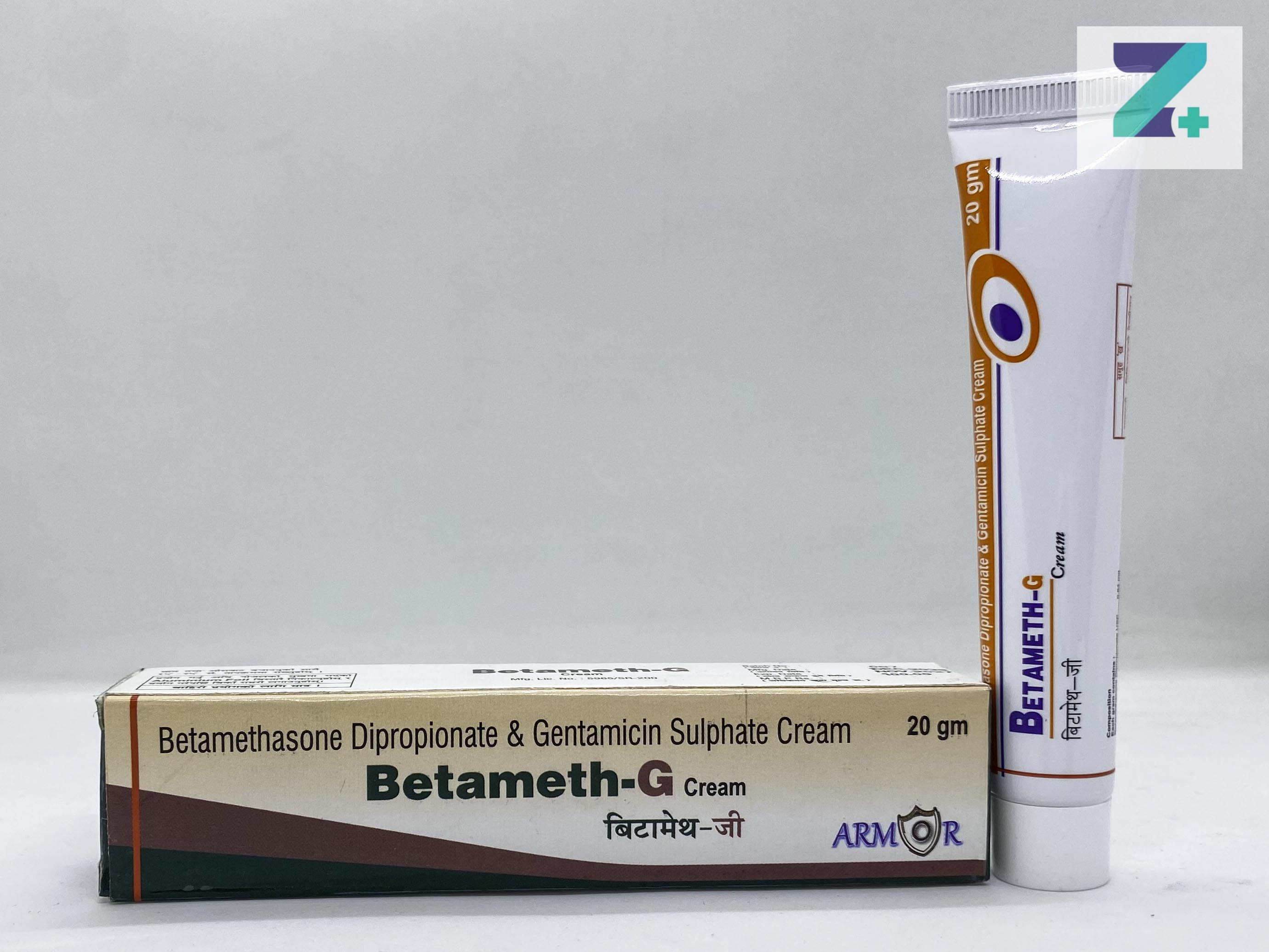
BETAMETH-G
Price: Rs.100.00
10% off
In stock
Loose stock: 0
Description
BETAMETH-G CREAM 20GM
Details
Composition
BETAMETHASONE DIPROPIONATE 0.64 MG,GENTAMICIN SULPHATE 1 MG
# Betamethasone Dipropionate 0.64 mg + Gentamicin Sulphate 1 mg
## Short Description
Betamethasone Dipropionate + Gentamicin Sulphate is a **topical corticosteroid and antibiotic combination** used for certain inflammatory skin conditions complicated by or suspected to involve susceptible bacterial infection.
Betamethasone dipropionate helps reduce **redness, swelling and itching**, while gentamicin sulphate helps control susceptible **bacterial skin infections**.
> **Important:** The exact concentration and dosage form should be verified against the manufacturer's label because topical products may express strengths differently depending on the formulation.
## Key Benefits
* Helps reduce skin inflammation
* Helps relieve redness and itching
* Helps reduce swelling and irritation
* Helps treat susceptible bacterial skin infections
* Combines anti-inflammatory and antibacterial action
* May help reduce discomfort associated with infected inflammatory skin conditions
## Uses / Indications
This combination may be prescribed for certain **inflammatory skin conditions with a bacterial infection or risk of bacterial infection**, such as:
* Infected eczema or dermatitis
* Certain infected inflammatory skin lesions
* Bacterial skin infections accompanied by significant inflammation
* Other corticosteroid-responsive dermatoses with susceptible bacterial involvement
It should only be used when both the **anti-inflammatory corticosteroid and antibacterial component are clinically appropriate**.
It is not suitable for treating viral or fungal skin infections unless specifically directed by a healthcare professional.
## How It Works
### Betamethasone Dipropionate
Betamethasone dipropionate is a **potent topical corticosteroid**. It suppresses inflammatory activity in the skin, helping reduce:
* Redness
* Swelling
* Itching
* Irritation
### Gentamicin Sulphate
Gentamicin is an **aminoglycoside antibiotic**. It works against susceptible bacteria by interfering with bacterial protein production, which prevents bacterial growth and can lead to bacterial death.
### Combined Action
The combination provides:
**Betamethasone → reduces inflammation and itching**
**Gentamicin → helps control susceptible bacterial infection**
## Dosage & Administration
* Use exactly as prescribed by your doctor
* Apply a **thin layer** to the affected area
* The usual frequency depends on the specific formulation and medical advice
* Gently rub into the affected skin
* Wash your hands before and after application unless the hands are being treated
* Avoid contact with the eyes, mouth and other mucous membranes
* Do not apply to large areas unless specifically instructed
* Do not cover the treated area with an airtight dressing unless directed by your doctor
* Do not use for longer than prescribed
* Do not apply more frequently than recommended
* Avoid using on broken or severely damaged skin unless specifically advised
### Important
Topical corticosteroid-antibiotic combinations are generally intended for **short-term use**. Prolonged or unnecessary antibiotic use can contribute to bacterial resistance, while prolonged corticosteroid use can cause skin damage.
## Side Effects
Possible side effects include:
* Burning
* Stinging
* Itching
* Irritation
* Redness
* Dryness
* Skin peeling
Prolonged or excessive corticosteroid use may cause:
* Skin thinning
* Stretch marks
* Easy bruising
* Changes in skin pigmentation
* Visible small blood vessels
* Increased hair growth
Gentamicin may occasionally cause local irritation or allergic skin reactions.
Seek medical attention if you develop:
* Severe skin irritation
* Significant swelling
* Worsening infection
* Severe allergic reaction
* Unusual skin changes
## Precautions & Warnings
* For **external use only**
* Avoid contact with eyes
* Do not use on the face unless specifically prescribed
* Avoid prolonged use
* Do not use for acne unless specifically directed
* Do not use for fungal or viral infections unless your doctor specifically recommends it
* Corticosteroids can mask or worsen certain infections
* Do not cover the treated area with an occlusive dressing unless instructed
* Avoid applying to large areas of the body without medical supervision
* Children may be more susceptible to corticosteroid absorption
* Tell your doctor if you have sensitive skin or a history of skin allergies
* Stop and seek medical advice if the condition worsens or fails to improve
* Tell your doctor if you are pregnant, planning pregnancy or breastfeeding
### Important Corticosteroid Warning
Betamethasone dipropionate is a **potent corticosteroid**. Long-term or inappropriate use can cause skin thinning and other local or systemic corticosteroid effects.
### Important Antibiotic Warning
Gentamicin should be used only when bacterial infection is suspected or confirmed to be susceptible to the antibiotic. Unnecessary or prolonged topical antibiotic use can contribute to **antibiotic resistance**.
## Drug Interactions
Because this is a topical preparation, significant systemic drug interactions are less common. However, caution may be required with:
* Other topical corticosteroids
* Other topical antibiotics
* Other medicines containing aminoglycoside antibiotics
* Immunosuppressive medicines
* Occlusive dressings, which can increase corticosteroid absorption
Tell your doctor or pharmacist about all prescription medicines, OTC medicines, supplements and topical products you use.
## Storage Information
* Store according to the manufacturer's instructions
* Keep the tube or container tightly closed
* Store in a cool, dry place
* Protect from excessive heat and direct sunlight
* Keep away from moisture
* Do not freeze unless specifically stated on the label
* Keep out of reach and sight of children
* Do not use after the expiry date
## Prescription Status
Betamethasone Dipropionate + Gentamicin Sulphate is generally treated as a **prescription medicine**, although requirements can vary according to the country and formulation.
Because it contains a potent corticosteroid and an antibiotic, medical supervision is recommended.
## Genuine Medicine Assurance
* Purchase the medicine from a licensed and reputable pharmacy
* Check the product name, active ingredients and strengths
* Verify the manufacturer's name
* Check the batch number and expiry date
* Ensure the tube, seal and packaging are intact
* Avoid products from unverified sellers
* Do not use products with suspicious, damaged or altered packaging
* Follow the storage instructions on the manufacturer's label
* If you suspect a medicine is counterfeit, consult a pharmacist or the relevant medicine regulatory authority
## Frequently Asked Questions
### What is Betamethasone Dipropionate + Gentamicin Sulphate used for?
It is used for certain **inflamed skin conditions associated with susceptible bacterial infection**, such as some cases of infected eczema or dermatitis.
### Is Betamethasone Dipropionate + Gentamicin an antibiotic cream?
It contains **gentamicin, an antibiotic**, together with betamethasone dipropionate, a corticosteroid. It is therefore a combination antibacterial and anti-inflammatory topical medicine.
### Is Betamethasone a steroid?
Yes. Betamethasone dipropionate is a **potent topical corticosteroid**.
### Is Gentamicin an antibiotic?
Yes. Gentamicin is an aminoglycoside antibiotic that acts against susceptible bacteria.
### Can this medicine treat eczema?
It may be prescribed for eczema when there is an appropriate **bacterial infection or bacterial involvement**. It should not routinely be used for uncomplicated eczema.
### Can this medicine treat fungal infections?
No. Gentamicin does not treat fungal infections, and the corticosteroid may make some fungal infections worse or mask their symptoms.
### Can this medicine treat ringworm?
It should not be used to treat ringworm unless a healthcare professional has specifically diagnosed the condition and prescribed an appropriate treatment. A corticosteroid-antibiotic combination can mask or worsen fungal infections.
### Can it be used for acne?
It is generally **not recommended for acne**. Potent topical corticosteroids can worsen acne and cause other skin problems.
### Can I use it on my face?
Potent corticosteroids can cause significant facial side effects. Do not use this combination on the face unless specifically prescribed by your doctor.
### Can it be used on children?
Children may be more susceptible to corticosteroid absorption and side effects. Use in children should be under medical supervision.
### How often should I apply this medicine?
The frequency depends on the specific formulation and your doctor's instructions. Apply only a thin layer and do not use more frequently than recommended.
### How long can I use Betamethasone + Gentamicin?
It is generally intended for **short-term treatment**. Prolonged use increases the risk of steroid-related skin damage and unnecessary antibiotic exposure.
### Can this medicine thin the skin?
Yes. Prolonged or excessive use of betamethasone can cause **skin thinning, stretch marks and easy bruising**.
### Can this medicine cause skin discoloration?
Yes. Changes in skin pigmentation can occur with topical corticosteroid use.
### Can Gentamicin cause skin irritation?
Yes. Local irritation, burning, itching or allergic reactions can occur in some people.
### Can I cover the treated area with a bandage?
Do not use an airtight or occlusive dressing unless specifically instructed by your healthcare professional. Occlusion can increase corticosteroid absorption and side effects.
### Can I use another steroid cream with this medicine?
Avoid combining topical corticosteroids unless instructed by your doctor. Using multiple steroid products can increase the risk of adverse effects.
### Can I use another antibiotic cream at the same time?
Do not use additional topical antibiotics without medical advice. Unnecessary antibiotic use may increase irritation and contribute to antibiotic resistance.
### Can this medicine be used during pregnancy?
Consult your doctor before using this medicine during pregnancy. The potential benefits and risks should be assessed individually.
### Can I use it while breastfeeding?
Consult your healthcare professional before use. Avoid applying the medicine to the nipple or areas that could come into direct contact with the infant unless specifically instructed.
### What happens if I use too much?
Excessive use may increase the risk of skin thinning, irritation and systemic corticosteroid absorption. Stop excessive application and contact your healthcare professional for advice.
### What happens if I miss an application?
Apply it when remembered unless it is nearly time for the next scheduled application. Do not apply extra medicine to compensate for a missed application.
### Why shouldn't I use this cream for every skin rash?
Not every rash is caused by bacteria or responds to corticosteroids. Using a steroid-antibiotic combination on the wrong condition can **mask symptoms, worsen infections or contribute to antibiotic resistance**.
### Does this medicine cure bacterial skin infections?
It can help treat susceptible bacterial infections when prescribed appropriately, but the correct antibiotic depends on the bacteria involved and the type and severity of the infection.
### What should I do if the infection gets worse?
Stop self-treatment and consult a healthcare professional, particularly if you develop increasing redness, swelling, pain, pus, fever or rapidly spreading skin changes.
### Is Betamethasone + Gentamicin safe for long-term use?
Long-term use is generally avoided unless specifically supervised by a healthcare professional because of the risks associated with potent corticosteroids and unnecessary antibiotic exposure.
## Medical Disclaimer
This information is provided for general educational and SEO purposes only and is not a substitute for professional medical advice, diagnosis or treatment. **Betamethasone Dipropionate + Gentamicin Sulphate should be used only according to a qualified healthcare professional's instructions.** It contains a potent corticosteroid and an antibiotic and should not be routinely used for undiagnosed rashes, fungal infections, viral infections or acne. Prolonged or inappropriate use can cause skin thinning, mask infections and contribute to antibiotic resistance. Always verify the exact strength, dosage form and instructions on the manufacturer's label before use.