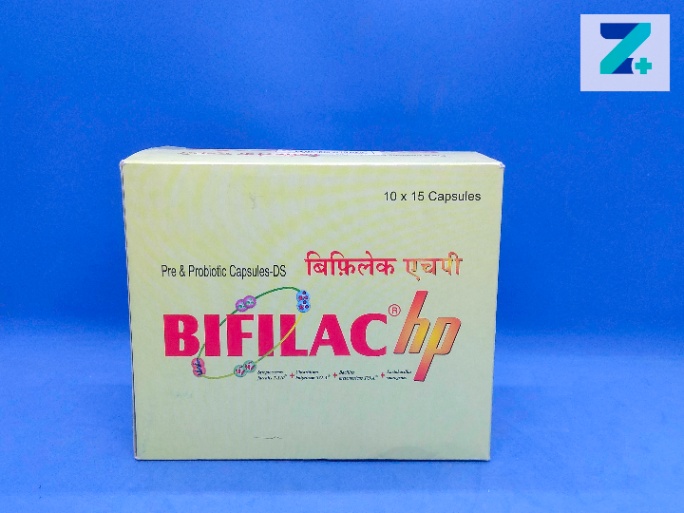
BIFILAC HP

Price: Rs.547.20
10% off
In stock
Loose stock: 9
Description
BIFILAC HP CAP 15
Details
Composition
BACILLUS MESENTERICUS TO A 2 MILLION CELLS,CLOSTRIDIUM BUTYRICUM TO A 4 MILLION CELLS,LACTOBACILLUS SPOROGENES 100 MILLION CELLS,STREPTOCOCCUS FAECALIS T 110 60 MILLION CELLS
# BACILLUS MESENTERICUS 2 MILLION CELLS + CLOSTRIDIUM BUTYRICUM 4 MILLION CELLS + LACTOBACILLUS SPOROGENES 100 MILLION CELLS + STREPTOCOCCUS FAECALIS T11 60 MILLION CELLS
## SHORT DESCRIPTION
This product is a **multi-strain probiotic preparation** containing four bacterial strains intended to support and restore the balance of beneficial microorganisms in the gastrointestinal tract.
The formulation contains:
* **Bacillus mesentericus – 2 million cells**
* **Clostridium butyricum – 4 million cells**
* **Lactobacillus sporogenes – 100 million cells**
* **Streptococcus faecalis T11 – 60 million cells**
It may be used as supportive treatment for certain digestive conditions involving disruption of the normal intestinal microbial balance.
> **Note:** *Lactobacillus sporogenes* is commonly used as a name for **Bacillus coagulans**, and *Streptococcus faecalis* is an older name associated with **Enterococcus faecalis**. The exact organism identity should be confirmed from the manufacturer's product information.
---
## KEY BENEFITS
* Supports a healthy **intestinal microbial balance**.
* Helps replenish beneficial bacteria following disruption of the gut microbiota.
* May support normal digestive function.
* May help improve symptoms associated with certain types of diarrhea.
* Supports the production of beneficial microbial metabolites.
* May help maintain normal intestinal conditions.
* Can be used as supportive therapy alongside appropriate treatment for certain gastrointestinal conditions.
---
## USES / INDICATIONS
This probiotic combination may be used as supportive treatment for conditions associated with an imbalance of intestinal microorganisms.
Potential uses include:
### 1. Diarrhea
May be used as supportive treatment for certain episodes of **acute or antibiotic-associated diarrhea**, depending on the individual patient's condition.
### 2. Disturbed Gut Flora
May help restore intestinal microbial balance after factors such as:
* Antibiotic treatment
* Gastrointestinal illness
* Dietary disturbances
* Other factors that disrupt normal gut microbiota
### 3. Digestive Health
May support normal intestinal function and overall gastrointestinal health.
> **Important:** Probiotics are supportive products and should not replace appropriate treatment for severe infections, persistent diarrhea, dehydration, or other serious gastrointestinal conditions.
---
## HOW IT WORKS
The product contains several microorganisms that may contribute to gastrointestinal microbial balance through different mechanisms.
### Bacillus Mesentericus
A spore-forming organism that may survive passage through the gastrointestinal tract and contribute to the intestinal microbial environment.
### Clostridium Butyricum
A butyrate-producing bacterium. **Butyrate** is a short-chain fatty acid that serves as an important energy source for intestinal cells and may support intestinal barrier function.
### Lactobacillus Sporogenes
Commonly identified as **Bacillus coagulans**, this spore-forming lactic-acid-producing microorganism can contribute to the production of lactic acid and support the intestinal microbial environment.
### Streptococcus Faecalis T11
An older designation associated with **Enterococcus faecalis**. Certain strains have been used in probiotic preparations to support intestinal microbial balance.
### Overall Action
**Probiotic microorganisms → support intestinal microbial balance → support normal digestive and intestinal function**
The exact clinical benefits can vary according to the specific strains, viable counts, preparation, and individual patient.
---
## DOSAGE & ADMINISTRATION
The appropriate dosage depends on the **specific product formulation, age, indication, and manufacturer's instructions**.
### General Administration
* Take exactly as directed on the product label or by your healthcare professional.
* Do not exceed the recommended dose.
* If supplied as a capsule, swallow it with an adequate amount of water unless instructed otherwise.
* If supplied as a powder or liquid preparation, follow the manufacturer's directions for preparation and administration.
* If the product needs to be mixed with liquid or food, follow the package instructions regarding suitable temperatures and liquids.
### During Antibiotic Treatment
If this probiotic is taken alongside an antibiotic, your healthcare professional may recommend separating the probiotic and antibiotic doses by approximately **2 hours**, depending on the organisms and product formulation.
### Duration
The duration of treatment depends on the reason for use. Follow the recommended course rather than continuing indefinitely without medical advice.
### Missed Dose
If you miss a dose, take it when remembered unless it is nearly time for the next dose.
**Do not double the next dose.**
---
## SIDE EFFECTS
Probiotics are generally well tolerated by healthy individuals, but some people may experience mild gastrointestinal symptoms.
### Common or Possible Side Effects
* Gas
* Bloating
* Abdominal discomfort
* Mild constipation
* Mild diarrhea
* Temporary changes in bowel habits
* Nausea
These effects are usually mild and may improve as the digestive system adjusts.
### Rare but Serious Reactions
Rarely, probiotic organisms can cause serious infections, particularly in people who are severely immunocompromised or seriously ill.
Seek medical attention if you develop:
* Persistent fever
* Severe abdominal pain
* Blood in the stool
* Severe or persistent diarrhea
* Signs of a serious infection
* Difficulty breathing or severe allergic symptoms
---
## PRECAUTIONS & WARNINGS
### Immunocompromised Patients
People with significantly weakened immune systems may have a higher risk of complications from live microorganisms.
Consult a healthcare professional before using probiotics if you have:
* Severe immunosuppression
* Cancer receiving intensive chemotherapy
* Advanced serious illness
* A history of serious bloodstream infections
### Critically Ill Patients
Probiotic use should be discussed with a healthcare professional in critically ill or hospitalized patients.
### Central Venous Catheters
Extra caution is required in patients with central venous catheters because rare cases of bloodstream infection associated with probiotic organisms have been reported.
### Severe Diarrhea
Do not rely solely on probiotics if diarrhea is:
* Severe
* Persistent
* Accompanied by high fever
* Associated with blood or mucus
* Causing significant dehydration
Medical evaluation may be necessary.
### Children and Infants
Use in infants and young children should be based on the specific product's approved indication and professional advice.
### Pregnancy and Breastfeeding
If pregnant, planning pregnancy, or breastfeeding, consult a healthcare professional before using this product.
---
## DRUG INTERACTIONS
Probiotic preparations generally have **few conventional drug interactions**, but certain considerations are important.
### Antibiotics
Antibiotics may affect some probiotic microorganisms.
If recommended by a healthcare professional, the probiotic and antibiotic may be taken at **different times**, often separated by around 2 hours.
### Immunosuppressive Medicines
Patients taking medicines that significantly suppress the immune system should consult their healthcare professional before using live microbial products.
### Antifungal Medicines
Some antifungal medicines may affect susceptible probiotic organisms, depending on the strains included.
### Other Probiotic Products
Taking several probiotic products simultaneously is usually unnecessary unless recommended by a healthcare professional.
Always tell your doctor or pharmacist about all prescription medicines, OTC medicines, supplements, and herbal products you are taking.
---
## STORAGE INFORMATION
Storage requirements vary according to the specific manufacturer and formulation.
* Store according to the manufacturer's instructions.
* Keep in the original packaging.
* Protect from excessive heat and moisture.
* Protect from direct sunlight.
* Some probiotic products may require **refrigeration**, while others are designed to remain stable at room temperature.
* **Do not refrigerate unless the product label specifically recommends refrigeration.**
* Keep away from children.
* Do not use after the expiry date.
* Do not use if the packaging is damaged or the product appears contaminated.
> **Important:** Because viable bacterial counts can decrease with inappropriate storage, always follow the temperature and storage conditions printed on the product packaging.
---
## PRESCRIPTION STATUS
**Prescription/OTC Status Depends on the Product and Local Regulations**
Probiotic preparations may be available **without a prescription** in many countries, while certain formulations may be regulated differently.
The exact dispensing status depends on the product, manufacturer, formulation, and local regulations.
---
## GENUINE MEDICINE ASSURANCE
For safe and effective use, purchase this probiotic preparation from a **licensed pharmacy or authorized medicine supplier**.
Before using the product, check:
* Product name
* Complete list of microorganisms
* Viable cell count/strength
* Manufacturer details
* Batch/lot number
* Manufacturing and expiry dates
* Storage instructions
* Packaging and seal integrity
* Regulatory/registration information where applicable
Avoid products with damaged, opened, contaminated, expired, or suspicious packaging.
Because probiotic products contain **living microorganisms**, proper storage and handling are particularly important for maintaining product quality.
---
# FAQ – PROBIOTIC COMBINATION
### 1. What is Bacillus Mesentericus + Clostridium Butyricum + Lactobacillus Sporogenes + Streptococcus Faecalis used for?
This combination is a **multi-strain probiotic preparation** intended to support intestinal microbial balance and digestive health. It may be used as supportive treatment for certain types of diarrhea or disturbed gut flora.
### 2. Is this medicine a probiotic?
Yes. It contains multiple microorganisms used in probiotic preparations to support the intestinal microbial environment.
### 3. What are the ingredients in this probiotic?
The formulation contains:
* Bacillus mesentericus – **2 million cells**
* Clostridium butyricum – **4 million cells**
* Lactobacillus sporogenes – **100 million cells**
* Streptococcus faecalis T11 – **60 million cells**
### 4. What is Lactobacillus Sporogenes?
*Lactobacillus sporogenes* is a commonly used name for **Bacillus coagulans**, a spore-forming microorganism that can produce lactic acid.
### 5. What is Streptococcus Faecalis T11?
*Streptococcus faecalis* is an older taxonomic name associated with **Enterococcus faecalis**. The exact strain identity and characteristics should be verified from the manufacturer's documentation.
### 6. What is the role of Clostridium Butyricum?
Clostridium butyricum can produce **butyrate**, a short-chain fatty acid that is important for intestinal cell health and may support the intestinal barrier.
### 7. Can this probiotic help with diarrhea?
It may provide supportive benefits for certain types of diarrhea, including some cases of antibiotic-associated or acute diarrhea. However, severe or persistent diarrhea requires appropriate medical evaluation.
### 8. Can I take this probiotic with antibiotics?
Probiotics may be used alongside some antibiotics. If recommended, separating the probiotic and antibiotic doses by approximately **2 hours** may help reduce direct exposure of the probiotic organisms to the antibiotic.
### 9. Can probiotics prevent antibiotic-associated diarrhea?
Some probiotic strains may reduce the risk of antibiotic-associated diarrhea, but the evidence varies according to the **specific strain, dose, and patient population**. Probiotics should not be considered universally effective for every patient.
### 10. Can this probiotic be taken daily?
Some probiotic products are designed for daily use, but the appropriate duration depends on the formulation and reason for use. Follow the product label or healthcare professional's recommendation.
### 11. Can probiotics cause gas or bloating?
Yes. Mild **gas, bloating, or abdominal discomfort** can occur when starting a probiotic, although many people tolerate them well.
### 12. Can children take this probiotic?
Children may be able to use certain probiotic formulations, but the appropriate dose depends on age, formulation, and indication. Follow pediatric dosing recommendations.
### 13. Can pregnant women take this probiotic?
Some probiotics may be used during pregnancy, but safety depends on the specific strains and the individual's health. Consult a healthcare professional before use during pregnancy.
### 14. Can probiotics be taken while breastfeeding?
Many probiotic preparations are considered compatible with breastfeeding, but product-specific advice is recommended, particularly for mothers or infants with medical conditions.
### 15. Do probiotics kill harmful bacteria?
Probiotics generally do not work like conventional antibiotics. They may **support microbial balance** through competition, production of metabolites, and interactions with the intestinal environment.
### 16. Do probiotics permanently restore gut bacteria?
Not necessarily. The effects of probiotics can be temporary and depend on the specific strains, diet, health status, and other factors.
### 17. Should probiotics be refrigerated?
Not always. Some probiotic products require refrigeration, while others are specifically formulated for room-temperature storage. **Follow the manufacturer's storage instructions.**
### 18. Can immunocompromised people take probiotics?
People with severe immune suppression should consult a healthcare professional before taking live microbial products because rare bloodstream infections have been reported.
### 19. What happens if I take too much probiotic?
A large amount may cause temporary gastrointestinal symptoms such as gas, bloating, or abdominal discomfort. If a significant overdose occurs or serious symptoms develop, seek medical advice.
### 20. Can this probiotic be taken with other probiotics?
There is usually little benefit to taking multiple probiotic products simultaneously unless recommended by a healthcare professional. Different products may contain overlapping organisms.
### 21. Is this probiotic an antibiotic?
No. It is a **probiotic preparation**, not a conventional antibiotic. It is intended to support the intestinal microbial environment rather than directly treat bacterial infections like prescription antibiotics.
### 22. Can probiotics treat intestinal infections?
Probiotics may provide supportive benefits in certain gastrointestinal conditions, but they **should not replace appropriate treatment for serious bacterial, parasitic, or other infections**.
### 23. How long does it take for a probiotic to work?
The time required varies according to the condition, specific strains, dose, and individual. Some gastrointestinal symptoms may improve within days, while others may require longer or different treatment.
### 24. Is this probiotic available without a prescription?
Many probiotic preparations are available without a prescription, but the exact status depends on the **specific product and local regulations**.
---
## MEDICAL DISCLAIMER
This information about **Bacillus Mesentericus 2 Million Cells + Clostridium Butyricum 4 Million Cells + Lactobacillus Sporogenes 100 Million Cells + Streptococcus Faecalis T11 60 Million Cells** is provided for general educational and informational purposes only. It is **not a substitute for professional medical advice, diagnosis, or treatment**.
Probiotics are generally well tolerated in healthy individuals, but people who are **severely immunocompromised, critically ill, or have central venous catheters** should consult a healthcare professional before using products containing live microorganisms.
Seek medical attention for severe or persistent diarrhea, dehydration, blood in the stool, high fever, severe abdominal pain, or other concerning symptoms.
**Do not use this product as a replacement for medically necessary antibiotic, antiparasitic, or other treatment. Always follow the manufacturer's instructions and the advice of your doctor or pharmacist.**