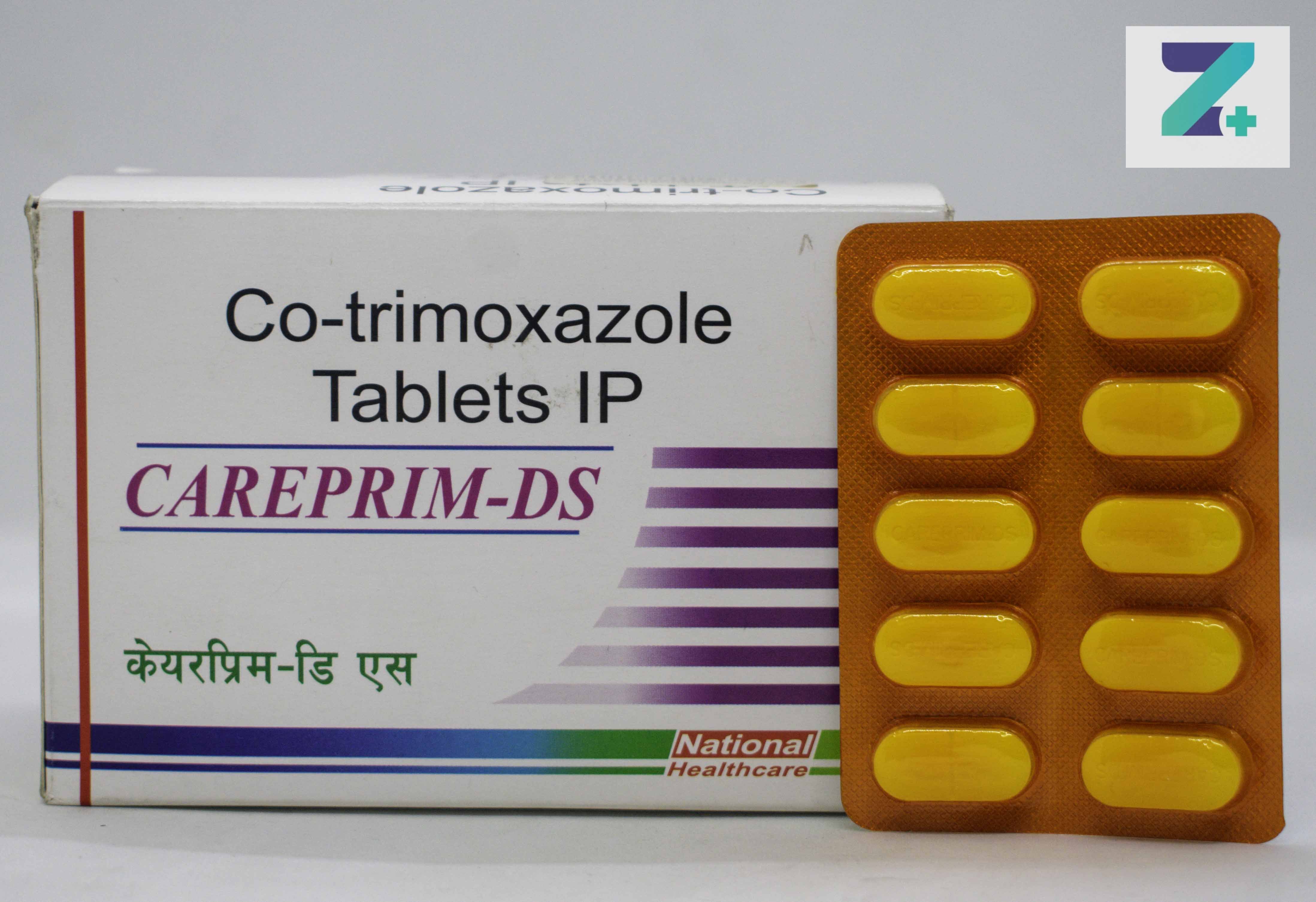
CAREPRIM-DS
Price: Rs.66.00
10% off
In stock
Loose stock: 2
Description
CAREPRIM-DS TAB 10
Details
Composition
SULPHAMETHOXAZOLE 800 MG,TRIMETHOPRIM 160 MG
# SULPHAMETHOXAZOLE 800 MG + TRIMETHOPRIM 160 MG
## SHORT DESCRIPTION
**Sulfamethoxazole 800 mg + Trimethoprim 160 mg** is a combination antibiotic commonly known as **co-trimoxazole (trimethoprim/sulfamethoxazole)**. It is used to treat certain bacterial infections caused by susceptible organisms.
The combination blocks **two sequential steps in bacterial folate production**, providing a synergistic antibacterial effect.
It is commonly used for selected **urinary tract, respiratory, skin, gastrointestinal, and other bacterial infections**, depending on local resistance patterns and the susceptibility of the causative organism.
> **Important:** This medicine does not treat viral infections such as the common cold or influenza.
---
## KEY BENEFITS
* Treats a variety of **susceptible bacterial infections**.
* Combines two antibiotics with complementary mechanisms.
* Blocks bacterial folate metabolism at **two different stages**.
* Commonly used for selected urinary tract infections.
* May be used for certain respiratory, skin, and gastrointestinal infections.
* Can be used for specific opportunistic infections such as **Pneumocystis jirovecii pneumonia (PJP)** when medically indicated.
* Available as an oral treatment for outpatient management of appropriate infections.
---
## USES / INDICATIONS
Sulfamethoxazole 800 mg + Trimethoprim 160 mg may be prescribed for susceptible infections such as:
### Urinary Tract Infections
* Certain uncomplicated urinary tract infections
* Other susceptible urinary infections
### Respiratory Tract Infections
* Selected bacterial respiratory infections
* Certain exacerbations of chronic bronchitis when appropriate
### Skin & Soft-Tissue Infections
* Certain susceptible bacterial skin infections
* Some **community-acquired MRSA** infections when the organism is susceptible
### Gastrointestinal Infections
* Certain bacterial intestinal infections, depending on the organism and local susceptibility
### Pneumocystis jirovecii Pneumonia
* **Treatment or prevention of PJP** in selected high-risk patients under specialist supervision
The appropriate indication depends on the **type of infection, bacterial susceptibility, patient characteristics, and local antibiotic resistance patterns**.
---
## HOW IT WORKS
The medicine contains two active antibacterial ingredients:
### Sulfamethoxazole
Sulfamethoxazole interferes with bacterial folate production by inhibiting an enzyme involved in the synthesis of **dihydrofolic acid**.
### Trimethoprim
Trimethoprim blocks a later step in the same pathway by inhibiting **dihydrofolate reductase**, reducing the production of tetrahydrofolate.
### Combined Action
Because the two medicines block **sequential steps in bacterial folate metabolism**, the combination produces a stronger antibacterial effect than either component alone against susceptible organisms.
Humans obtain folate primarily from their diet and do not synthesize it through the same pathway, allowing selective antibacterial action.
---
## DOSAGE & ADMINISTRATION
* Take Sulfamethoxazole 800 mg + Trimethoprim 160 mg **exactly as prescribed**.
* The appropriate dosage depends on the **type and severity of infection, age, body weight, kidney function, and clinical circumstances**.
* It may be taken **with or without food**.
* Take the medicine with adequate fluids unless your healthcare professional has advised fluid restriction.
* Take doses at evenly spaced intervals when possible.
* Complete the prescribed course unless your healthcare professional tells you otherwise.
### Missed Dose
Take the missed dose when remembered unless it is nearly time for the next dose.
**Do not take two doses together** to compensate for a missed dose.
### Important
Dosage for **Pneumocystis jirovecii pneumonia**, prevention of PJP, and certain other serious infections is substantially different from routine treatment and must be determined by a healthcare professional.
---
## SIDE EFFECTS
### Common Side Effects
Possible side effects include:
* Nausea
* Vomiting
* Loss of appetite
* Diarrhea
* Abdominal discomfort
* Headache
* Skin rash
### Important or Serious Side Effects
Although uncommon, this medicine can cause serious reactions, including:
* Severe skin reactions such as **Stevens-Johnson syndrome/toxic epidermal necrolysis**
* Severe allergic reactions
* Blood disorders such as anemia, low white blood cell count, or low platelets
* Liver injury
* Kidney problems
* **High potassium (hyperkalemia)**
* Low sodium in some patients
* Severe or persistent antibiotic-associated diarrhea
Seek urgent medical attention if you develop:
* Blistering or peeling skin
* Severe widespread rash
* Sores in the mouth or eyes
* Difficulty breathing
* Facial or throat swelling
* Unusual bruising or bleeding
* Severe weakness or paleness
* Yellowing of the skin or eyes
* Severe muscle weakness or abnormal heartbeat
---
## PRECAUTIONS & WARNINGS
* Do not use this medicine if you have a known serious allergy to **sulfonamide antibiotics, trimethoprim, or any component of the formulation**.
* Tell your doctor if you have **kidney or liver disease**.
* Dose adjustment may be necessary in patients with impaired kidney function.
* Tell your doctor if you have a history of blood disorders or folate deficiency.
* Use caution in people with conditions that increase the risk of **high potassium levels**.
* Older adults may have a higher risk of adverse effects.
* Maintain adequate hydration unless you have been instructed to restrict fluids.
* Avoid unnecessary exposure to intense sunlight because the medicine may increase **photosensitivity**.
* Stop treatment and seek medical advice if a new rash develops, particularly if it is accompanied by fever or mucosal sores.
* Prolonged treatment may require monitoring of **blood counts, kidney function, and electrolytes**.
* Tell your doctor if you are pregnant, planning pregnancy, or breastfeeding.
* Antibiotics should not be used unnecessarily because they contribute to **antimicrobial resistance**.
---
## DRUG INTERACTIONS
Sulfamethoxazole + Trimethoprim has several clinically important drug interactions.
### Warfarin
Trimethoprim/sulfamethoxazole can significantly increase the effect of **warfarin**, increasing the risk of bleeding. Closer monitoring may be required.
### ACE Inhibitors and ARBs
Examples include:
* Lisinopril
* Enalapril
* Losartan
* Valsartan
The combination may increase the risk of **hyperkalemia**, particularly in older adults or patients with kidney impairment.
### Spironolactone
Concurrent use may substantially increase the risk of **high potassium and potentially serious cardiac complications**.
### Methotrexate
Co-trimoxazole may increase the risk of **methotrexate toxicity**, including bone marrow suppression.
### Phenytoin
Trimethoprim/sulfamethoxazole may increase phenytoin exposure and the risk of adverse effects.
### Certain Diabetes Medicines
Sulfamethoxazole may increase the effect of some **sulfonylurea diabetes medicines**, potentially causing low blood sugar.
### Other Medicines
Interactions can also occur with certain:
* Diuretics
* Anticonvulsants
* Immunosuppressants
* Anticoagulants
* Medicines affecting kidney function
Always provide your doctor or pharmacist with a complete list of your prescription medicines, OTC medicines, and supplements.
---
## STORAGE INFORMATION
* Store according to the conditions specified on the **product packaging**.
* Keep tablets in their original container.
* Protect from excessive heat, moisture, and direct sunlight.
* Keep the container tightly closed.
* Keep out of reach of children and pets.
* Do not use after the expiry date.
* Do not use tablets if the packaging is damaged or the tablets appear abnormal.
---
## PRESCRIPTION STATUS
**Sulfamethoxazole 800 mg + Trimethoprim 160 mg is generally a prescription antibiotic.**
It should be used under medical supervision because appropriate dosing depends on the infection, kidney function, other medicines, and individual risk factors.
---
## GENUINE MEDICINE ASSURANCE
When purchasing Sulfamethoxazole 800 mg + Trimethoprim 160 mg, ensure that:
* The medicine comes in **original, sealed manufacturer packaging**.
* Both active ingredients and their strengths are clearly stated.
* The **batch/lot number and expiry date** are present and readable.
* Packaging has no signs of tampering.
* Tablets have the expected appearance described by the manufacturer.
* The medicine is purchased from a **licensed and reputable pharmacy or authorized medicine supplier**.
* The product supplied matches the prescription.
Do not use medicine that appears counterfeit, expired, damaged, or improperly stored.
---
# FAQ – SULFAMETHOXAZOLE 800 MG + TRIMETHOPRIM 160 MG
### 1. What is Sulfamethoxazole 800 mg + Trimethoprim 160 mg?
It is a combination antibiotic commonly called **co-trimoxazole or trimethoprim/sulfamethoxazole**. It contains two antibacterial medicines that work together to inhibit bacterial folate metabolism.
### 2. What is Sulfamethoxazole + Trimethoprim used for?
It is used to treat certain **susceptible bacterial infections**, including selected urinary, respiratory, skin, and gastrointestinal infections.
### 3. Is Sulfamethoxazole + Trimethoprim an antibiotic?
Yes. It is a combination **antibacterial antibiotic**.
### 4. Does it treat viral infections?
No. It does not treat viral infections such as **colds, influenza, or most viral sore throats**.
### 5. How does Co-trimoxazole work?
Sulfamethoxazole and trimethoprim block **two consecutive steps in bacterial folate production**, preventing susceptible bacteria from growing and reproducing.
### 6. Can this medicine treat urinary tract infections?
Yes. It may be prescribed for certain UTIs when the causative organism is susceptible and local resistance patterns support its use.
### 7. Can it treat skin infections?
Yes. It may be effective against certain susceptible skin infections, including some **community-acquired MRSA infections**.
### 8. Should I take this medicine with food?
It can generally be taken with or without food. Taking it with food may help reduce stomach discomfort. Adequate fluid intake is generally recommended unless your doctor has advised otherwise.
### 9. How long should I take Sulfamethoxazole + Trimethoprim?
The duration depends on the type and severity of infection. **Complete the prescribed course** unless your healthcare professional instructs you to stop.
### 10. What are the common side effects?
Common effects include **nausea, vomiting, diarrhea, loss of appetite, headache, abdominal discomfort, and skin rash**.
### 11. Can this medicine cause a skin rash?
Yes. Rash can occur and may sometimes indicate a serious allergic or skin reaction. **Stop and seek medical advice promptly if you develop a severe, rapidly spreading, blistering, or peeling rash.**
### 12. Can Sulfamethoxazole + Trimethoprim increase potassium?
Yes. Trimethoprim can increase potassium levels, particularly in people with **kidney impairment** or those taking medicines such as ACE inhibitors, ARBs, or spironolactone.
### 13. Can I take it with Warfarin?
This combination can significantly increase the effect of **warfarin** and the risk of bleeding. Your doctor may need to monitor you closely or select an alternative antibiotic.
### 14. Can I take it with Spironolactone?
The combination can substantially increase the risk of **dangerously high potassium levels**. Do not use them together unless specifically directed and monitored by your healthcare professional.
### 15. Can I take Sulfamethoxazole + Trimethoprim during pregnancy?
This medicine requires careful consideration during pregnancy, particularly at certain stages. Tell your doctor if you are pregnant or planning pregnancy so an appropriate antibiotic can be selected.
### 16. Can I take it while breastfeeding?
Small amounts can pass into breast milk. Your healthcare professional should assess whether it is appropriate, particularly if the infant is premature, very young, jaundiced, or has certain medical conditions.
### 17. What should I do if I miss a dose?
Take it when you remember unless it is nearly time for the next dose. **Do not double the dose.**
### 18. Can I drink alcohol while taking this antibiotic?
There is no universally recognized severe alcohol interaction comparable to some other antibiotics, but alcohol can worsen **nausea, dizziness, dehydration, or other illness-related symptoms**. Avoid excessive alcohol while recovering.
### 19. What happens if I take too much?
An overdose may cause nausea, vomiting, dizziness, confusion, blood abnormalities, kidney problems, or electrolyte disturbances. Seek medical attention if you have taken significantly more than prescribed.
### 20. What should I do if my infection does not improve?
Contact your healthcare professional if symptoms **do not improve, worsen, or return**. The infection may be resistant, caused by a virus, or require a different treatment.
---
## MEDICAL DISCLAIMER
This information about **Sulfamethoxazole 800 mg + Trimethoprim 160 mg** is provided for educational and informational purposes only. It is not a substitute for professional medical advice, diagnosis, or treatment.
This antibiotic should be used only when medically appropriate for a **susceptible bacterial infection**. It has potentially serious interactions with medicines such as warfarin, spironolactone, ACE inhibitors, ARBs, and methotrexate.
**Do not start, stop, or change the dose without consulting a qualified healthcare professional.** Seek urgent medical attention for severe rash, blistering or peeling skin, difficulty breathing, facial swelling, unusual bleeding, severe weakness, or symptoms suggestive of high potassium or other serious adverse reactions.