CHYMOSIN FORTE
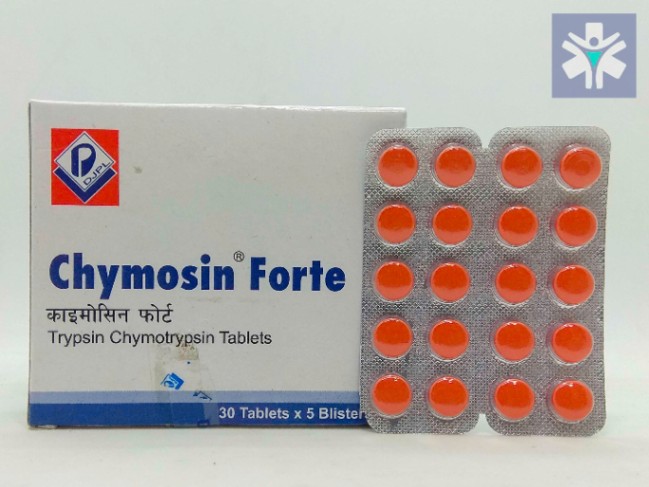
Price: Rs.410.00
10% off
In stock
Loose stock: 0
Description
CHYMOSIN FORTE TAB 10
Details
Composition
TRYPSIN 200000 U
# TRYPSIN 200,000 U
## Short Description
**Trypsin 200,000 U** is a **proteolytic enzyme preparation** used as supportive therapy to help reduce **swelling (edema), inflammation, and tissue congestion** associated with certain injuries, surgical procedures, and inflammatory conditions.
Trypsin breaks down proteins and protein-containing materials involved in inflammatory processes. Depending on the formulation, it may be used alone or in combination with other enzymes or medicines.
> **Important:** The appropriate dose and route depend heavily on the specific formulation. “200,000 U” is a unit-based strength, and products with this strength may have different approved routes and dosing instructions. Always follow the product label and healthcare professional's directions.
## Key Benefits
* May help reduce **tissue swelling and edema**.
* Supports resolution of inflammatory tissue congestion.
* May help promote recovery following certain **injuries or surgical procedures**.
* Can help break down protein-rich inflammatory material.
* May support the body's natural tissue-repair processes.
* Can be used as an **adjunctive treatment**, rather than a replacement for treatment of the underlying condition.
## Uses / Indications
Trypsin may be used as supportive treatment for conditions involving inflammation and tissue swelling, including:
* **Post-operative swelling and inflammation**.
* Soft-tissue injuries.
* Sprains and strains.
* Bruising and localized edema.
* Traumatic tissue inflammation.
* Certain inflammatory conditions, when prescribed.
The exact approved indications vary according to the formulation, route of administration, and local regulatory approval.
## How It Works
Trypsin is a **proteolytic enzyme**, meaning it breaks down proteins into smaller peptides.
During inflammation and tissue injury, protein-rich material and inflammatory components can accumulate around damaged tissues.
Trypsin may help by:
* Breaking down certain proteins.
* Supporting the removal of protein-containing inflammatory material.
* Helping reduce tissue congestion.
* Supporting resolution of localized swelling.
### Overall Effect
**Trypsin → proteolytic activity → breakdown of protein material → reduced tissue congestion/swelling → support for recovery.**
It is important to understand that trypsin is generally considered a **supportive treatment** and does not directly cure the underlying cause of an infection, injury, or inflammatory disease.
## Dosage & Administration
**Dosage depends on the specific Trypsin 200,000 U product and its route of administration.**
Do not assume that the dose for one trypsin formulation applies to another product.
### General Guidance
* Use exactly as prescribed.
* Follow the manufacturer's instructions regarding administration.
* Do not exceed the recommended dose.
* Do not crush, chew, split, or otherwise alter the dosage form unless the product instructions specifically permit it.
* Complete the prescribed course if your healthcare professional has recommended a defined treatment period.
### Oral Products
If the product is an oral enzyme preparation, it may have specific instructions regarding **timing in relation to meals**. Follow the product label or prescription rather than assuming that all trypsin products should be taken in the same way.
### Missed Dose
Take the missed dose when remembered unless it is close to the next scheduled dose. **Do not double the dose.**
## Side Effects
Possible side effects vary according to the formulation and route.
Potential adverse effects may include:
* Nausea.
* Stomach discomfort.
* Indigestion.
* Diarrhea.
* Abdominal discomfort.
* Headache.
* Dizziness.
### Allergic Reactions
Rarely, enzyme preparations may cause hypersensitivity reactions.
Seek medical attention if you experience:
* Facial or throat swelling.
* Difficulty breathing.
* Widespread rash.
* Severe itching.
* Severe dizziness.
### Injection-Related Reactions
If a particular trypsin formulation is administered by injection, local reactions such as **pain, redness, or swelling at the injection site** may occur.
## Precautions & Warnings
### Bleeding Disorders
Use caution if you have:
* A bleeding disorder.
* Low platelet counts.
* A history of unusual bleeding.
* Conditions that increase bleeding risk.
Discuss trypsin use with your healthcare professional before starting treatment.
### Anticoagulants and Antiplatelet Medicines
If you take medicines that affect blood clotting, your doctor should know before treatment.
Examples include:
* Warfarin.
* Rivaroxaban.
* Apixaban.
* Aspirin.
* Clopidogrel.
### Surgery
Tell your doctor if you are scheduled for surgery or have recently undergone surgery. The safety of enzyme preparations around surgical procedures depends on the specific formulation and clinical circumstances.
### Pregnancy
Tell your healthcare professional if you are pregnant, planning pregnancy, or trying to conceive. Use should be based on an assessment of potential benefits and risks.
### Breastfeeding
Consult your healthcare professional before using trypsin while breastfeeding.
### Children
Use in children should be based on professional medical advice because safety and dosing depend on the formulation and indication.
### Allergy
Do not use the medicine if you have previously experienced a serious allergic reaction to trypsin or any other component of the product.
## Drug Interactions
The interaction profile depends on the formulation and route of administration.
### Anticoagulants
Trypsin may require caution when combined with medicines that reduce blood clotting, particularly if the preparation has systemic effects.
Examples include:
* Warfarin.
* Rivaroxaban.
* Apixaban.
* Dabigatran.
### Antiplatelet Medicines
Caution may be appropriate when combined with:
* Aspirin.
* Clopidogrel.
* Other antiplatelet medicines.
### Other Enzyme Preparations
Tell your healthcare professional if you are taking other proteolytic enzymes such as:
* Bromelain.
* Chymotrypsin.
* Serratiopeptidase.
The clinical significance depends on the particular product and dose.
### Other Medicines
Always tell your doctor or pharmacist about:
* Prescription medicines.
* OTC medicines.
* Vitamins.
* Herbal products.
* Dietary supplements.
## Storage Information
* Store according to the manufacturer's instructions.
* Protect from excessive heat, moisture, and direct sunlight.
* Keep the product in its original packaging.
* Keep the container tightly closed when applicable.
* Follow any specific refrigeration requirements stated on the product label.
* Keep out of reach of children.
* Do not use after the expiry date.
* Do not use if the packaging is damaged or the product appears altered.
## Prescription Status
**Trypsin 200,000 U may be prescription-only or pharmacist-supervised depending on the formulation and country.**
The regulatory status can differ between oral, injectable, and other enzyme preparations. Follow local prescribing and dispensing requirements.
## Genuine Medicine Assurance
When purchasing Trypsin 200,000 U, obtain it from a **licensed pharmacy or authorized medicine supplier**.
Check the product for:
* Correct active ingredient: **Trypsin**.
* Correct strength: **200,000 U**.
* Manufacturer information.
* Batch/lot number.
* Manufacturing and expiry dates.
* Intact packaging and seals.
* Appropriate storage conditions.
* Clear instructions for the intended route of administration.
Do not use a product if the packaging appears damaged, tampered with, incorrectly labeled, or suspicious.
## Frequently Asked Questions (FAQ)
### 1. What is Trypsin 200,000 U used for?
Trypsin is a proteolytic enzyme that may be used as **supportive treatment for swelling, inflammation, and tissue congestion**, particularly following certain injuries or surgical procedures.
### 2. What does 200,000 U mean?
The **200,000 U** refers to the enzyme's activity expressed in units. It is not equivalent to 200,000 mg. The exact meaning and measurement standard depend on the manufacturer's product specifications.
### 3. Is trypsin an anti-inflammatory medicine?
Trypsin is an **enzyme preparation with proteolytic activity**. It may help reduce inflammatory tissue congestion and swelling, but it is not the same type of anti-inflammatory medicine as NSAIDs or corticosteroids.
### 4. Can Trypsin 200,000 U reduce swelling?
It may help reduce swelling associated with certain injuries, inflammation, or surgical procedures when used appropriately.
### 5. Can trypsin help after surgery?
It may be prescribed as supportive therapy to help manage **post-operative swelling and tissue inflammation**. Its use should follow the surgeon's or healthcare professional's recommendation.
### 6. Can trypsin be used for injuries?
Trypsin may be used as an adjunct in certain **soft-tissue injuries, sprains, strains, and bruising**, depending on the clinical situation and product approval.
### 7. Does trypsin heal wounds?
Trypsin may support the resolution of inflammatory tissue changes, but it should not be considered a direct wound-healing medicine. Proper wound care and treatment of infection or other underlying problems remain important.
### 8. Is Trypsin 200,000 U an antibiotic?
**No.** Trypsin is an enzyme and does not directly kill bacteria like an antibiotic.
### 9. Can trypsin treat an infection?
Trypsin does not replace appropriate antibacterial or antifungal treatment. If swelling is caused by an infection, the underlying infection requires appropriate medical treatment.
### 10. Can trypsin be taken with antibiotics?
There is not necessarily a clinically important interaction with every antibiotic, but tell your healthcare professional about all medicines you take before starting trypsin.
### 11. Can I take trypsin with blood thinners?
Caution may be necessary with **anticoagulants and antiplatelet medicines** because of potential bleeding concerns depending on the formulation. Consult your doctor before combining them.
### 12. Can trypsin cause stomach problems?
Some oral enzyme preparations may cause **nausea, abdominal discomfort, indigestion, or diarrhea**.
### 13. Can trypsin cause an allergic reaction?
Yes, although serious allergic reactions are uncommon. Seek immediate medical attention for **difficulty breathing, facial swelling, widespread rash, or severe dizziness**.
### 14. Can Trypsin 200,000 U be used during pregnancy?
Do not use it during pregnancy unless specifically recommended by your healthcare professional. Safety depends on the formulation and clinical circumstances.
### 15. Can trypsin be used while breastfeeding?
Consult your healthcare professional before using Trypsin 200,000 U while breastfeeding.
### 16. Can children take Trypsin 200,000 U?
Use in children should be determined by a healthcare professional. The appropriate dose depends on the child's age, weight, condition, and specific formulation.
### 17. How should Trypsin 200,000 U be taken?
The correct administration depends on the specific product. **Follow the manufacturer's instructions and your prescription**, particularly because different trypsin formulations can have different routes and dosing schedules.
### 18. What should I do if I miss a dose?
Take it when remembered unless it is almost time for the next dose. **Do not double the next dose.**
### 19. Can I take trypsin with other enzymes?
Some products combine trypsin with other enzymes, but you should not add another enzyme supplement without discussing it with your healthcare professional.
### 20. Is Trypsin 200,000 U available without a prescription?
The answer depends on the country and formulation. Some trypsin preparations may be prescription or pharmacist-supervised medicines.
### 21. How should Trypsin 200,000 U be stored?
Store it according to the manufacturer's instructions, protecting it from **heat, moisture, and direct sunlight**. Follow the label if refrigeration is required.
### 22. Can trypsin reduce bruising?
It may be used as supportive therapy for certain injuries involving **bruising and soft-tissue swelling**, although evidence and approved indications vary by formulation.
### 23. Is trypsin the same as chymotrypsin?
No. Both are **proteolytic enzymes**, but they are different enzymes with different biochemical properties. Some products contain them together.
### 24. Can I stop trypsin when the swelling improves?
Follow the treatment duration recommended by your healthcare professional. Do not extend or discontinue prescribed treatment without appropriate advice.
### 25. When should I see a doctor instead of using trypsin?
Seek medical evaluation if swelling is severe, rapidly worsening, associated with significant pain, fever, extensive redness, pus, unexplained bruising, unusual bleeding, or other concerning symptoms.
## Medical Disclaimer
This information about **Trypsin 200,000 U** is provided for general educational and informational purposes only. It is not a substitute for professional medical advice, diagnosis, or treatment.
Trypsin products can differ substantially in **formulation, enzyme activity measurement, route of administration, and approved indications**. Always verify the specific product label and follow the instructions of a qualified healthcare professional.
People taking **anticoagulants or antiplatelet medicines**, those with bleeding disorders, and patients undergoing or recovering from surgery should seek professional advice before using trypsin. Discontinue use and seek medical attention for signs of a serious allergic reaction or unusual bleeding.