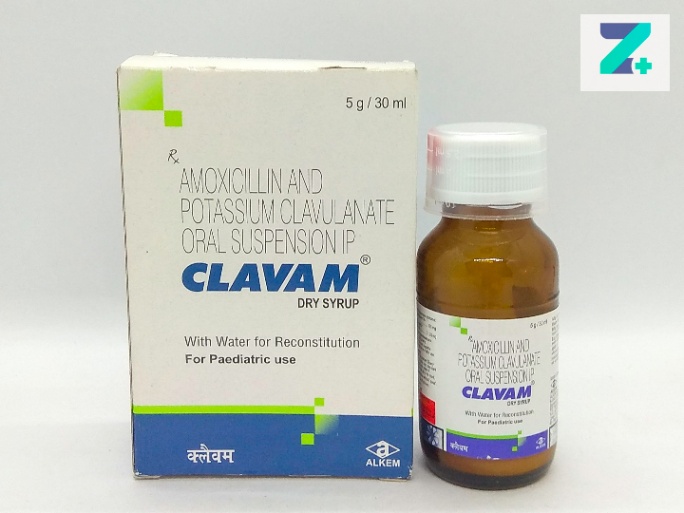
CLAVAM DRY SYR
Price: Rs.94.64
10% off
In stock
Loose stock: 0
Description
CLAVAM DRY SYR SYR 30ML
Details
Composition
AMOXICILLIN 125 MG,CLAVULANATE POTASSIUM 31.25 MG
# Amoxicillin 125 mg + Clavulanate Potassium 31.25 mg
## SHORT DESCRIPTION
Amoxicillin 125 mg + Clavulanate Potassium 31.25 mg is a **prescription antibiotic combination** containing a penicillin-type antibiotic and a beta-lactamase inhibitor. It is used to treat certain **bacterial infections** when the causative bacteria are susceptible to this combination.
Amoxicillin kills susceptible bacteria, while clavulanate helps protect amoxicillin from destruction by certain bacterial enzymes called **beta-lactamases**.
> **Important:** This medicine does not work against viral infections such as the common cold or flu.
## KEY BENEFITS
* Helps treat susceptible **bacterial infections**
* Combines amoxicillin with clavulanate for broader antibacterial coverage
* Clavulanate helps overcome resistance caused by certain beta-lactamase enzymes
* May be prescribed for respiratory, ear, sinus, skin and urinary bacterial infections
* Pediatric formulations may be available at this strength
* Helps eradicate susceptible bacteria and resolve infection-related symptoms
## USES / INDICATIONS
Amoxicillin 125 mg + Clavulanate Potassium 31.25 mg may be prescribed for susceptible bacterial infections such as:
* **Ear infections** including acute otitis media
* Sinus infections
* Lower respiratory tract infections
* Skin and soft-tissue infections
* Urinary tract infections
* Dental infections
* Other bacterial infections when clinically appropriate
The exact indication depends on the patient's age, weight, infection, kidney function and local bacterial resistance patterns.
## HOW IT WORKS
### Amoxicillin
Amoxicillin is a **penicillin-type antibiotic**. It interferes with bacterial cell-wall formation, causing susceptible bacteria to die.
### Clavulanate Potassium
Some bacteria produce beta-lactamase enzymes that can break down amoxicillin and make it ineffective. Clavulanate inhibits certain of these enzymes, helping protect amoxicillin from degradation.
Together, the combination can treat some infections that may not respond adequately to amoxicillin alone.
## DOSAGE & ADMINISTRATION
* Take or administer this medicine exactly as prescribed.
* The appropriate dose is determined according to the **infection, age, body weight and kidney function**.
* For children, dosing is generally calculated according to **body weight and the amoxicillin component**, rather than simply using an adult dose.
* Take doses at evenly spaced intervals as directed.
* Taking the medicine **at the start of a meal** may help reduce stomach upset and improve absorption of clavulanate.
* Complete the prescribed course unless your healthcare professional tells you to stop.
* Do not share antibiotics with another person.
* Do not use leftover antibiotics for a future illness.
### Missed Dose
Give or take the missed dose when remembered unless it is nearly time for the next dose. Do not double the next dose.
## SIDE EFFECTS
Common side effects may include:
* Diarrhea
* Nausea
* Vomiting
* Stomach discomfort
* Indigestion
* Headache
* Mild skin rash
### Serious Side Effects
Seek medical attention if you develop:
* Severe or persistent diarrhea
* Bloody or watery diarrhea
* Severe skin rash
* Blistering or peeling skin
* Facial or throat swelling
* Difficulty breathing
* Severe allergic reaction
* Yellowing of the skin or eyes
* Dark urine
* Unusual weakness or severe abdominal pain
Antibiotic-associated diarrhea can occasionally be caused by **Clostridioides difficile** and may occur during or after treatment.
## PRECAUTIONS & WARNINGS
* Do not use if you have a serious allergy to **penicillins, amoxicillin, clavulanate or certain other beta-lactam antibiotics**.
* Tell your doctor if you have previously experienced antibiotic-associated jaundice or liver problems while taking amoxicillin/clavulanate.
* Inform your doctor if you have kidney disease because dosage adjustment may be necessary.
* Tell your doctor if you have a history of severe allergic reactions.
* Stop the medicine and seek urgent medical attention if signs of a serious allergic reaction occur.
* Do not use this medicine for viral infections such as colds or influenza.
* Prolonged or unnecessary antibiotic use can encourage **antibiotic resistance**.
* Contact your healthcare professional if diarrhea is severe or persistent.
* Tell your doctor if you are pregnant or breastfeeding.
* Follow the prescribed duration even if symptoms improve, unless your healthcare professional advises otherwise.
## DRUG INTERACTIONS
Important interactions may occur with:
* **Warfarin and other anticoagulants** — may affect anticoagulation and require monitoring.
* **Methotrexate** — amoxicillin may increase methotrexate exposure.
* **Allopurinol** — may increase the likelihood of skin rash.
* **Probenecid** — may increase amoxicillin concentrations.
* **Mycophenolate** — antibiotic treatment may alter exposure to mycophenolic acid.
* Other antibiotics or medicines should be disclosed to your healthcare professional.
Tell your doctor or pharmacist about all prescription medicines, OTC medicines, vitamins and supplements you are taking.
## STORAGE INFORMATION
Storage depends on the formulation.
### Oral Suspension
* Store according to the product label.
* Some reconstituted suspensions require refrigeration, while specific formulations may have different storage requirements.
* **Do not assume all suspensions have identical storage instructions.**
* Shake well before each dose.
* Discard the suspension after the period specified on the product label.
### Tablets or Other Formulations
* Store according to the manufacturer's instructions.
* Keep away from excessive heat and moisture.
* Keep the medicine in its original packaging.
* Keep out of reach of children.
* Do not use after the expiry date.
## PRESCRIPTION STATUS
**Prescription medicine.**
Amoxicillin 125 mg + Clavulanate Potassium 31.25 mg should be used only when prescribed or recommended by a qualified healthcare professional. Availability and dispensing requirements may vary by country.
## GENUINE MEDICINE ASSURANCE
For safe and genuine Amoxicillin 125 mg + Clavulanate Potassium 31.25 mg:
* Purchase from a licensed and reputable pharmacy.
* Check the medicine name, strength and dosage form.
* Verify the manufacturer's details.
* Check the batch number and expiry date.
* Ensure the packaging and seal are intact.
* Do not use products with damaged or suspicious packaging.
* Follow the storage instructions printed on the package.
* Purchase antibiotics only through authorized sources.
* Ask a pharmacist if you have concerns about product authenticity.
## FAQ
### What is Amoxicillin 125 mg + Clavulanate 31.25 mg used for?
It is used to treat certain **bacterial infections**, including some ear, sinus, respiratory, skin, urinary and dental infections when the bacteria are susceptible.
### Is Amoxicillin + Clavulanate an antibiotic?
Yes. It is a combination antibiotic containing **amoxicillin and clavulanate potassium**.
### Why is clavulanate added to amoxicillin?
Clavulanate inhibits certain bacterial beta-lactamase enzymes that can break down amoxicillin. This helps amoxicillin remain effective against some beta-lactamase-producing bacteria.
### Does Amoxicillin + Clavulanate treat viral infections?
No. It does not treat viral infections such as **colds, influenza or most viral sore throats**.
### Is this medicine suitable for children?
This strength may be used in pediatric patients when prescribed. The dose should be calculated according to the child's **body weight and infection**, so children should not be given an adult dose without medical advice.
### How should Amoxicillin + Clavulanate be taken?
Take it exactly as prescribed. Taking it **at the beginning of a meal** can help reduce stomach upset and may improve absorption.
### Can I stop Amoxicillin + Clavulanate when I feel better?
Do not stop or shorten the prescribed course without consulting your healthcare professional. Stopping treatment improperly can contribute to treatment failure and antibiotic resistance.
### What are the common side effects of Amoxicillin + Clavulanate?
Common side effects include **diarrhea, nausea, vomiting and stomach discomfort**.
### Can Amoxicillin + Clavulanate cause diarrhea?
Yes. Diarrhea is one of the most common side effects. Severe, persistent or bloody diarrhea requires medical evaluation because it may indicate an antibiotic-associated intestinal infection.
### Can I take Amoxicillin + Clavulanate if I am allergic to penicillin?
No, not without specific medical assessment. Amoxicillin is a penicillin-type antibiotic, so people with a serious penicillin allergy may be at risk of a severe allergic reaction.
### Can Amoxicillin + Clavulanate cause an allergic reaction?
Yes. Seek urgent medical attention for **difficulty breathing, facial or throat swelling, widespread hives or severe skin reactions**.
### Can I take Amoxicillin + Clavulanate with food?
Yes. Taking it at the **start of a meal** is generally recommended because it can improve tolerance and absorption.
### Can I take Amoxicillin + Clavulanate with paracetamol?
There is generally no major direct interaction between these medicines, but always follow the recommended doses and tell your healthcare professional about all medicines you take.
### Can Amoxicillin + Clavulanate be taken with other antibiotics?
Do not combine antibiotics unless specifically prescribed. Using unnecessary antibiotics or combinations can increase side effects and antibiotic resistance.
### Does Amoxicillin + Clavulanate affect birth control?
Vomiting or severe diarrhea can reduce the effectiveness of oral contraceptives. Certain antibiotic-related circumstances may also require additional contraceptive advice. Discuss your specific contraceptive method with a healthcare professional.
### Can Amoxicillin + Clavulanate be used during pregnancy?
It may be used during pregnancy when medically indicated. Tell your doctor if you are pregnant or planning pregnancy so that the appropriate antibiotic can be selected.
### Can it be used while breastfeeding?
Amoxicillin and clavulanate can pass into breast milk in small amounts. They are commonly considered compatible with breastfeeding, but consult your healthcare professional if the infant develops diarrhea, rash or other unusual symptoms.
### What happens if I miss a dose?
Take the missed dose when remembered unless it is nearly time for the next dose. Do not take two doses together.
### What happens if I take too much Amoxicillin + Clavulanate?
An overdose may cause gastrointestinal symptoms and, particularly in people with kidney impairment, other complications. Contact a healthcare professional or poison/emergency service promptly if an overdose is suspected.
### How should Amoxicillin + Clavulanate suspension be stored?
Follow the exact storage instructions on the product label. Some reconstituted suspensions require refrigeration, while storage requirements vary by formulation. Shake the suspension well before use and discard it after the specified period.
### Does Amoxicillin + Clavulanate cause antibiotic resistance?
Unnecessary, incorrect or incomplete antibiotic use can contribute to **antibiotic resistance**. Use this medicine only when prescribed and follow the prescribed regimen.
## MEDICAL DISCLAIMER
This information is provided for educational and informational purposes only and does not replace professional medical advice, diagnosis or treatment. **Amoxicillin 125 mg + Clavulanate Potassium 31.25 mg is a prescription antibiotic and should be used only under the direction of a qualified healthcare professional.** The appropriate dose, duration and formulation depend on the patient's age, weight, infection, kidney function and other clinical factors. Do not use antibiotics for viral infections or share leftover antibiotics. Seek urgent medical attention for severe allergic reactions or severe/persistent diarrhea. Always follow the specific product label and your healthcare professional's instructions.