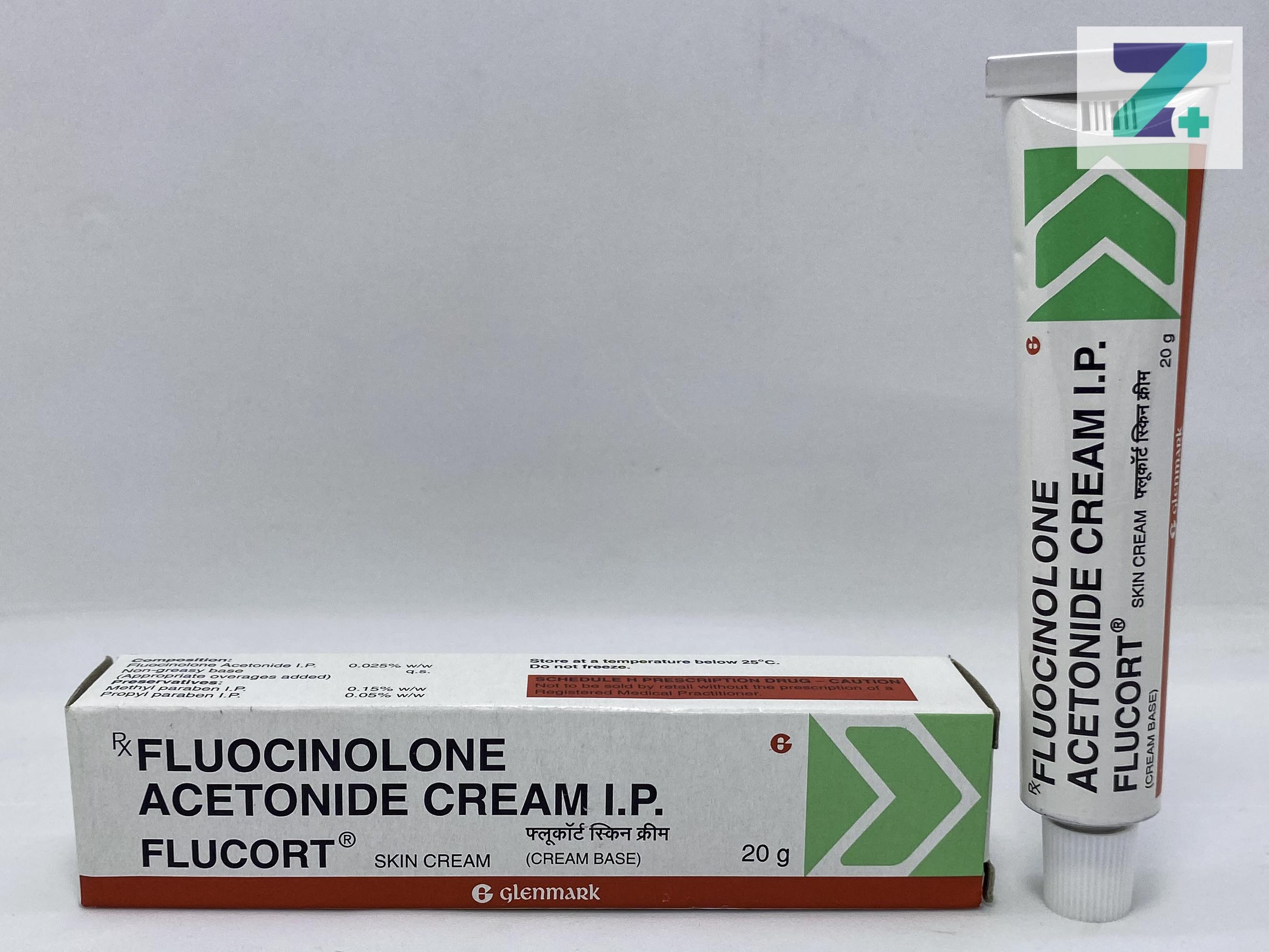
FLUCORT
Price: Rs.220.80
10% off
In stock
Loose stock: 0
Description
FLUCORT CREAM 20G
Details
Composition
FLUOCINOLONE ACETONIDE 0.025 % W/W
# Fluocinolone Acetonide 0.025% W/W
## Short Description
**Fluocinolone Acetonide 0.025% W/W** is a **topical corticosteroid** used to reduce inflammation, redness, itching, and irritation associated with various steroid-responsive skin conditions. It works by reducing the release of inflammatory substances in the skin.
It may be prescribed for conditions such as **eczema, dermatitis, allergic skin reactions, and other inflammatory skin disorders** when a topical corticosteroid is appropriate.
> **Important:** Fluocinolone acetonide should be used only on the areas and for the duration recommended by a healthcare professional. Avoid prolonged or excessive use, particularly on the face, skin folds, or large areas.
---
## Key Benefits
* Helps reduce **skin inflammation and redness**.
* Relieves **itching and irritation** associated with inflammatory skin conditions.
* Can help reduce swelling and discomfort.
* Useful for certain forms of **eczema and dermatitis**.
* Helps control steroid-responsive allergic and inflammatory skin reactions.
* Applied directly to affected skin for localized action.
---
## Uses / Indications
Fluocinolone Acetonide 0.025% W/W may be prescribed for inflammatory skin conditions that respond to topical corticosteroids, including:
### 1. Eczema
May help relieve:
* Itching
* Redness
* Inflammation
* Dryness and irritation
### 2. Dermatitis
It may be used for selected forms of:
* Atopic dermatitis
* Contact dermatitis
* Allergic dermatitis
* Other steroid-responsive dermatitis
### 3. Other Inflammatory Skin Conditions
A healthcare professional may prescribe it for other inflammatory or itchy skin conditions when clinically appropriate.
> Fluocinolone acetonide is **not an antifungal or antibiotic** and should not be used alone to treat fungal, bacterial, or viral skin infections.
---
## How It Works
Fluocinolone acetonide is a **corticosteroid**.
After application to the skin, it reduces inflammatory activity by affecting gene expression and suppressing the production and release of various inflammatory mediators.
This decreases:
* Redness
* Swelling
* Itching
* Inflammation
* Skin irritation
### Simple Mechanism
**Fluocinolone acetonide → suppresses inflammatory responses in the skin → reduces redness, swelling and itching.**
---
## Dosage & Administration
> **Use the exact amount and frequency prescribed by your healthcare professional.**
### General Application
A typical instruction for topical corticosteroids is to apply a **thin layer to the affected skin**, usually **once or twice daily**, depending on the formulation and severity of the condition.
1. Wash and dry your hands.
2. Clean and dry the affected area if appropriate.
3. Apply a thin layer to the affected skin.
4. Gently rub it in until absorbed.
5. Wash your hands after application unless the hands are being treated.
### Important Administration Instructions
* Use only on affected areas.
* Avoid applying more frequently than prescribed.
* Do not use excessive amounts.
* Avoid covering treated areas with airtight or occlusive dressings unless specifically instructed.
* Avoid contact with the eyes.
### Duration of Treatment
Topical corticosteroids should generally be used for the **shortest duration necessary** to control symptoms.
Long-term or continuous use should be supervised by a healthcare professional.
### Missed Application
Apply when remembered unless it is nearly time for the next application.
**Do not apply a double amount to compensate for a missed application.**
---
## Side Effects
### Common Side Effects
Possible local side effects include:
* Burning
* Stinging
* Itching
* Irritation
* Dryness
* Redness
These may be more noticeable when treatment is first started.
### Skin Changes With Prolonged Use
Extended or excessive use may cause:
* Skin thinning
* Stretch marks
* Easy bruising
* Visible small blood vessels
* Changes in skin pigmentation
* Increased hair growth
* Reduced skin thickness
* Delayed wound healing
### Infection
Corticosteroids can suppress local immune responses and may allow an underlying infection to worsen or become less noticeable.
### Systemic Effects
Although topical corticosteroids generally have limited systemic absorption, significant absorption can occur when they are:
* Used over large areas
* Applied frequently
* Used for prolonged periods
* Applied to broken or damaged skin
* Used under occlusive dressings
Rare systemic corticosteroid effects can include **suppression of the hypothalamic-pituitary-adrenal (HPA) axis**.
---
## Precautions & Warnings
### External Use Only
Use only on the skin unless your specific formulation has been prescribed for another route.
### Avoid the Eyes
Do not allow the medicine to enter the eyes. Repeated exposure around the eyes can potentially contribute to problems such as **glaucoma or cataracts**.
### Face
The skin of the face is particularly sensitive to corticosteroids. Use on the face only when specifically recommended by a healthcare professional.
### Skin Folds
Use caution in areas such as:
* Groin
* Armpits
* Under the breasts
These areas can absorb corticosteroids more readily and are more susceptible to skin thinning.
### Infections
Do not use corticosteroids alone to treat untreated:
* Fungal infections
* Bacterial infections
* Viral infections
If an infection develops or worsens during treatment, medical evaluation may be required.
### Occlusive Dressings
Do not cover treated areas with plastic or airtight dressings unless specifically directed by your healthcare professional. Occlusion can substantially increase corticosteroid absorption.
### Children
Children may absorb proportionally larger amounts of topical corticosteroids and may be more susceptible to systemic effects.
Use pediatric treatment only according to professional advice.
### Pregnancy
Tell your healthcare professional if you are pregnant or planning pregnancy. Topical corticosteroids should be used during pregnancy only when medically appropriate.
### Breastfeeding
Consult your healthcare professional before using fluocinolone acetonide while breastfeeding. Avoid applying it directly to the nipple or breast immediately before feeding.
---
## Drug Interactions
Because fluocinolone acetonide is applied topically, significant systemic drug interactions are generally uncommon when it is used appropriately on small areas.
However, caution may be necessary with:
### Other Corticosteroids
Using multiple corticosteroid products simultaneously may increase overall corticosteroid exposure and the risk of adverse effects.
### Immunosuppressive Medicines
Concurrent use with other immunosuppressive therapies may increase susceptibility to infections, particularly when substantial topical absorption occurs.
### Other Topical Medicines
Applying multiple topical products to the same area may increase irritation or alter absorption.
> Tell your doctor or pharmacist about **all prescription medicines, OTC medicines, vitamins and herbal supplements** you use.
---
## Storage Information
* Store according to the manufacturer's instructions.
* Keep at the recommended room temperature unless the product label states otherwise.
* Protect from excessive heat and direct sunlight.
* Keep away from moisture.
* Keep the container tightly closed.
* Do not freeze unless specifically instructed.
* Keep out of reach of children.
* Do not use after the expiry date.
---
## Prescription Status
**Fluocinolone Acetonide 0.025% W/W may be prescription-only depending on the country, formulation, and local regulations.**
Use should be guided by a healthcare professional, particularly when treating children, sensitive areas, large areas of skin, or persistent skin conditions.
---
## Genuine Medicine Assurance
When purchasing **Fluocinolone Acetonide 0.025% W/W**:
* Purchase from a **licensed and reputable pharmacy**.
* Verify the medicine name and concentration.
* Check the manufacturer's name.
* Check the batch/lot number and expiry date.
* Ensure the tube or container is properly sealed.
* Check that the packaging is intact and professionally labeled.
* Verify registration information where applicable.
* Avoid products with suspicious, damaged, or altered packaging.
* Do not purchase prescription medicines from unauthorized sellers.
* Follow the manufacturer's storage instructions.
* If you suspect a counterfeit product, contact the manufacturer, licensed pharmacy, or relevant medicines regulatory authority.
---
# Frequently Asked Questions (FAQ)
### 1. What is Fluocinolone Acetonide 0.025% used for?
Fluocinolone acetonide 0.025% is a **topical corticosteroid** used to reduce inflammation, redness and itching associated with certain eczema, dermatitis and other steroid-responsive skin conditions.
### 2. Is Fluocinolone Acetonide a steroid?
Yes. Fluocinolone acetonide is a **topical corticosteroid**.
### 3. Is Fluocinolone Acetonide an antifungal?
No. Fluocinolone acetonide is not an antifungal medicine. It reduces inflammation but does not eliminate fungal infections.
### 4. Can Fluocinolone Acetonide treat eczema?
Yes. It may be prescribed to reduce inflammation and itching associated with certain forms of eczema.
### 5. Can Fluocinolone Acetonide be used for dermatitis?
Yes. It may be used for selected steroid-responsive forms of **contact, allergic, atopic, or other inflammatory dermatitis**.
### 6. How often should Fluocinolone Acetonide 0.025% be applied?
Depending on the formulation and condition, it is commonly applied **once or twice daily**. Follow the specific prescription or product instructions.
### 7. Can I apply Fluocinolone Acetonide to my face?
Only if specifically recommended by a healthcare professional. The face is more susceptible to corticosteroid-related adverse effects such as **skin thinning and visible blood vessels**.
### 8. Can Fluocinolone Acetonide be used on the scalp?
Some fluocinolone formulations are specifically designed for scalp use, while others are not. Use only the formulation and application method appropriate for the affected area.
### 9. Can Fluocinolone Acetonide be used on fungal infections?
A corticosteroid alone should **not** be used to treat a fungal infection. It can suppress inflammation and potentially make an infection harder to recognize or control.
### 10. Can Fluocinolone Acetonide thin the skin?
Yes. **Skin thinning (atrophy)** can occur, particularly with prolonged, excessive, or inappropriate use.
### 11. Can Fluocinolone Acetonide cause stretch marks?
Yes. Prolonged use of topical corticosteroids, particularly on areas such as the groin or skin folds, can contribute to **stretch marks (striae)**.
### 12. Can children use Fluocinolone Acetonide 0.025%?
Children can be more sensitive to topical corticosteroids. Use in children should be guided by a healthcare professional.
### 13. Can Fluocinolone Acetonide be used during pregnancy?
Discuss use with your healthcare professional if you are pregnant or planning pregnancy. Use should be limited to situations where it is medically appropriate.
### 14. Can Fluocinolone Acetonide be used while breastfeeding?
Consult your healthcare professional before use. Avoid applying the medicine directly to the nipple or breast immediately before breastfeeding.
### 15. What happens if I miss an application?
Apply it when remembered unless it is nearly time for the next application. **Do not apply an excessive amount to make up for a missed dose.**
### 16. Can I cover the treated skin with a bandage?
Do not use an occlusive dressing unless specifically instructed by your healthcare professional because it can increase corticosteroid absorption.
### 17. How long can I use Fluocinolone Acetonide?
Use it for the **shortest duration necessary** to control the skin condition. Prolonged treatment should be monitored by a healthcare professional.
### 18. Can Fluocinolone Acetonide cause skin irritation?
Yes. Burning, stinging, redness, dryness and itching may occur, particularly during initial treatment.
### 19. What should I do if my skin infection gets worse while using it?
Contact your healthcare professional. A corticosteroid can suppress local inflammation and may worsen or mask certain untreated infections.
### 20. Is Fluocinolone Acetonide 0.025% available without a prescription?
Prescription requirements vary by **country, formulation and local regulations**. Follow local pharmacy and prescribing requirements.
---
## Medical Disclaimer
This information about **Fluocinolone Acetonide 0.025% W/W** is provided for educational and general informational purposes only. It is **not a substitute for professional medical advice, diagnosis or treatment**.
Fluocinolone acetonide is a topical corticosteroid and should be used appropriately to minimize the risk of skin thinning, infection, systemic corticosteroid effects and other adverse reactions. The appropriate strength, application frequency and treatment duration depend on the patient's condition, age, treatment site and clinical response.
**Do not use this medicine on the face, groin, skin folds, broken skin, large areas, or under occlusive dressings unless directed by a qualified healthcare professional.** Do not use it alone to treat suspected fungal, bacterial or viral infections.
If the skin condition worsens, becomes infected, fails to improve, or develops significant irritation, seek medical advice.
**Do not start, stop, or change treatment without consulting a qualified healthcare professional.**