INFEXIM-400MG
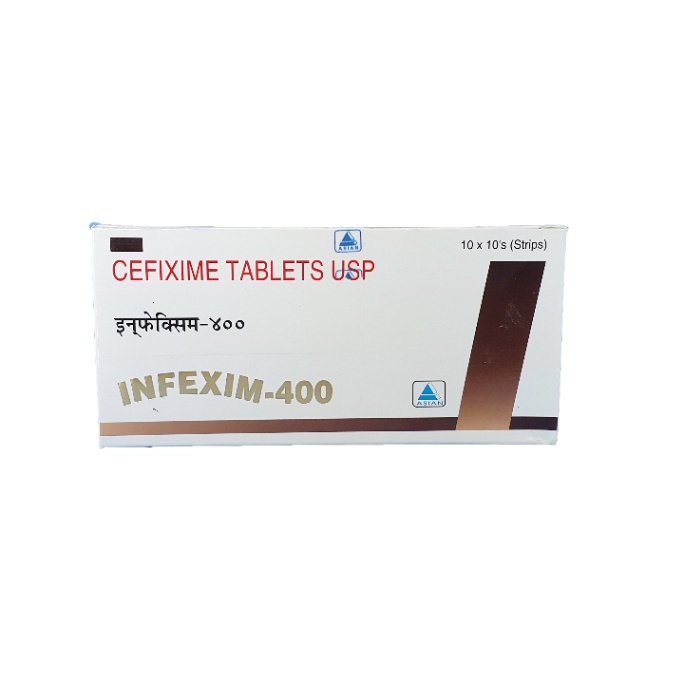
Price: Rs.400.00
10% off
In stock
Loose stock: 5
Description
INFEXIM-400MG TAB 10
Details
Composition
CEFIXIME 400 MG
# CEFIXIME 400 MG
## SHORT DESCRIPTION
**Cefixime 400 mg** is an oral **third-generation cephalosporin antibiotic** used to treat certain bacterial infections. It works by interfering with bacterial cell-wall formation, causing susceptible bacteria to die.
Cefixime is used for selected infections such as **urinary tract infections, certain respiratory tract infections, otitis media, and some bacterial throat infections**, depending on bacterial susceptibility and local prescribing guidelines.
> **Important:** Cefixime treats **bacterial infections only**. It does not work against viral infections such as the common cold or influenza.
---
## KEY BENEFITS
* Treats susceptible **bacterial infections**.
* Convenient oral antibiotic administration.
* Effective against a range of susceptible Gram-positive and Gram-negative bacteria.
* May be prescribed for certain:
* Urinary tract infections
* Respiratory tract infections
* Ear infections
* Throat infections
* Can be used when the infecting organism is susceptible to cefixime.
---
## USES / INDICATIONS
Cefixime 400 mg may be prescribed for susceptible bacterial infections, including:
### 1. Urinary Tract Infections
It may be used for certain uncomplicated urinary tract infections caused by susceptible bacteria.
### 2. Respiratory Tract Infections
Cefixime may be prescribed for selected bacterial respiratory infections, including certain:
* Bronchitis
* Pneumonia
* Other respiratory tract infections
### 3. Ear Infections
It may be used for **acute otitis media** caused by susceptible bacteria.
### 4. Throat and Tonsil Infections
Cefixime may be used for certain bacterial infections of the throat and tonsils when the causative organism is susceptible.
### 5. Other Bacterial Infections
Depending on local approvals and bacterial susceptibility, cefixime may be prescribed for other infections.
**The choice of antibiotic should be based on the suspected or confirmed organism, site of infection, local resistance patterns, and clinical assessment.**
---
## HOW IT WORKS
Cefixime belongs to the **cephalosporin class of beta-lactam antibiotics**.
It binds to bacterial **penicillin-binding proteins (PBPs)** and interferes with the formation of peptidoglycan, an essential component of the bacterial cell wall.
### Simple Explanation
**Cefixime → blocks bacterial cell-wall synthesis → weakens the bacterial cell wall → susceptible bacteria die**
Cefixime does not work against viruses because viruses do not have the bacterial cell-wall structures targeted by this antibiotic.
---
## DOSAGE & ADMINISTRATION
### Adults and Adolescents
For many adult infections, the commonly used total dose is **400 mg per day**, either as:
* **400 mg once daily**, or
* **200 mg every 12 hours**
The exact regimen depends on the infection and the prescribing instructions.
### Children
Pediatric dosing is generally **weight-based** and should be determined by a healthcare professional. The 400 mg tablet may not be appropriate for every child.
### Patients With Kidney Impairment
Dose adjustment may be necessary in patients with significant renal impairment.
### How to Take
* Take exactly as prescribed.
* Cefixime may generally be taken **with or without food**.
* Take doses at evenly spaced times when using divided dosing.
* Swallow tablets with water.
* Complete the prescribed course unless your healthcare professional tells you otherwise.
### Missed Dose
Take the missed dose when remembered unless it is nearly time for the next dose.
**Do not take two doses at the same time.**
### Important
Do not use leftover antibiotics from previous illnesses or share cefixime with another person.
---
## SIDE EFFECTS
### Common Side Effects
Possible side effects include:
* Diarrhea
* Nausea
* Abdominal discomfort
* Indigestion
* Vomiting
* Headache
### Serious Side Effects
Seek immediate medical attention if you experience:
* Difficulty breathing
* Swelling of the face, lips, tongue, or throat
* Severe skin rash
* Blistering or peeling skin
* Severe or persistent diarrhea
* Blood or mucus in stools
* Severe abdominal pain
### Antibiotic-Associated Diarrhea
Cefixime can sometimes cause **Clostridioides difficile-associated diarrhea**, which may occur during treatment or even weeks afterward.
Contact a healthcare professional if you develop severe, persistent, or bloody diarrhea.
---
## PRECAUTIONS & WARNINGS
### Allergy to Cephalosporins
Do not use cefixime if you have previously experienced a serious allergic reaction to cefixime or another cephalosporin.
### Penicillin Allergy
People with a history of serious allergy to penicillin or other beta-lactam antibiotics should inform their healthcare professional before taking cefixime.
### Kidney Disease
Cefixime is eliminated partly through the kidneys. Dose adjustment may be necessary in people with impaired kidney function.
### Severe Diarrhea
Do not self-treat severe diarrhea occurring during or after antibiotic therapy without medical advice.
### Antibiotic Resistance
Using cefixime when it is not needed can contribute to **antibiotic resistance**.
Do not use cefixime for:
* Common colds
* Influenza
* Other viral infections
### Superinfection
Prolonged or inappropriate antibiotic use can allow resistant bacteria or fungi to grow, potentially causing a secondary infection.
### Pregnancy
Tell your healthcare professional if you are pregnant or planning pregnancy. Cefixime should be used when medically appropriate.
### Breastfeeding
Cefixime passes into breast milk in small amounts. Consult a healthcare professional if you are breastfeeding.
---
## DRUG INTERACTIONS
### Warfarin and Other Anticoagulants
Cephalosporins may occasionally affect coagulation and increase bleeding risk, particularly in susceptible patients.
Patients taking **warfarin** may require monitoring of coagulation parameters.
### Carbamazepine
Cefixime may increase carbamazepine concentrations in some patients. Monitoring may be required.
### Laboratory Tests
Cefixime can interfere with some laboratory tests, including certain:
* Urine glucose tests
* Coombs' tests
### Other Medicines
Always tell your doctor or pharmacist about all:
* Prescription medicines
* OTC medicines
* Vitamins
* Mineral supplements
* Herbal products
---
## STORAGE INFORMATION
* Store Cefixime 400 mg according to the manufacturer's recommended conditions.
* Keep tablets in the original packaging.
* Protect from excessive heat and moisture.
* Keep away from direct sunlight.
* Keep out of reach and sight of children.
* Keep the package tightly closed where applicable.
* Do not use after the expiry date.
* Do not use tablets if the packaging is damaged or appears tampered with.
---
## PRESCRIPTION STATUS
**Prescription Medicine**
Cefixime 400 mg is generally a **prescription-only antibiotic**.
It should be used only when a bacterial infection is suspected or confirmed and treatment with cefixime is considered appropriate by a healthcare professional.
---
## GENUINE MEDICINE ASSURANCE
For safe and effective treatment, purchase **Cefixime 400 mg** from a licensed pharmacy or authorized medicine supplier.
Before use, check:
* Product name and strength
* Active ingredient
* Manufacturer information
* Batch/lot number
* Manufacturing and expiry dates
* Packaging and seal integrity
* Regulatory/registration information where applicable
Do not use the medicine if it is:
* Expired
* Damaged
* Tampered with
* Missing batch or expiry information
* Unusual in appearance
If you have concerns about authenticity, consult a licensed pharmacist or the relevant medicine regulatory authority.
---
# FAQ – CEFIXIME 400 MG
### 1. What is Cefixime 400 mg used for?
Cefixime 400 mg is an oral antibiotic used to treat certain **bacterial infections**, including selected urinary, respiratory, ear, and throat infections caused by susceptible bacteria.
### 2. Is Cefixime 400 mg an antibiotic?
Yes. Cefixime is a **third-generation cephalosporin antibiotic**.
### 3. Does Cefixime work for viral infections?
No. Cefixime does not treat viral infections such as the **common cold or influenza**.
### 4. How does Cefixime work?
Cefixime interferes with **bacterial cell-wall synthesis**, weakening the cell wall and causing susceptible bacteria to die.
### 5. Is Cefixime 400 mg a strong antibiotic?
Cefixime is a broad-spectrum cephalosporin antibiotic, but antibiotics should not be classified simply as "strong" or "weak." The appropriate antibiotic depends on the specific bacteria and infection.
### 6. How should Cefixime 400 mg be taken?
Follow your doctor's instructions. In adults, cefixime is commonly given as **400 mg once daily or 200 mg twice daily**, depending on the infection.
### 7. Can Cefixime 400 mg be taken with food?
Yes. Cefixime tablets can generally be taken **with or without food**.
### 8. How long does Cefixime take to work?
Some symptoms may begin improving within a few days, but the timing depends on the infection and the individual. If symptoms worsen or fail to improve, contact your healthcare professional.
### 9. Should I complete the Cefixime course?
If cefixime has been prescribed as a course, take it exactly as directed and complete the prescribed treatment unless your healthcare professional tells you to stop or changes the treatment.
### 10. Can Cefixime be used for a urinary tract infection?
Yes. Cefixime can be used for certain **susceptible urinary tract infections**, depending on the bacteria causing the infection and local resistance patterns.
### 11. Can Cefixime be used for a throat infection?
It may be prescribed for certain bacterial throat or tonsil infections when the causative organism is susceptible.
### 12. Can Cefixime treat cough?
Cefixime does not treat cough itself. It may be prescribed when a cough is associated with a **susceptible bacterial respiratory infection**.
### 13. Can Cefixime treat pneumonia?
Cefixime may be used for selected bacterial respiratory infections, but the appropriate antibiotic for pneumonia depends on the suspected organism, severity, patient factors, and local guidelines.
### 14. Can Cefixime cause diarrhea?
Yes. **Diarrhea is one of the more common side effects** of cefixime and other antibiotics.
### 15. What should I do if I develop severe diarrhea while taking Cefixime?
Contact a healthcare professional, particularly if diarrhea is severe, persistent, watery, or bloody. Antibiotic-associated *C. difficile* infection can occur during or after treatment.
### 16. Can I take Cefixime if I am allergic to penicillin?
Some people with penicillin allergies can take cephalosporins, but individuals with a **history of severe immediate beta-lactam allergy** should be assessed carefully by a healthcare professional before taking cefixime.
### 17. Can Cefixime be taken during pregnancy?
Cefixime may be used during pregnancy when medically appropriate. Inform your healthcare professional if you are pregnant or planning pregnancy.
### 18. Can Cefixime be taken while breastfeeding?
Cefixime passes into breast milk in small amounts. Discuss its use with your healthcare professional if you are breastfeeding.
### 19. Can Cefixime be used in children?
Yes, cefixime can be prescribed for children for appropriate infections, but pediatric dosing is generally **based on body weight**.
### 20. Can Cefixime be used in kidney disease?
It may require dose adjustment in patients with significant kidney impairment. Tell your doctor if you have kidney disease.
### 21. Can Cefixime be taken with paracetamol?
There is generally no major direct interaction between cefixime and paracetamol, but medicines should still be used according to appropriate dosing instructions.
### 22. Can Cefixime be taken with ibuprofen?
There is no major routine interaction, but your healthcare professional should know about all medicines you take, especially if you have kidney problems or other risk factors.
### 23. Can Cefixime be taken with probiotics?
Some people use probiotics during antibiotic treatment to help reduce antibiotic-associated gastrointestinal symptoms. If you use a probiotic, ask your pharmacist about appropriate timing and suitability.
### 24. What happens if I miss a Cefixime dose?
Take the missed dose when remembered unless it is nearly time for the next dose. **Do not double the next dose.**
### 25. Is Cefixime 400 mg available without a prescription?
Cefixime 400 mg is generally a **prescription-only antibiotic**. Regulations can vary by country.
---
## MEDICAL DISCLAIMER
This information about **Cefixime 400 mg** is provided for general educational and informational purposes only. It is **not a substitute for professional medical advice, diagnosis, or treatment**.
Cefixime is a prescription antibiotic and should only be used when appropriate for a **susceptible bacterial infection**. Unnecessary antibiotic use contributes to antimicrobial resistance.
Important risks include **allergic reactions, diarrhea, antibiotic-associated *Clostridioides difficile* infection, and other adverse effects**. Patients with significant kidney disease or a history of serious beta-lactam allergy should consult a healthcare professional before use.
**Do not start, stop, extend, or share Cefixime 400 mg without medical advice.** Do not use leftover antibiotics for a new illness.
Seek urgent medical attention for difficulty breathing, facial or throat swelling, severe skin reactions, or other signs of a serious allergic reaction. Seek medical advice for severe or persistent diarrhea during or after treatment.
**Always read the product label/package insert and follow your doctor's or pharmacist's instructions.**