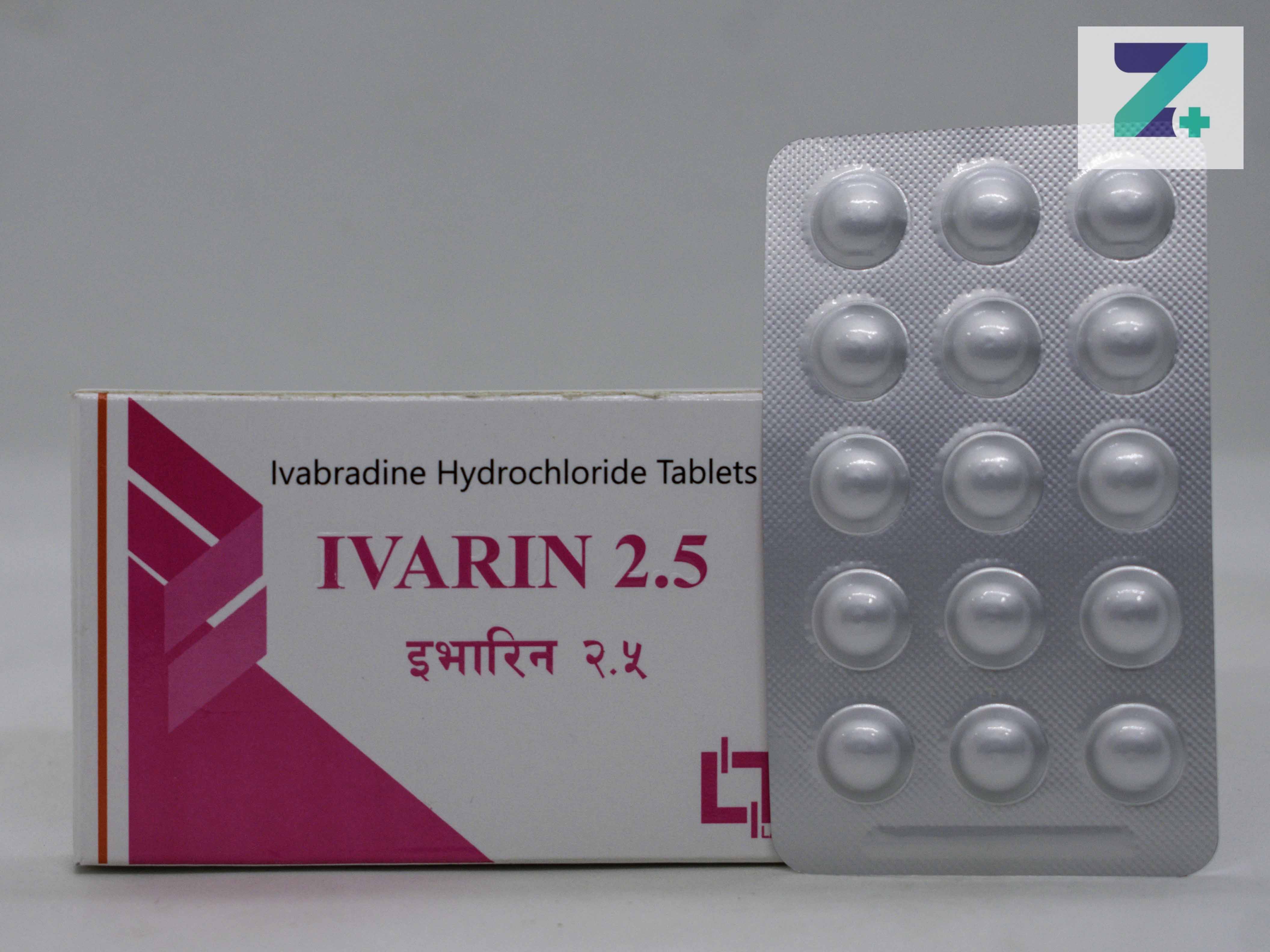
IVARIN 2.5
Price: Rs.375.00
10% off
In stock
Loose stock: 0
Description
IVARIN 2.5 TAB 15
Details
Composition
IVABRADINE 2.5
# Ivabradine 2.5 mg
## SHORT DESCRIPTION
Ivabradine 2.5 mg is a **heart-rate-lowering medicine** used in selected patients with certain heart conditions. It works mainly by slowing the heart rate without significantly reducing the force of heart muscle contraction or blood pressure.
It is commonly used for **chronic stable angina** and, in appropriate patients, **chronic heart failure with reduced ejection fraction**, according to the patient's heart rate, heart rhythm and clinical condition.
## KEY BENEFITS
* Helps reduce an abnormally high resting heart rate
* May reduce symptoms of chronic stable angina
* Can improve exercise tolerance in appropriate patients with angina
* May help reduce symptoms and hospitalizations related to chronic heart failure in selected patients
* Specifically targets heart-rate control
* Generally has less direct effect on the strength of heart contraction compared with some other heart-rate-lowering medicines
## USES / INDICATIONS
Ivabradine may be prescribed for:
* **Chronic stable angina** in selected patients with normal sinus rhythm
* **Chronic heart failure with reduced ejection fraction** in selected patients with an elevated resting heart rate
* Heart-rate reduction when a beta-blocker is unsuitable, not tolerated or insufficient, depending on the clinical situation and local treatment guidelines
Ivabradine is **not suitable for every type of fast heartbeat** and is generally not effective when the heart rhythm is not sinus rhythm.
## HOW IT WORKS
Ivabradine selectively inhibits the **If ("funny") current** in the sinoatrial node, which is the heart's natural pacemaker.
By slowing the rate at which the sinoatrial node generates electrical impulses, ivabradine **reduces heart rate**.
Unlike many other heart-rate-lowering medicines, ivabradine does not primarily reduce the force of heart contraction. Its effectiveness depends on the patient being in **sinus rhythm**.
## DOSAGE & ADMINISTRATION
The appropriate dose depends on the indication, resting heart rate, age and response to treatment.
* Ivabradine is commonly started at **5 mg twice daily** in appropriate adult patients, with dose adjustment according to heart rate and tolerability.
* **2.5 mg twice daily** may be used in selected patients when a lower starting or maintenance dose is appropriate.
* Take it **with food**, generally at approximately the same times each day.
* Tablets should be swallowed with water.
* Your doctor may adjust the dose based on your resting heart rate and symptoms.
* Regular heart-rate monitoring may be required during treatment.
* Do not change the dose or stop treatment without consulting your doctor.
### Missed Dose
If you miss a dose, skip the missed dose and take the next dose at the usual scheduled time. **Do not take a double dose** to compensate for a missed dose.
## SIDE EFFECTS
Common side effects may include:
* **Phosphenes** — temporary visual brightness, flashes or changes in visual perception
* Slow heart rate
* Headache
* Dizziness
* Increased blood pressure
* Fatigue
Visual symptoms are often more noticeable during the first few months and may improve during continued treatment or after discontinuation.
### Serious Side Effects
Seek medical attention if you experience:
* Very slow heartbeat
* Fainting or severe dizziness
* New or worsening irregular heartbeat
* Persistent palpitations
* Severe allergic reaction
* Significant worsening of heart failure symptoms
Ivabradine can increase the risk of **atrial fibrillation** in some patients.
## PRECAUTIONS & WARNINGS
* Ivabradine should be used only when the patient is in **sinus rhythm** unless specifically directed otherwise by a specialist.
* Tell your doctor if you have a low resting heart rate.
* Inform your doctor if you have low blood pressure.
* Tell your doctor if you have heart rhythm problems or a history of atrial fibrillation.
* Inform your doctor if you have conduction problems or a pacemaker.
* Tell your doctor if you have severe liver disease.
* Use caution in patients with significant kidney problems.
* Avoid grapefruit or grapefruit juice unless your doctor advises otherwise, as it may increase ivabradine exposure.
* Visual disturbances may occur. Use caution when driving at night or in situations involving sudden changes in light.
* Regular monitoring of heart rate and heart rhythm may be required.
* Inform your doctor if you are pregnant, planning pregnancy or breastfeeding.
* Do not stop prescribed heart-failure or angina treatment without medical advice.
## DRUG INTERACTIONS
Ivabradine has important interactions with several medicines, including:
* **Strong CYP3A4 inhibitors** such as ketoconazole, itraconazole, clarithromycin and certain HIV protease inhibitors — can substantially increase ivabradine levels and are generally contraindicated.
* **Moderate CYP3A4 inhibitors** such as diltiazem and verapamil — may increase ivabradine concentration and slow the heart rate; concomitant use is generally avoided.
* **CYP3A4 inducers** such as rifampicin, phenytoin and carbamazepine — may reduce ivabradine levels and its effectiveness.
* **Other heart-rate-lowering medicines** — may increase the risk of excessive bradycardia.
* **QT-prolonging medicines** — excessive heart-rate reduction may increase the risk of cardiac rhythm problems in susceptible patients.
* **Grapefruit or grapefruit juice** — may increase ivabradine exposure.
Always tell your doctor or pharmacist about all prescription medicines, over-the-counter medicines, vitamins and herbal supplements you are taking.
## STORAGE INFORMATION
* Store according to the manufacturer's instructions.
* Keep the tablets in their original packaging.
* Protect from excessive heat and moisture.
* Keep away from direct sunlight.
* Keep out of reach of children.
* Do not use after the expiry date.
* Do not use tablets if the packaging is damaged or the tablets appear abnormal.
## PRESCRIPTION STATUS
**Prescription medicine.** Ivabradine 2.5 mg should be used under the supervision of a qualified healthcare professional, preferably a physician experienced in treating cardiovascular conditions. Prescription requirements may vary according to local regulations.
## GENUINE MEDICINE ASSURANCE
For safe and genuine medicine use:
* Purchase Ivabradine 2.5 mg only from a licensed and reputable pharmacy.
* Check the medicine name, strength, batch number and expiry date.
* Ensure the packaging and seal are intact.
* Verify the manufacturer's details.
* Avoid medicines with damaged, altered or suspicious packaging.
* Purchase medicines only from authorized sources.
* Consult a pharmacist if you have concerns about product authenticity.
## FAQ
### What is Ivabradine 2.5 mg used for?
Ivabradine 2.5 mg is used in selected patients to **lower heart rate**. It may be prescribed for chronic stable angina or chronic heart failure with reduced ejection fraction when the patient meets specific clinical criteria.
### How does Ivabradine work?
Ivabradine selectively blocks the **If current** in the sinoatrial node, slowing the heart's natural pacemaker and reducing heart rate.
### Does Ivabradine lower blood pressure?
Ivabradine primarily lowers heart rate and generally has little direct effect on blood pressure. However, dizziness or low blood pressure can occur in some patients.
### Is Ivabradine a beta-blocker?
No. Ivabradine is **not a beta-blocker**. It lowers heart rate by acting directly on the If current in the sinoatrial node.
### What is Ivabradine 2.5 mg used for in heart failure?
In selected patients with chronic heart failure and reduced ejection fraction who are in sinus rhythm and have an elevated resting heart rate, ivabradine can help reduce heart-rate-related symptoms and the risk of certain heart-failure hospitalizations.
### Can Ivabradine be used for angina?
Yes. Ivabradine may be used for **chronic stable angina** in appropriately selected patients to reduce heart rate and improve exercise tolerance.
### How often should Ivabradine 2.5 mg be taken?
When prescribed at this strength, it is commonly taken **twice daily with food**. The exact dose depends on the patient's condition and response to treatment.
### Why is Ivabradine taken with food?
Taking ivabradine with food helps provide more consistent absorption. Follow your doctor's instructions and the specific product labeling.
### Can Ivabradine cause a slow heartbeat?
Yes. Because ivabradine lowers heart rate, **bradycardia** can occur. Your doctor may reduce the dose or discontinue treatment if your heart rate becomes too low.
### Can Ivabradine cause visual disturbances?
Yes. Some people experience **phosphenes**, described as temporary flashes, brightness or changes in visual perception. These effects are usually transient but should be discussed with your doctor if persistent or troublesome.
### Can I drive while taking Ivabradine?
Visual disturbances may affect vision, particularly when moving between dark and bright environments. Use caution when driving, especially at night, until you know how the medicine affects you.
### Can Ivabradine cause atrial fibrillation?
Yes. Ivabradine may increase the risk of **atrial fibrillation** in some patients. Seek medical advice if you develop a rapid or irregular heartbeat or palpitations.
### Can Ivabradine be taken with beta-blockers?
Ivabradine can sometimes be prescribed alongside a beta-blocker when clinically appropriate, but the combination can increase the risk of an excessively slow heart rate. It should only be used together under medical supervision.
### Can Ivabradine be taken with Verapamil or Diltiazem?
Ivabradine is generally **not recommended with verapamil or diltiazem** because these medicines can increase ivabradine exposure and further slow the heart rate.
### Can I take Ivabradine with Clarithromycin?
Clarithromycin is a strong CYP3A4 inhibitor and can significantly increase ivabradine levels. The combination is generally contraindicated. Tell your doctor that you take ivabradine before starting clarithromycin or another macrolide antibiotic.
### Can I drink grapefruit juice while taking Ivabradine?
It is generally recommended to **avoid grapefruit and grapefruit juice** because they can increase ivabradine exposure.
### What should I do if I miss an Ivabradine dose?
Skip the missed dose and take the next dose at the usual time. Do not take two doses together.
### Can I stop Ivabradine suddenly?
Do not stop ivabradine without speaking with your doctor. Your doctor will determine whether another treatment or dose adjustment is required for your heart condition.
### Can Ivabradine be used during pregnancy?
Ivabradine is generally not recommended during pregnancy because it may pose a risk to the developing baby. Tell your doctor if you are pregnant, planning pregnancy or become pregnant during treatment.
### How should Ivabradine 2.5 mg be stored?
Store it according to the manufacturer's instructions, in its original packaging, away from excessive heat and moisture and out of reach of children.
## MEDICAL DISCLAIMER
This information is provided for educational and informational purposes only and should not replace professional medical advice, diagnosis or treatment. Ivabradine 2.5 mg is a prescription cardiovascular medicine and should be used only under the supervision of a qualified healthcare professional. The appropriate dose depends on the patient's heart rate, heart rhythm, medical condition and response to treatment. Do not start, stop or change the dose without consulting your doctor. Seek urgent medical attention for fainting, severe dizziness, very slow heartbeat, chest pain, severe shortness of breath or a new irregular heartbeat.