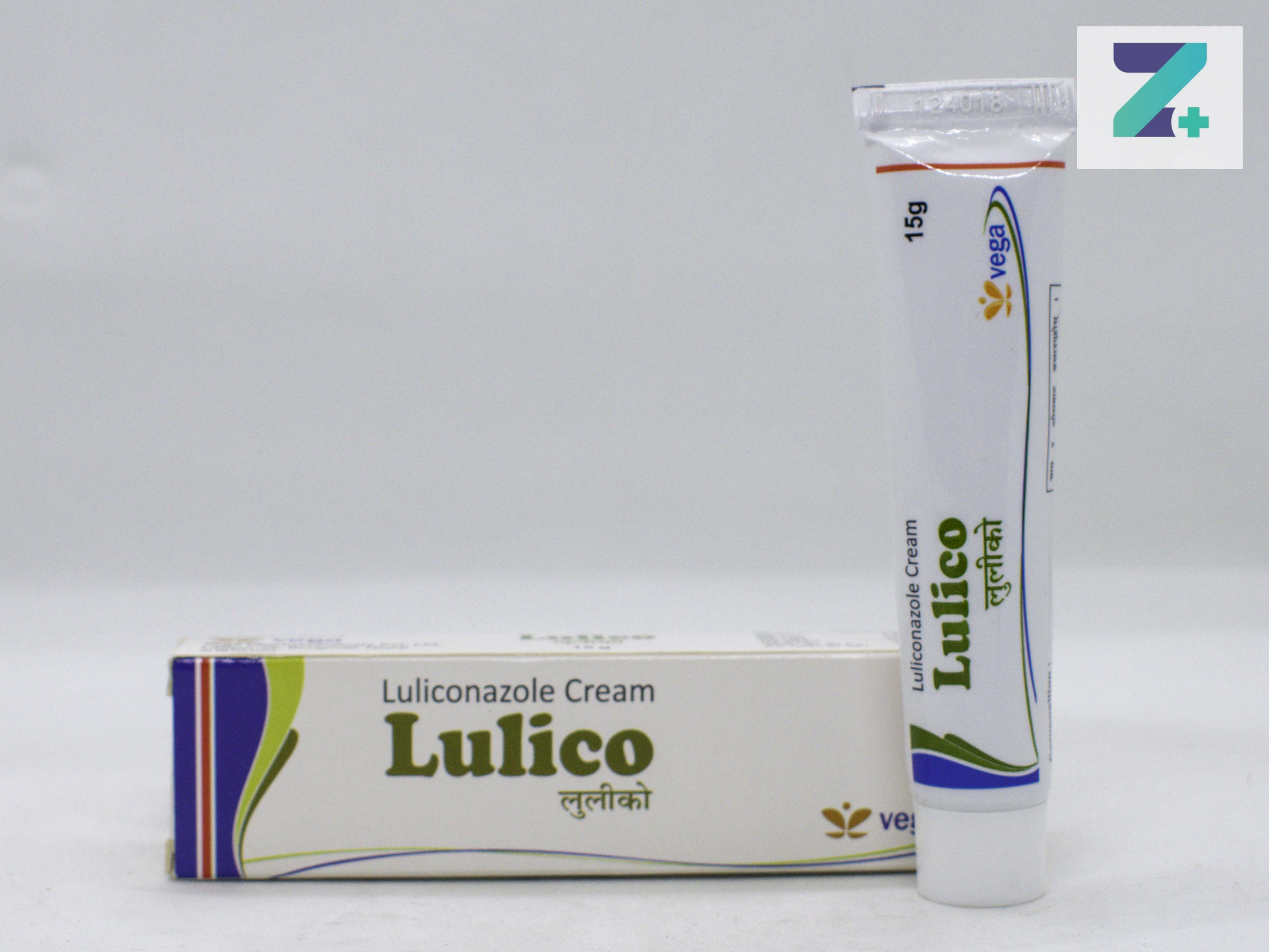
LULICO
Price: Rs.320.00
10% off
In stock
Loose stock: 0
Description
LULICO CREAM 15GM
Details
Composition
LULICONAZOLE 1% W/W
# Luliconazole 1% w/w
## Short Description
**Luliconazole 1% w/w** is a topical azole antifungal medicine used to treat certain fungal infections of the skin, including **athlete’s foot (tinea pedis), jock itch (tinea cruris), and ringworm (tinea corporis)**. It works by interfering with fungal cell-membrane formation, helping stop the growth of the fungi responsible for the infection. ([MedlinePlus][1])
---
## Key Benefits
* Helps treat common **fungal skin infections**.
* Effective against dermatophytes associated with **ringworm, jock itch, and athlete’s foot**.
* Helps reduce fungal growth and associated symptoms such as **itching, redness, scaling, and discomfort**.
* Convenient **once-daily topical application** for approved indications.
* Acts directly on the affected skin. ([DailyMed][2])
---
## Uses / Indications
Luliconazole 1% cream may be used for:
1. **Tinea pedis (Athlete’s foot)** – particularly fungal infection between the toes.
2. **Tinea cruris (Jock itch)** – fungal infection affecting the groin or buttocks.
3. **Tinea corporis (Ringworm)** – fungal infection causing characteristic circular or scaly skin lesions.
The labeled U.S. indication specifically includes infections caused by *Trichophyton rubrum* and *Epidermophyton floccosum*. ([DailyMed][2])
---
## How It Works
Luliconazole belongs to the **azole class of antifungal medicines**. It inhibits the fungal enzyme **lanosterol demethylase**, which is involved in the production of **ergosterol**, an important component of fungal cell membranes.
By reducing ergosterol production, luliconazole interferes with the integrity and growth of susceptible fungi, helping clear the infection. ([DailyMed][3])
---
## Dosage & Administration
**For topical use only.**
* **Tinea pedis (between the toes):** Apply a thin layer to the affected skin and approximately **1 inch (2.5 cm) of surrounding skin once daily for 2 weeks**.
* **Tinea cruris or tinea corporis:** Apply a thin layer to the affected skin and approximately **1 inch (2.5 cm) of surrounding skin once daily for 1 week**. ([DailyMed][2])
* Wash and dry the affected area before application.
* Wash your hands before and after applying the cream, unless the hands themselves are being treated.
* Continue treatment for the prescribed duration even if symptoms improve earlier.
* Do not apply more frequently or use larger amounts unless directed by a healthcare professional.
* If a dose is missed, apply it when remembered unless it is nearly time for the next dose. Do not apply extra cream to compensate. ([MedlinePlus][1])
**Important:** Luliconazole cream is **not for use in the eyes, mouth, or vagina and should not be swallowed**. ([DailyMed][2])
---
## Side Effects
Luliconazole is generally well tolerated when used as directed.
Possible side effects include:
* Mild irritation at the application site
* Itching
* Stinging or burning
* Redness or other application-site reactions
Clinical trials reported application-site reactions in **less than 1%** of treated subjects. Post-marketing reports have also included contact dermatitis and cellulitis. ([DailyMed][2])
**Seek medical advice** if irritation becomes severe, persistent, or if you develop signs of an allergic reaction or worsening infection.
---
## Precautions & Warnings
* **For external use only.**
* Avoid contact with the **eyes, mouth, and vaginal area**.
* Do not swallow the medicine.
* Do not apply to areas other than those recommended by your healthcare professional.
* Tell your doctor if you have previously experienced an allergy to luliconazole or any ingredient in the formulation.
* Inform your healthcare professional about pregnancy, planned pregnancy, or breastfeeding before using this medicine. ([MedlinePlus][1])
* Keep the medicine away from children.
* If the infection does not improve after the recommended treatment course or becomes worse, consult a healthcare professional rather than continuing treatment indefinitely.
---
## Drug Interactions
Because luliconazole is applied to the skin, **clinically significant drug interactions are generally not expected with appropriate topical use**.
However:
* Tell your doctor or pharmacist about all prescription medicines, OTC medicines, vitamins, supplements, and herbal products you use.
* Avoid applying other topical medicines to the same area unless your healthcare professional recommends them.
* Do not combine multiple antifungal or steroid-containing creams on the same area without professional advice. ([MedlinePlus][1])
---
## Storage Information
* Store at **room temperature**.
* The labeled storage range for one U.S. product is **20°C–25°C (68°F–77°F)**, with permitted excursions of 15°C–30°C (59°F–86°F). ([DailyMed][2])
* Keep the tube/container tightly closed.
* Protect from excessive heat, moisture, and direct light.
* Do not freeze unless the product label specifically permits it.
* Keep out of the reach of children and pets.
Always follow the storage instructions printed on the specific product package.
---
## Prescription Status
**Prescription status may vary by country, formulation, strength, and local regulations.**
In the United States, luliconazole 1% cream is labeled as a **prescription medicine (Rx only)**. ([DailyMed][3])
For sale or dispensing in Nepal or another country, follow the applicable national medicines regulations and the product's approved labeling.
---
## Genuine Medicine Assurance
When purchasing **Luliconazole 1% w/w**, ensure that:
* The product comes from a **licensed and reputable pharmacy or healthcare supplier**.
* The packaging is sealed and undamaged.
* The **batch/lot number, manufacturing date, expiry date, and manufacturer details** are clearly printed.
* The product has the appropriate regulatory authorization for your market.
* You do not purchase medicines with altered labels, damaged packaging, or suspiciously low prices.
* Keep the original packaging and invoice/receipt where possible for verification.
**Important:** Product authenticity should be verified using the manufacturer's or relevant regulatory authority's available verification system where applicable.
---
# FAQ – Luliconazole 1% w/w
### 1. What is Luliconazole 1% cream used for?
Luliconazole 1% cream is an antifungal medicine used to treat certain fungal skin infections, including **athlete’s foot, jock itch, and ringworm**. ([MedlinePlus][1])
### 2. How often should Luliconazole 1% be applied?
It is generally applied **once daily**. The treatment duration depends on the infection: typically **2 weeks for interdigital athlete’s foot** and **1 week for tinea cruris or tinea corporis**, according to the product labeling. ([DailyMed][2])
### 3. Can Luliconazole be used for ringworm?
Yes. Luliconazole 1% cream is indicated for **tinea corporis (ringworm)** caused by susceptible dermatophytes. ([DailyMed][2])
### 4. Can Luliconazole treat athlete’s foot?
Yes. It is indicated for **interdigital tinea pedis**, commonly known as athlete’s foot between the toes. ([DailyMed][2])
### 5. Can Luliconazole be used for jock itch?
Yes. Luliconazole 1% cream is indicated for **tinea cruris (jock itch)**. ([DailyMed][2])
### 6. Can Luliconazole be applied inside the vagina?
**No.** Luliconazole cream is intended for topical skin use and should **not be used intravaginally**. ([DailyMed][2])
### 7. Can Luliconazole be applied to the face?
Only use it on the face if specifically recommended by a healthcare professional. The approved indications and application instructions should be followed carefully.
### 8. What happens if I forget to apply Luliconazole?
Apply the missed dose when you remember. If it is almost time for the next dose, skip the missed application and continue your normal schedule. **Do not apply extra cream** to make up for a missed dose. ([MedlinePlus][1])
### 9. Can I stop using Luliconazole when the itching disappears?
It is generally recommended to **complete the prescribed treatment course**, even if symptoms improve earlier. Stopping treatment too soon may allow the infection to persist or return. ([MedlinePlus][1])
### 10. Does Luliconazole cause skin irritation?
It can. Mild application-site irritation, itching, stinging, or burning may occur. Clinical-trial application-site reactions occurred in less than 1% of subjects. ([DailyMed][2])
### 11. Can Luliconazole be used with other creams?
Avoid applying other medicated creams to the same area unless advised by a doctor or pharmacist. This is particularly important with combination creams containing **steroids or other antifungals**.
### 12. Is Luliconazole an antibiotic?
**No.** Luliconazole is an **antifungal medicine**, not an antibiotic. It is intended to treat susceptible fungal infections of the skin.
### 13. How does Luliconazole work?
It inhibits an enzyme involved in fungal **ergosterol production**, disrupting the fungal cell membrane and inhibiting fungal growth. ([DailyMed][3])
### 14. Can Luliconazole be used during pregnancy?
If you are pregnant, planning pregnancy, or breastfeeding, consult your healthcare professional before using luliconazole. The available product information advises discussing these circumstances with a doctor. ([MedlinePlus][1])
### 15. What should I do if my fungal infection does not improve?
If symptoms persist, worsen, or return after treatment, consult a healthcare professional. The rash may have another cause or may require a different treatment.
---
## Medical Disclaimer
**This information is provided for educational and informational purposes only and is not a substitute for professional medical advice, diagnosis, or treatment.** Luliconazole 1% w/w should be used according to the directions on the specific product label or as prescribed by a qualified healthcare professional. Dosage, duration, approved indications, prescription requirements, and precautions may vary by country and formulation.
Do not self-diagnose a skin infection solely from its appearance. Seek medical advice if the condition is severe, recurrent, spreading, or not improving with treatment. Always check the actual medicine packaging and consult a doctor or pharmacist if you have questions about appropriate use.
[1]: https://medlineplus.gov/druginfo/meds/a614020.html?utm_source=chatgpt.com "Luliconazole Topical: MedlinePlus Drug Information"
[2]: https://dailymed.nlm.nih.gov/dailymed/fda/fdaDrugXsl.cfm?setid=7ccda3ba-9c98-468d-83c6-7f0cc7c88c33&utm_source=chatgpt.com "These highlights do not include all the information needed to use Luliconazole Cream safely and effectively. See full prescribing information for Luliconazole Cream. Luliconazole cream, for topical useInitial U.S. Approval: 2013"
[3]: https://dailymed.nlm.nih.gov/dailymed/drugInfo.cfm?setid=7ccda3ba-9c98-468d-83c6-7f0cc7c88c33&utm_source=chatgpt.com "DailyMed - LULICONAZOLE cream"