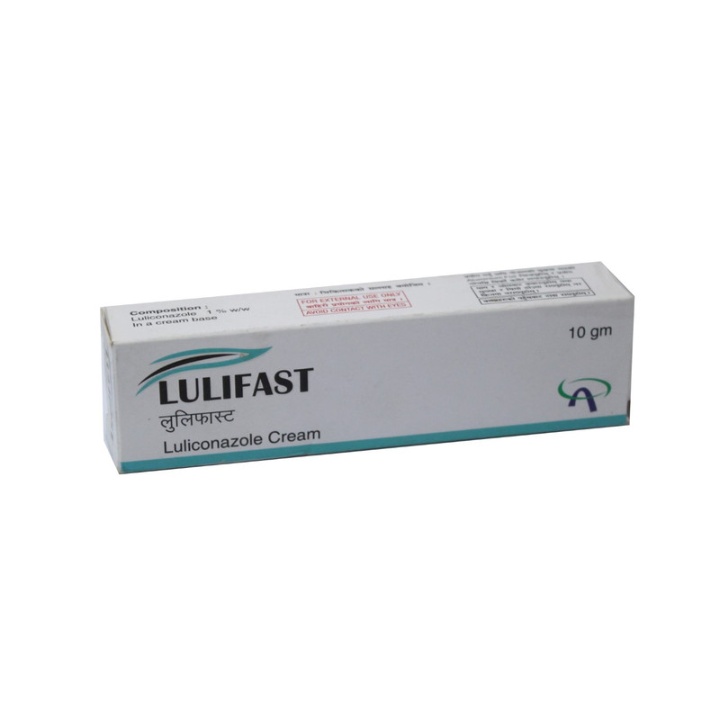
LULIFAST
Price: Rs.215.00
10% off
In stock
Loose stock: 0
Description
LULIFAST CREAM 10GM
Details
Composition
LULICONAZOLE 1 % W/W
# Luliconazole 1% w/w
## Short Description
Luliconazole 1% w/w is a **topical antifungal medicine** used to treat fungal skin infections. It is commonly prescribed for **ringworm (tinea corporis), jock itch (tinea cruris), and athlete's foot (tinea pedis)**. It works by interfering with the growth and survival of fungi on the skin.
## Key Benefits
* Helps treat fungal skin infections
* Helps relieve symptoms such as itching, redness and scaling associated with fungal infections
* Effective against susceptible dermatophyte fungi
* Convenient topical application
* Helps clear fungal infection when used for the full recommended treatment period
## Uses / Indications
Luliconazole 1% w/w may be used to treat:
* **Tinea corporis** (ringworm of the body)
* **Tinea cruris** (jock itch)
* **Tinea pedis** (athlete's foot)
* Other susceptible superficial fungal skin infections when prescribed by a healthcare professional
It is intended for **external use on the skin** unless the specific product information states otherwise.
## How It Works
Luliconazole belongs to the **azole class of antifungal medicines**. It inhibits an enzyme called **lanosterol 14-alpha-demethylase**, which is required for the production of ergosterol, an essential component of fungal cell membranes.
By disrupting fungal cell membrane formation, luliconazole inhibits fungal growth and helps eliminate the infection.
## Dosage & Administration
* Use Luliconazole 1% w/w exactly as directed by your doctor or pharmacist
* Clean and thoroughly dry the affected area before application
* Apply a **thin layer** to the affected skin
* Wash your hands before and after application unless the hands are the treatment area
* Apply the medicine to the affected area and surrounding skin as directed
* Avoid contact with the eyes, mouth and other mucous membranes
* Do not cover the area with an airtight dressing unless instructed
* Use it for the **full recommended duration**, even if symptoms improve earlier
* Do not apply more frequently or use larger amounts than recommended
* If you miss an application, apply it when remembered unless it is nearly time for the next application
## Side Effects
Possible side effects include:
* Mild burning
* Stinging
* Itching
* Redness
* Skin irritation
* Dryness at the application site
These effects are generally mild and temporary.
Stop using the medicine and seek medical advice if you develop severe irritation, swelling, blistering or signs of a serious allergic reaction.
## Precautions & Warnings
* Do not use if you are allergic to luliconazole or any ingredient in the product
* For external use only unless specifically directed otherwise
* Avoid contact with the eyes, mouth and inside of the nose
* Do not apply to severely damaged or irritated skin unless advised by a healthcare professional
* Wash your hands after application
* Keep the affected area clean and dry
* Do not share towels, clothing or personal items that may spread fungal infection
* Avoid unnecessary use on unaffected skin
* Complete the recommended course to reduce the risk of treatment failure
* Tell your doctor if the infection does not improve or becomes worse
* Tell your doctor if you are pregnant, planning pregnancy or breastfeeding
* Keep out of reach of children
## Drug Interactions
Because luliconazole is applied to the skin, significant systemic drug interactions are **unlikely in most patients**.
However, tell your doctor or pharmacist about:
* Other topical antifungal medicines
* Topical corticosteroids
* Other creams or ointments being used on the same area
* Prescription medicines
* Over-the-counter medicines
* Vitamins and supplements
Avoid applying multiple topical medicines to the same area unless advised by a healthcare professional.
## Storage Information
* Store according to the manufacturer's instructions
* Keep the cream in its original container
* Protect from excessive heat and direct sunlight
* Keep away from excessive moisture
* Keep the tube or container tightly closed
* Do not freeze unless specifically instructed on the product label
* Keep out of reach and sight of children
* Do not use after the expiry date
* Follow the storage conditions printed on the product label
## Prescription Status
Luliconazole 1% w/w may be **prescription-only or pharmacy/OTC depending on the country and formulation**. Follow local regulations and use it according to professional medical advice.
## Genuine Medicine Assurance
* Purchase Luliconazole only from a licensed and reputable pharmacy
* Check the medicine name and **1% w/w strength**
* Verify the batch number and expiry date
* Ensure the tube, seal and packaging are intact
* Do not use products with damaged, altered or suspicious packaging
* Confirm that the formulation matches your prescription or recommendation
* Purchase medicines from authorized sources
* If you suspect the product is counterfeit, consult a pharmacist or the relevant medicine regulatory authority
## Frequently Asked Questions
### What is Luliconazole 1% cream used for?
Luliconazole 1% is a topical antifungal medicine commonly used to treat **ringworm, jock itch and athlete's foot** caused by susceptible fungi.
### Is Luliconazole an antifungal medicine?
Yes. Luliconazole is an **azole antifungal medicine** used to treat fungal infections of the skin.
### Can Luliconazole treat ringworm?
Yes. Luliconazole 1% is commonly used to treat **tinea corporis**, also known as ringworm of the body.
### Can Luliconazole treat athlete's foot?
Yes. Luliconazole can be prescribed for **tinea pedis (athlete's foot)** caused by susceptible fungi.
### Can Luliconazole treat jock itch?
Yes. Luliconazole 1% is used for **tinea cruris (jock itch)**.
### How does Luliconazole work?
It blocks an enzyme needed by fungi to produce ergosterol, an essential component of their cell membranes. This disrupts fungal growth and survival.
### How should Luliconazole 1% be applied?
Clean and dry the affected area, then apply a thin layer as directed by your doctor. Wash your hands before and after application and avoid contact with the eyes and mouth.
### How long does Luliconazole take to work?
Itching and redness may begin improving before the infection is completely cleared. Continue treatment for the full duration recommended by your healthcare professional even if symptoms improve.
### Can I stop Luliconazole when the itching goes away?
No. Symptoms may improve before the fungal infection has completely cleared. Follow the prescribed treatment duration to reduce the chance of recurrence or treatment failure.
### Can Luliconazole be used on the face?
It should only be used on facial skin when specifically recommended by a healthcare professional. Avoid the eyes and other sensitive areas.
### Can Luliconazole be used for nail fungus?
Luliconazole cream is primarily intended for **skin fungal infections**. Fungal nail infections often require a different treatment approach and should be evaluated by a healthcare professional.
### Can Luliconazole treat dandruff?
Luliconazole is not generally the first-line treatment for ordinary dandruff. Persistent scalp scaling should be evaluated to determine the underlying cause.
### Is Luliconazole a steroid?
No. Luliconazole is an **antifungal medicine**, not a corticosteroid.
### Can Luliconazole be used with a steroid cream?
A corticosteroid may sometimes be prescribed with an antifungal for specific conditions, but using steroid-containing creams without medical advice can worsen or mask certain fungal infections. Do not combine them unless recommended by a healthcare professional.
### Can Luliconazole cause skin irritation?
Yes. Mild burning, stinging, itching, redness or irritation may occur at the application site.
### Can Luliconazole be used during pregnancy?
Consult your doctor before using Luliconazole during pregnancy. Your healthcare professional can assess whether it is appropriate for your condition.
### Can Luliconazole be used while breastfeeding?
Consult your doctor before using Luliconazole while breastfeeding. Avoid applying it to the breast or nipple area where the infant could directly ingest the medicine.
### Can children use Luliconazole 1%?
Use in children depends on the patient's age, formulation and local prescribing recommendations. Follow your pediatrician's or healthcare professional's advice.
### What happens if I miss an application?
Apply the missed dose when you remember unless it is almost time for the next application. Do not apply extra cream to compensate.
### Can Luliconazole be used for bacterial infections?
No. Luliconazole is an antifungal medicine and does not treat bacterial infections.
### Can Luliconazole be used for yeast infections?
Its suitability depends on the type and location of the fungal infection. It should be used only for infections for which it has been appropriately recommended.
### How can I prevent a fungal infection from coming back?
Keep affected areas clean and dry, change sweaty clothing promptly, avoid sharing towels and clothing, wear breathable footwear and complete the recommended antifungal treatment.
### When should I see a doctor?
Consult a healthcare professional if the infection does not improve after appropriate treatment, spreads rapidly, becomes painful, develops pus or affects the nails, scalp or other areas requiring specialized treatment.
## Medical Disclaimer
This information is provided for general educational purposes only and is not a substitute for professional medical advice, diagnosis or treatment. Luliconazole 1% w/w should be used according to the product label or advice from a qualified healthcare professional. The correct treatment depends on the type and location of the fungal infection. Do not use steroid-containing combination creams or other medicines without appropriate medical advice. Seek medical attention if the infection worsens, fails to improve, or if severe skin irritation or an allergic reaction develops.