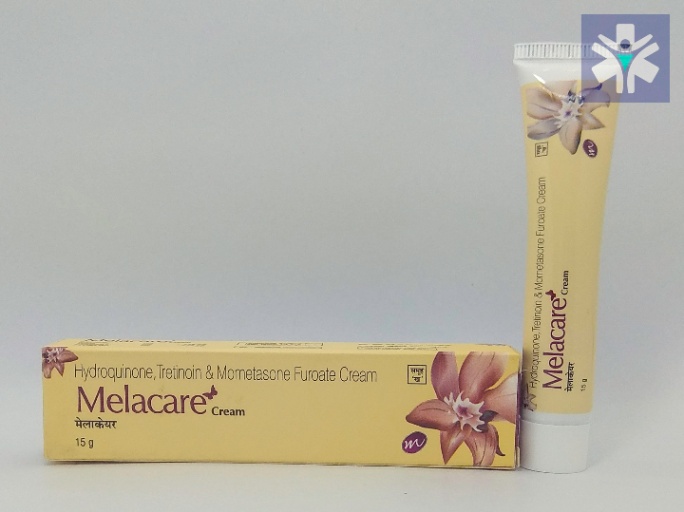
MELACARE
Price: Rs.250.00
10% off
In stock
Loose stock: 0
Description
MELACARE CREAM 15GM
Details
Composition
HYDROQUINONE 2 % W/W,MOMETASONE FUROATE 0.1 % W/W,TRETINOIN 0.025 % W/W
# HYDROQUINONE 2% W/W + MOMETASONE FUROATE 0.1% W/W + TRETINOIN 0.025% W/W
## Short Description
**Hydroquinone 2% + Mometasone Furoate 0.1% + Tretinoin 0.025%** is a topical combination containing a **skin-lightening agent, retinoid, and corticosteroid**. It may be prescribed for certain types of **facial hyperpigmentation**, particularly melasma, under medical supervision.
* **Hydroquinone** reduces the production of melanin (skin pigment).
* **Tretinoin** promotes skin-cell turnover and can improve penetration of hydroquinone.
* **Mometasone** reduces inflammation and irritation.
> **Important:** Because this combination contains a topical corticosteroid, it should generally be used **only under medical supervision and for a limited duration**. Prolonged or inappropriate use can cause significant skin damage.
## Key Benefits
* Helps reduce the appearance of **dark patches and hyperpigmentation**.
* May be prescribed for **melasma** and other selected pigmentary disorders.
* Hydroquinone helps reduce excessive melanin production.
* Tretinoin promotes skin-cell turnover and can improve the appearance of uneven pigmentation.
* Mometasone can reduce inflammation and irritation associated with the treatment.
* May help create a more **even-looking skin tone** when appropriately prescribed.
* The combination targets pigmentation through complementary mechanisms.
## Uses / Indications
This combination may be prescribed for:
* **Melasma**.
* Certain forms of facial hyperpigmentation.
* Dark patches associated with excessive melanin production.
* Other pigmentary conditions when specifically diagnosed and treated by a healthcare professional.
### Important
It is **not a general-purpose fairness or skin-whitening cream** and should not be used indiscriminately.
The diagnosis of the pigmentation should be established before treatment because dark patches can have many different causes.
## How It Works
### Hydroquinone 2%
Hydroquinone is a **depigmenting agent**.
It inhibits **tyrosinase**, an enzyme involved in melanin production. This reduces the formation of new melanin and gradually helps lighten areas of excessive pigmentation.
### Tretinoin 0.025%
Tretinoin is a **topical retinoid** derived from vitamin A.
It promotes skin-cell turnover and helps normalize the distribution of pigment within the skin. It may also improve penetration of hydroquinone into the skin.
### Mometasone Furoate 0.1%
Mometasone is a **topical corticosteroid** that reduces inflammatory reactions in the skin.
It may help minimize treatment-related irritation, but it also carries significant risks when used excessively or for prolonged periods.
### Combined Action
**Hydroquinone → reduces melanin production**
**Tretinoin → increases skin-cell turnover**
**Mometasone → reduces inflammation**
Together, these ingredients can provide a more comprehensive approach to selected cases of hyperpigmentation.
## Dosage & Administration
The exact treatment regimen should be determined by a **qualified healthcare professional**.
A commonly prescribed approach for facial hyperpigmentation is:
* Apply a **very thin layer** to the affected pigmented areas, usually once daily in the evening.
* Apply to clean, completely dry skin.
* Avoid applying immediately after washing if the skin is irritated.
* Wash hands before and after application.
* Avoid the eyes, lips, nostrils, and other mucous membranes.
* Do not apply to broken, sunburned, irritated, or infected skin.
* Use only the amount prescribed.
### Sun Protection
**Daily broad-spectrum sunscreen is essential.**
Use a suitable **broad-spectrum SPF 30 or higher** and minimize unnecessary sun exposure. Sun exposure can worsen melasma and counteract treatment.
### Treatment Duration
Because the product contains **mometasone**, prolonged continuous use should generally be avoided.
Your healthcare professional may recommend:
* A limited treatment course.
* Intermittent treatment.
* A maintenance treatment without the corticosteroid component.
Do not continue treatment indefinitely just because pigmentation remains.
### Missed Application
Apply the next dose at the usual time. **Do not apply extra cream to compensate for a missed application.**
## Side Effects
Common side effects may include:
* Mild redness.
* Dryness.
* Peeling.
* Burning or stinging.
* Mild irritation.
* Increased sensitivity to sunlight.
These effects may be more noticeable during the first few weeks of treatment.
### Hydroquinone-Related Effects
Prolonged or inappropriate use may cause:
* Irritant dermatitis.
* Allergic contact dermatitis.
* Uneven pigmentation.
* Bluish-black or dark discoloration called **exogenous ochronosis**, particularly with prolonged use.
### Tretinoin-Related Effects
Tretinoin may cause:
* Dryness.
* Peeling.
* Redness.
* Burning.
* Increased sensitivity to sunlight.
* Temporary worsening of irritation.
### Mometasone-Related Effects
Long-term or excessive corticosteroid use can cause:
* Skin thinning.
* Stretch marks.
* Visible small blood vessels.
* Acne or steroid-related acne-like eruptions.
* Perioral dermatitis.
* Changes in pigmentation.
* Increased susceptibility to skin infections.
* Delayed wound healing.
### Seek Medical Attention If
Contact a healthcare professional if you develop:
* Severe burning or irritation.
* Facial swelling.
* Severe rash.
* Significant skin discoloration.
* Persistent worsening of the treated area.
* Signs of infection.
* Severe allergic symptoms.
## Precautions & Warnings
### For External Use Only
Do not swallow the medicine.
Avoid contact with:
* Eyes.
* Lips.
* Mouth.
* Inside the nose.
* Other mucous membranes.
### Avoid Prolonged Steroid Use
Mometasone is a corticosteroid and should not be used continuously for long periods without medical supervision.
Prolonged use on the face can cause **skin thinning, visible blood vessels, acne, and other steroid-related complications**.
### Sun Exposure
The skin may become more sensitive to sunlight because of tretinoin, while UV exposure can worsen pigmentation.
Use sunscreen every day and minimize direct sun exposure.
### Avoid Irritating Skin Products
Unless advised otherwise, avoid combining this treatment with potentially irritating products such as:
* Strong exfoliating acids.
* Harsh scrubs.
* Alcohol-based irritants.
* Other retinoids.
* Strong acne treatments.
### Broken or Irritated Skin
Do not apply to severely irritated, sunburned, infected, or broken skin unless specifically instructed.
### Pregnancy
**Tretinoin is generally avoided during pregnancy.** Tell your healthcare professional if you are pregnant, planning pregnancy, or become pregnant while using this medicine.
### Breastfeeding
Discuss use with your healthcare professional. Avoid applying the medicine to areas that could come into direct contact with an infant, particularly the breast/nipple area.
### Children
This combination should generally not be used in children unless specifically prescribed and monitored by a healthcare professional.
## Drug Interactions
Because this is a topical preparation, systemic drug interactions are generally less likely than with oral medicines. However, interactions and additive skin irritation can occur.
### Other Topical Retinoids
Using tretinoin with another topical retinoid may significantly increase irritation.
### Other Skin-Lightening Products
Combining hydroquinone with other depigmenting agents may increase irritation or unwanted pigmentation changes.
### Benzoyl Peroxide
Benzoyl peroxide can increase skin irritation when combined with tretinoin. In some formulations, it may also temporarily affect tretinoin activity. Use only according to professional advice.
### Exfoliating Products
Products containing strong acids, abrasive scrubs, or peeling agents may increase irritation.
### Other Corticosteroids
Using additional topical corticosteroids on the same area can increase the risk of **skin thinning and other steroid-related effects**.
Tell your doctor or pharmacist about all medicines, skincare products, supplements, and herbal products you use.
## Storage Information
* Store according to the manufacturer's instructions.
* Generally keep at controlled room temperature.
* Protect from excessive heat and direct sunlight.
* Keep the tube/container tightly closed.
* Keep away from moisture.
* Keep out of reach of children.
* Do not freeze unless specifically instructed.
* Do not use after the expiry date.
* Do not use if the packaging or tube is damaged or contaminated.
## Prescription Status
**Hydroquinone 2% + Mometasone Furoate 0.1% + Tretinoin 0.025% is generally considered a prescription medicine or prescription-supervised treatment**, although regulatory status varies between countries and formulations.
Because it contains a **topical corticosteroid and tretinoin**, medical supervision is recommended.
## Genuine Medicine Assurance
When purchasing this combination, obtain it from a **licensed pharmacy or authorized medicine supplier**.
Before using the product, verify:
* Correct active ingredients and strengths.
* Manufacturer information.
* Batch/lot number.
* Manufacturing and expiry dates.
* Intact packaging and seal.
* Clear labeling and application instructions.
Do not use the product if the packaging appears damaged, tampered with, incorrectly labeled, or suspicious.
## Frequently Asked Questions (FAQ)
### 1. What is Hydroquinone 2% + Mometasone 0.1% + Tretinoin 0.025% used for?
It may be prescribed for **melasma and selected forms of facial hyperpigmentation**. It is intended for short-term, medically supervised use rather than general skin whitening.
### 2. How does hydroquinone lighten dark spots?
Hydroquinone inhibits **tyrosinase**, an enzyme involved in melanin production. This reduces the formation of pigment over time.
### 3. What does tretinoin do in this combination?
Tretinoin increases **skin-cell turnover** and helps improve the distribution of pigment. It can also enhance the penetration of hydroquinone.
### 4. Why is mometasone included?
Mometasone reduces **skin inflammation and irritation**. However, because it is a corticosteroid, prolonged use can cause skin damage.
### 5. Can this cream permanently cure melasma?
Melasma can be a chronic, recurring condition. Treatment can improve pigmentation, but **recurrence is possible**, especially with sun exposure or hormonal triggers.
### 6. How long does it take to see results?
Improvement varies between individuals. Pigmentation may gradually improve over **several weeks**, but treatment duration should be determined by a healthcare professional.
### 7. Can I use this cream every night indefinitely?
No. The presence of **mometasone** makes prolonged unsupervised use inappropriate. Your healthcare professional should determine the duration and whether a steroid-free maintenance treatment is needed.
### 8. Can this cream be used for acne?
It is not primarily an acne treatment. Although tretinoin is used for acne, the combination also contains hydroquinone and a corticosteroid, so it should not be used for acne unless specifically prescribed.
### 9. Can I use this cream on my entire face?
Only use it in the manner directed by your healthcare professional. For pigmentation, treatment is generally targeted to affected areas rather than indiscriminately covering the entire face.
### 10. Can I use it under my eyes?
The skin around the eyes is very thin and sensitive. **Do not apply near the eyes unless specifically instructed by a healthcare professional.**
### 11. Can I use this cream during the day?
Many treatment regimens use this combination **in the evening**, particularly because tretinoin can increase sensitivity to sunlight. Follow the prescribed instructions.
### 12. Do I need sunscreen while using this cream?
Yes. **Daily broad-spectrum sunscreen is essential.** Sun exposure can worsen melasma and reduce the effectiveness of pigmentation treatment.
### 13. Can I use vitamin C with this cream?
Vitamin C skincare products may sometimes be incorporated into a pigmentation regimen, but combining multiple active ingredients can increase irritation. Introduce additional products only with appropriate professional advice.
### 14. Can I use other exfoliating acids with this cream?
Strong exfoliating acids can increase irritation when used with tretinoin. Discuss your skincare routine with a healthcare professional before combining them.
### 15. Can this cream cause skin thinning?
Yes. **Mometasone can cause skin thinning**, particularly when used for prolonged periods, on the face, under occlusion, or in excessive amounts.
### 16. Can hydroquinone make skin darker?
Inappropriate or prolonged hydroquinone use can rarely cause **exogenous ochronosis**, a persistent dark or blue-black discoloration of the skin.
### 17. Is redness or peeling normal?
Mild redness, dryness, and peeling can occur, particularly because of tretinoin. Severe or persistent irritation should be discussed with your healthcare professional.
### 18. Can I use this cream if I have sensitive skin?
Sensitive skin may be more prone to irritation. A healthcare professional may recommend a gradual or modified treatment approach.
### 19. Can I use this cream during pregnancy?
Because it contains **tretinoin**, this combination is generally avoided during pregnancy. Tell your healthcare professional if you are pregnant or planning pregnancy.
### 20. Can I use it while breastfeeding?
Discuss treatment with your healthcare professional. Do not apply it to the breast or nipple area where the infant could ingest the product.
### 21. Can men use this cream?
Yes, when medically appropriate. Hyperpigmentation and melasma can occur in men as well, but the cause of pigmentation should be diagnosed before treatment.
### 22. Can I use this cream for dark spots caused by acne?
A healthcare professional may prescribe pigmentation treatment for **post-inflammatory hyperpigmentation**, but this particular combination should not be self-used because of its corticosteroid component.
### 23. What happens if I apply too much?
Excessive application can increase irritation and corticosteroid-related adverse effects. Gently remove excess product if appropriate and follow your healthcare professional's instructions.
### 24. Is Hydroquinone + Mometasone + Tretinoin available without a prescription?
The regulatory status varies by country, but combinations containing **tretinoin and a corticosteroid are generally prescription or medically supervised treatments**.
### 25. What should I do if my pigmentation gets worse?
Stop self-treatment and consult a dermatologist or other qualified healthcare professional. Worsening pigmentation can sometimes indicate irritation, an incorrect diagnosis, or a treatment-related complication.
## Medical Disclaimer
This information about **Hydroquinone 2% w/w + Mometasone Furoate 0.1% w/w + Tretinoin 0.025% w/w** is provided for general educational and informational purposes only. It is not a substitute for professional medical advice, diagnosis, or treatment.
This combination contains **hydroquinone, tretinoin, and a topical corticosteroid** and should be used only as directed by a qualified healthcare professional. Prolonged or inappropriate use, particularly on the face, can cause **skin thinning, irritation, acne-like eruptions, pigmentary changes, and other complications**.
Avoid unnecessary sun exposure and use appropriate broad-spectrum sunscreen during treatment. **Tretinoin-containing products are generally avoided during pregnancy.** Seek professional medical advice if severe irritation, swelling, unusual discoloration, infection, or other concerning skin changes develop.