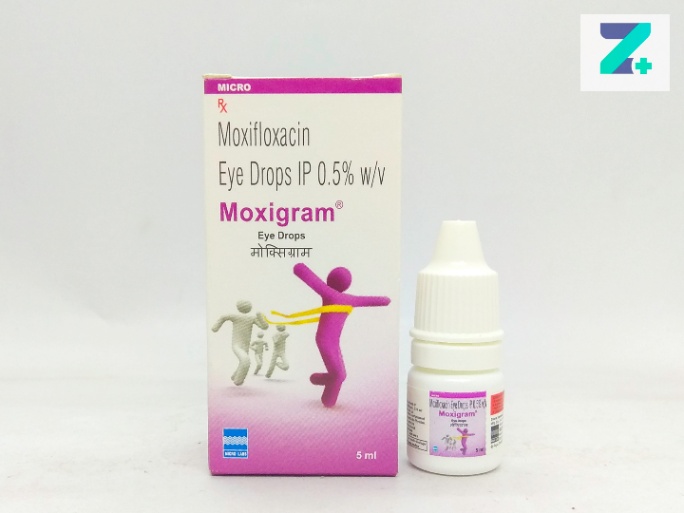
MOXIGRAM
Price: Rs.328.48
10% off
In stock
Loose stock: 0
Description
MOXIGRAM EYE DROPS 5ML
Details
Composition
MOXIFLOXACIN 0.5 %
# MOXIFLOXACIN 0.5%
## SHORT DESCRIPTION
**Moxifloxacin 0.5%** is a **fluoroquinolone antibiotic ophthalmic medicine** used to treat certain bacterial infections of the eye. It works by inhibiting bacterial enzymes required for DNA replication and repair, helping eliminate susceptible bacteria.
Moxifloxacin 0.5% eye drops are commonly used for **bacterial conjunctivitis** and other susceptible superficial ocular infections, depending on the specific product labeling.
> **Important:** Moxifloxacin ophthalmic is intended for bacterial eye infections. It does not treat viral or fungal eye infections.
---
## KEY BENEFITS
* Helps treat **susceptible bacterial eye infections**.
* Provides broad-spectrum antibacterial activity.
* May help reduce eye redness, discharge, irritation, and discomfort caused by bacterial infection.
* Works directly at the site of ocular infection.
* Convenient topical ophthalmic formulation.
* Can help prevent bacterial infection from worsening when appropriately prescribed.
---
## USES / INDICATIONS
Moxifloxacin 0.5% ophthalmic solution may be prescribed for:
1. **Bacterial conjunctivitis**.
2. Certain susceptible superficial bacterial infections of the eye.
3. Other ocular bacterial infections when specifically recommended by an ophthalmologist or healthcare professional.
The approved indications may vary by country and formulation.
> Moxifloxacin eye drops should not be used for unexplained eye redness without appropriate medical assessment, particularly when symptoms are severe.
---
## HOW IT WORKS
Moxifloxacin belongs to the **fluoroquinolone antibiotic** class.
It inhibits two bacterial enzymes:
* **DNA gyrase**
* **Topoisomerase IV**
These enzymes are essential for bacterial DNA replication, repair, and reproduction.
By blocking these enzymes, moxifloxacin interferes with bacterial growth and causes the death of susceptible bacteria.
---
## DOSAGE & ADMINISTRATION
### Adults
For bacterial conjunctivitis, a commonly used regimen for **moxifloxacin 0.5% ophthalmic solution** is:
**1 drop in the affected eye(s) 3 times daily for approximately 7 days**, or according to the prescribing healthcare professional and specific product labeling.
### How to Apply Eye Drops
1. Wash your hands thoroughly.
2. Remove contact lenses before applying the drops.
3. Tilt your head back and gently pull down the lower eyelid.
4. Place the prescribed number of drops into the affected eye.
5. Avoid touching the eye, eyelashes, or eyelid with the dropper tip.
6. Close the eye gently after application.
7. Wash your hands again if necessary.
If using more than one eye medication, ask your healthcare professional about appropriate spacing between products.
### Contact Lenses
Do not wear contact lenses while you have an active bacterial eye infection unless your eye-care professional specifically advises otherwise.
If your product contains a preservative such as benzalkonium chloride, contact lenses may need to be removed before administration and replaced only after the recommended interval.
### Missed Dose
Apply the missed dose when remembered unless it is almost time for the next dose.
**Do not use extra drops to make up for a missed dose.**
---
## SIDE EFFECTS
### Common Side Effects
Possible side effects include:
* Temporary eye irritation
* Burning or stinging
* Eye discomfort
* Dry eyes
* Itching
* Redness
* Watery eyes
* Temporary blurred vision
These effects are generally mild and short-lasting.
### Serious Side Effects
Stop using the medicine and seek urgent medical attention if you develop:
* Severe eye pain
* Significant swelling
* Severe redness or worsening inflammation
* Sudden vision changes
* Severe allergic reaction
* Swelling of the face, lips, tongue, or throat
* Difficulty breathing
Persistent or worsening eye symptoms should be evaluated by an eye-care professional.
---
## PRECAUTIONS & WARNINGS
### Correct Diagnosis
Moxifloxacin is an antibiotic and should be used when a **bacterial infection is suspected or confirmed**.
It is not effective against:
* Viral conjunctivitis
* Fungal eye infections
* Allergic conjunctivitis
### Eye Pain or Vision Changes
Seek prompt medical evaluation if eye redness is associated with:
* Severe pain
* Light sensitivity
* Significant vision loss or changes
* Eye trauma
* Severe swelling
* A foreign body in the eye
These symptoms may indicate a condition requiring different treatment.
### Allergic Reactions
Discontinue treatment and seek medical attention if signs of a serious allergic reaction occur.
### Prolonged Use
Prolonged or inappropriate antibiotic use may allow resistant organisms or fungal infections to develop.
Use moxifloxacin only for the prescribed duration.
### Pregnancy & Breastfeeding
Tell your healthcare professional if you are pregnant, planning pregnancy, or breastfeeding before using moxifloxacin ophthalmic products.
---
## DRUG INTERACTIONS
Because moxifloxacin eye drops are applied locally, **systemic drug interactions are generally less likely** than with oral moxifloxacin.
However:
* Tell your doctor about all medicines you use.
* If using multiple ophthalmic medicines, separate their administration according to medical advice.
* Avoid using other antibiotic or steroid eye drops unless recommended by an eye-care professional.
* Systemic absorption can occur in small amounts, so relevant medical history and concurrent medicines should still be considered.
Do not add another eye medicine simply because symptoms do not improve.
---
## STORAGE INFORMATION
* Store according to the manufacturer's instructions, generally at **room temperature**.
* Protect from excessive heat and direct sunlight.
* Keep the bottle tightly closed when not in use.
* Do not touch the dropper tip to the eye, eyelids, fingers, or other surfaces.
* Keep out of reach and sight of children.
* Do not use after the expiry date.
* Discard the bottle according to the manufacturer's instructions after opening.
---
## PRESCRIPTION STATUS
**Prescription status varies by country and formulation.**
Moxifloxacin 0.5% ophthalmic solution is commonly supplied as a **prescription antibiotic** and should preferably be used under the direction of a healthcare professional.
---
## GENUINE MEDICINE ASSURANCE
When purchasing **Moxifloxacin 0.5% eye drops**, obtain the medicine from a **licensed pharmacy or authorized medicine supplier**.
Before use, verify:
* Medicine name and concentration
* Active ingredient
* Manufacturer information
* Batch/lot number
* Manufacturing and expiry dates
* Bottle and seal integrity
* Regulatory information
* Product appearance and labeling
Do not use eye drops if the bottle is damaged, the seal is broken, the solution appears unusually cloudy or contaminated, or the product has expired.
---
# FAQ – MOXIFLOXACIN 0.5% EYE DROPS
### 1. What is Moxifloxacin 0.5% used for?
Moxifloxacin 0.5% eye drops are used to treat **certain bacterial eye infections**, particularly bacterial conjunctivitis caused by susceptible bacteria.
### 2. Is Moxifloxacin 0.5% an antibiotic?
Yes. Moxifloxacin is a **fluoroquinolone antibiotic**.
### 3. How does Moxifloxacin eye drops work?
It blocks bacterial **DNA gyrase and topoisomerase IV**, enzymes necessary for bacterial DNA replication and repair.
### 4. Can Moxifloxacin eye drops treat conjunctivitis?
Yes. Moxifloxacin ophthalmic solution may be prescribed for **bacterial conjunctivitis**.
### 5. Can Moxifloxacin treat viral conjunctivitis?
**No.** Moxifloxacin is an antibiotic and does not treat viral conjunctivitis.
### 6. Can Moxifloxacin eye drops treat fungal eye infections?
No. Moxifloxacin is not an antifungal medicine and should not be used to treat fungal eye infections.
### 7. How often should Moxifloxacin 0.5% eye drops be used?
A commonly used regimen for bacterial conjunctivitis is **one drop three times daily for about 7 days**, but follow the exact instructions provided by your healthcare professional and the product label.
### 8. Can I wear contact lenses while using Moxifloxacin eye drops?
It is generally recommended to **avoid contact lenses during an active eye infection**. If contact lenses are worn, follow your eye-care professional's instructions regarding removal and replacement.
### 9. What are the common side effects of Moxifloxacin eye drops?
Common effects may include **temporary burning, stinging, irritation, redness, itching, dry eyes, watery eyes, or blurred vision**.
### 10. Can Moxifloxacin eye drops cause blurred vision?
Temporary blurred vision can occur immediately after applying eye drops. If blurred vision is persistent, severe, or associated with pain, seek medical evaluation.
### 11. Can Moxifloxacin eye drops be used in children?
Moxifloxacin ophthalmic products may be prescribed for children depending on the specific product and clinical situation. Follow pediatric dosing instructions from a healthcare professional.
### 12. Can Moxifloxacin eye drops be used during pregnancy?
Tell your healthcare professional if you are pregnant or planning pregnancy. They can determine whether the expected benefits justify use.
### 13. Can Moxifloxacin eye drops be used while breastfeeding?
Consult your healthcare professional before use during breastfeeding.
### 14. Can I use Moxifloxacin eye drops with other eye drops?
They may sometimes be used with other ophthalmic medicines, but appropriate spacing may be necessary. Ask your doctor or pharmacist about the correct administration schedule.
### 15. Can I use Moxifloxacin eye drops for eye redness?
Only when bacterial infection is suspected or diagnosed. Eye redness can have many causes, including **viral infection, allergies, dry eye, injury, glaucoma, or other eye conditions**.
### 16. How long does Moxifloxacin take to work?
Symptoms of bacterial conjunctivitis may begin improving within a few days, but the response varies. Complete the prescribed course even if symptoms improve unless your healthcare professional advises otherwise.
### 17. Can I stop Moxifloxacin eye drops when my eye feels better?
Follow the prescribed treatment duration. Stopping treatment too early may contribute to persistence or recurrence of infection.
### 18. What should I do if I miss a dose?
Apply the missed dose when remembered unless it is nearly time for the next dose. **Do not use extra drops to compensate.**
### 19. What should I do if I accidentally put too many drops in my eye?
A small excess amount is generally unlikely to cause serious harm, but it may cause temporary irritation or blurred vision. Rinse with clean water if needed and contact a healthcare professional if significant symptoms develop.
### 20. When should I see a doctor for an eye infection?
Seek prompt medical attention for **severe eye pain, significant vision changes, marked light sensitivity, severe swelling, eye injury, worsening symptoms, or symptoms that do not improve with treatment**.
---
## MEDICAL DISCLAIMER
This information about **Moxifloxacin 0.5% ophthalmic solution** is provided for general educational and informational purposes only. It does not replace professional medical advice, diagnosis, or treatment.
Moxifloxacin eye drops should be used only for appropriate **bacterial eye infections** and according to the prescribed dose and duration. They are not effective against viral or fungal eye infections.
Eye pain, significant vision changes, severe redness, light sensitivity, or eye trauma can indicate a potentially serious condition requiring prompt examination. Do not use leftover antibiotics or share eye drops with another person.