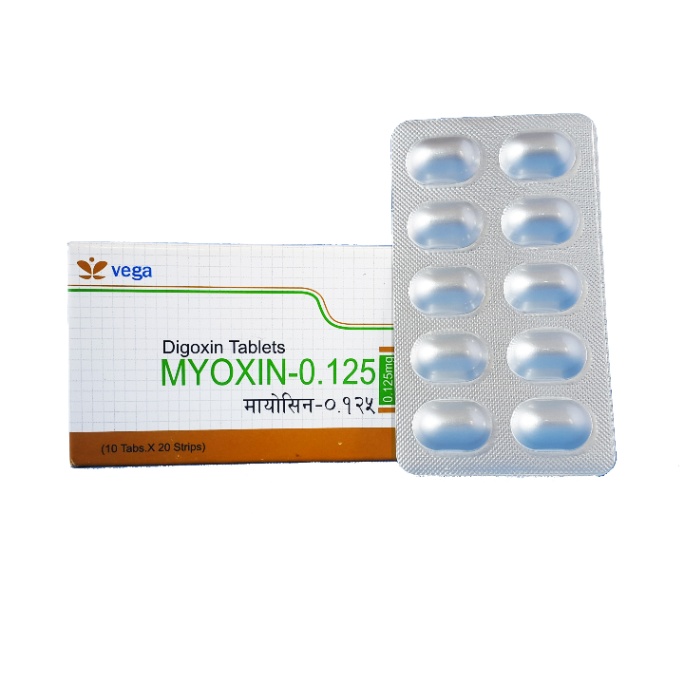
MYOXIN 0.125MG
Price: Rs.20.00
10% off
In stock
Loose stock: 0
Description
MYOXIN 0.125MG TAB 10
Details
Composition
DIGOXIN 0.25 MG
# DIGOXIN 0.25 MG
## Short Description
**Digoxin 0.25 mg** is a prescription **cardiac glycoside** used for certain heart conditions. It can help control the heart rate in some patients with **atrial fibrillation or atrial flutter** and may be used as part of treatment for **heart failure with reduced ejection fraction (HFrEF)** in selected patients.
Digoxin has a **narrow therapeutic index**, meaning the difference between an effective dose and a toxic dose can be relatively small. The dose must therefore be individualized, particularly according to kidney function, age, body size, electrolyte levels, and other medicines.
> **Important:** Digoxin 0.25 mg is a relatively strong tablet strength and is **not necessarily the appropriate dose for every patient**. Never change the dose without medical supervision.
---
## Key Benefits
* Helps **slow the ventricular heart rate** in certain patients with atrial fibrillation or atrial flutter.
* Can improve symptoms in selected patients with **heart failure**.
* Increases the strength of heart muscle contraction.
* May help reduce symptoms such as breathlessness and fatigue in appropriately selected heart-failure patients.
* Can be useful when additional heart-rate control is required alongside other medicines.
* Has a relatively long duration of action, allowing convenient dosing in appropriate patients.
---
## Uses / Indications
### 1. Atrial Fibrillation
Digoxin may be used to help control the **ventricular rate** in patients with atrial fibrillation.
It is particularly useful in some patients when rate control is required and may be combined with other rate-controlling medicines under medical supervision.
### 2. Atrial Flutter
Digoxin may also be used for ventricular rate control in certain patients with atrial flutter.
### 3. Heart Failure
Digoxin may be used as an additional treatment for selected patients with **heart failure with reduced ejection fraction (HFrEF)**.
It may help:
* Improve symptoms
* Improve exercise tolerance
* Reduce hospitalizations in selected patients
Digoxin does **not replace evidence-based heart-failure medicines** such as those specifically prescribed to improve long-term outcomes.
---
## How It Works
Digoxin has two major cardiovascular effects.
### Positive Inotropic Effect
Digoxin inhibits the **sodium-potassium ATPase (Na⁺/K⁺-ATPase)** pump in cardiac cells.
This increases intracellular sodium, which indirectly increases intracellular calcium. The increased calcium availability strengthens **cardiac muscle contraction**.
### Heart-Rate Control
Digoxin also increases **vagal (parasympathetic) activity** and slows conduction through the **atrioventricular (AV) node**.
This can reduce the number of atrial impulses reaching the ventricles and therefore help slow the ventricular heart rate, particularly in atrial fibrillation.
---
## Dosage & Administration
**Take Digoxin 0.25 mg exactly as prescribed by your doctor.**
Because digoxin has a narrow therapeutic range, dosing must be individualized.
### General Administration
* Take the medicine at approximately the same time each day.
* Swallow the tablet with water.
* It can generally be taken with or without food.
* Avoid changing brands or formulations without informing your healthcare professional.
* Take exactly the prescribed amount.
### Dose Selection
The appropriate dose depends on:
* Kidney function
* Age
* Body weight
* Heart condition
* Electrolyte levels
* Other medicines
* Previous digoxin exposure
Older adults and people with impaired kidney function often require **lower doses**.
### Blood-Level Monitoring
Your doctor may order a **serum digoxin concentration** when clinically appropriate, particularly if:
* Toxicity is suspected
* Kidney function changes
* The dose is changed
* Interacting medicines are started
* The clinical response is unexpected
Blood samples are generally taken at an appropriate interval after a dose because levels can vary depending on the timing of sampling.
### Missed Dose
If you miss a dose:
* Take it when remembered if there is sufficient time before the next dose.
* If it is nearly time for the next dose, skip the missed dose.
* **Do not double the dose.**
### Do Not Stop Without Medical Advice
Do not discontinue digoxin without consulting your doctor, particularly when it is being used for heart failure or heart-rate control.
---
## Side Effects
### Common Side Effects
Possible side effects include:
* Nausea
* Vomiting
* Diarrhea
* Loss of appetite
* Abdominal discomfort
* Headache
* Dizziness
* Fatigue
### Signs of Digoxin Toxicity
Because digoxin has a narrow therapeutic index, toxicity is particularly important to recognize.
Possible symptoms include:
* Nausea or repeated vomiting
* Loss of appetite
* Abdominal pain
* Diarrhea
* Weakness
* Confusion
* Dizziness
* Visual disturbances
* Blurred vision
* Changes in color perception
* Abnormal heart rhythms
* Very slow or very fast heartbeat
### Serious Side Effects
Seek urgent medical attention if you experience:
* Fainting
* Severe dizziness
* Palpitations
* New or worsening irregular heartbeat
* Severe weakness
* Confusion
* Significant visual changes
* Suspected overdose
Digoxin toxicity can cause **potentially life-threatening cardiac arrhythmias**.
---
## Precautions & Warnings
* Digoxin has a **narrow therapeutic index**.
* Never increase the dose without medical advice.
* Tell your doctor if you have **kidney disease**.
* Older adults may be more susceptible to toxicity.
* Low potassium levels (**hypokalemia**) can increase the risk of digoxin toxicity.
* Low magnesium levels (**hypomagnesemia**) can also increase toxicity risk.
* High calcium levels (**hypercalcemia**) may increase the risk of serious cardiac effects.
* Tell your doctor if you have an abnormal heart rhythm or conduction disorder.
* Inform your doctor if you have certain types of heart block or sick sinus syndrome.
* Tell your healthcare professional about all medicines and supplements you take.
* Avoid taking additional digoxin-containing products unless specifically prescribed.
* Seek medical attention if you develop unexplained nausea, vomiting, visual changes, severe weakness, or abnormal heartbeat.
### Kidney Function
Digoxin is eliminated primarily through the kidneys. Reduced kidney function can cause the medicine to accumulate and increase the risk of toxicity.
Regular kidney-function monitoring may therefore be necessary.
---
## Drug Interactions
Digoxin has numerous clinically important drug interactions.
### Amiodarone
Amiodarone can significantly increase digoxin concentrations.
Your doctor may need to reduce the digoxin dose and monitor levels closely.
### Verapamil
Verapamil can increase digoxin concentrations and may further slow the heart rate.
### Diltiazem
Diltiazem may increase digoxin exposure and can have additive effects on heart-rate control.
### Certain Antibiotics
Some antibiotics can increase digoxin concentrations or alter intestinal handling of digoxin.
Examples include certain **macrolide antibiotics**, such as clarithromycin and erythromycin.
### Spironolactone
Spironolactone can affect digoxin concentrations and may also interfere with some laboratory measurements of digoxin.
### Diuretics
Medicines such as:
* Furosemide
* Hydrochlorothiazide
can lower potassium or magnesium levels, potentially increasing the risk of digoxin toxicity.
### Beta-Blockers
Medicines such as:
* Metoprolol
* Atenolol
* Carvedilol
may have additive effects with digoxin on **heart-rate slowing and AV-node conduction**.
### Other Medicines
Other medicines that may interact with digoxin include certain:
* Antiarrhythmics
* Calcium-channel blockers
* Antibiotics
* Antifungals
* Immunosuppressants
* Herbal supplements
Always tell your doctor or pharmacist about every prescription medicine, OTC medicine, vitamin, and herbal supplement you use.
---
## Storage Information
* Store at **room temperature according to the manufacturer's instructions**.
* Keep tablets in their original packaging.
* Protect from excessive heat and moisture.
* Keep away from direct sunlight.
* Keep the container tightly closed.
* Keep out of reach of children.
* Do not use after the expiry date.
* Do not use tablets if the packaging is damaged or the medicine appears abnormal.
> **Keep digoxin securely stored. Accidental ingestion by children can be dangerous or potentially fatal.**
---
## Prescription Status
**Digoxin 0.25 mg is a prescription medicine.**
Because digoxin has a narrow therapeutic index and can cause serious toxicity, it should be used only under appropriate medical supervision.
Prescription requirements may vary by country.
---
## Genuine Medicine Assurance
When purchasing **Digoxin 0.25 mg**, ensure that you:
* Purchase from a **licensed pharmacy or authorized medicine supplier**.
* Verify the generic name and strength.
* Check the manufacturer's name.
* Verify the batch/lot number and expiry date.
* Ensure the packaging and security seal are intact.
* Check the tablet appearance against the manufacturer's information.
* Avoid medicines with suspicious packaging or unusually low prices.
* Do not purchase prescription medicines from unauthorized sellers.
For authenticity assurance, compare the packaging and product information with the manufacturer's official documentation or the relevant national medicines regulatory authority.
---
# FAQ
### 1. What is Digoxin 0.25 mg used for?
Digoxin 0.25 mg is used for certain heart conditions, particularly **heart-rate control in atrial fibrillation or atrial flutter** and as an additional treatment for selected patients with heart failure.
### 2. Is Digoxin a heart medicine?
Yes. Digoxin is a **cardiac glycoside** that affects heart contraction and electrical conduction.
### 3. How does Digoxin work?
Digoxin increases the force of heart contraction and increases vagal activity, which **slows conduction through the AV node** and can reduce ventricular heart rate.
### 4. Is Digoxin a blood thinner?
**No.** Digoxin does not prevent blood clots in the way anticoagulants do. Patients with atrial fibrillation may require a separate anticoagulant depending on their individual stroke risk.
### 5. Does Digoxin lower heart rate?
Yes. Digoxin can slow the heart rate by increasing parasympathetic activity and slowing conduction through the AV node.
### 6. Can Digoxin be used for atrial fibrillation?
Yes. It may be prescribed for **ventricular rate control in atrial fibrillation**, depending on the patient's clinical circumstances.
### 7. Can Digoxin treat heart failure?
Digoxin may be used as an additional treatment for selected patients with **heart failure with reduced ejection fraction**. It does not replace other guideline-directed heart-failure treatments.
### 8. Why does Digoxin require blood tests?
Digoxin has a **narrow therapeutic index**, so blood-level testing may be used when toxicity is suspected, doses change, kidney function changes, or interacting medicines are introduced.
### 9. What are the symptoms of Digoxin toxicity?
Possible symptoms include:
* Nausea
* Vomiting
* Loss of appetite
* Weakness
* Confusion
* Visual changes
* Palpitations
* Slow or irregular heartbeat
Seek urgent medical attention if toxicity is suspected.
### 10. Can Digoxin affect vision?
Yes. Digoxin toxicity can cause **blurred vision or changes in color perception**, among other visual disturbances.
### 11. Can Digoxin cause nausea?
Yes. Nausea, vomiting, and loss of appetite can occur and may also be signs of excessive digoxin exposure.
### 12. Can kidney disease affect Digoxin treatment?
Yes. Kidney impairment can cause digoxin to accumulate because it is primarily eliminated by the kidneys. Dose adjustment and monitoring may be necessary.
### 13. Does low potassium affect Digoxin?
Yes. **Low potassium can increase the risk of digoxin toxicity.** Certain diuretics can lower potassium levels, so electrolyte monitoring may be important.
### 14. Can I take Digoxin with Furosemide?
The combination may be prescribed, particularly in patients with heart failure, but furosemide can lower potassium and magnesium levels, potentially increasing digoxin toxicity risk. Medical monitoring is important.
### 15. Can Digoxin be taken with Spironolactone?
They can sometimes be prescribed together, but spironolactone may affect digoxin concentrations and laboratory measurements. Your healthcare professional should monitor the combination appropriately.
### 16. Can I drink alcohol while taking Digoxin?
Alcohol may worsen dizziness or other symptoms in some patients and can complicate heart conditions. Discuss alcohol consumption with your healthcare professional.
### 17. What happens if I miss a Digoxin dose?
Take the dose when remembered unless it is close to the next scheduled dose. Skip the missed dose if necessary and **do not double the next dose**.
### 18. Can I stop Digoxin suddenly?
Do not stop digoxin without medical advice. Your doctor should determine whether treatment needs to be continued, adjusted, or discontinued.
### 19. What happens if I take too much Digoxin?
A digoxin overdose can cause **serious and potentially life-threatening toxicity**, including dangerous abnormal heart rhythms. Seek emergency medical attention immediately if an overdose is suspected.
### 20. Is Digoxin 0.25 mg a high dose?
The appropriate dose depends on the individual. **0.25 mg is a commonly available tablet strength, but it may be too high for some patients**, particularly older adults or people with reduced kidney function. Never select or change the dose without medical supervision.
---
## Medical Disclaimer
This information is provided for **educational and informational purposes only** and is not a substitute for professional medical advice, diagnosis, or treatment.
**Digoxin 0.25 mg is a prescription cardiac medicine with a narrow therapeutic index.** The appropriate dose varies according to kidney function, age, body size, electrolyte levels, heart condition, and other medicines.
Digoxin toxicity can be serious or life-threatening. Symptoms such as **persistent nausea or vomiting, loss of appetite, confusion, visual disturbances, severe weakness, fainting, or an irregular heartbeat** require prompt medical evaluation.
Patients taking diuretics or other medicines that affect potassium or magnesium levels may require additional monitoring. Digoxin also has numerous important drug interactions, so healthcare professionals should be informed about all medicines and supplements being taken.
Always follow the **specific manufacturer's package insert and your healthcare professional's instructions**, as approved indications, dosage recommendations, monitoring requirements, contraindications, warnings, and prescription requirements may vary between products and countries.