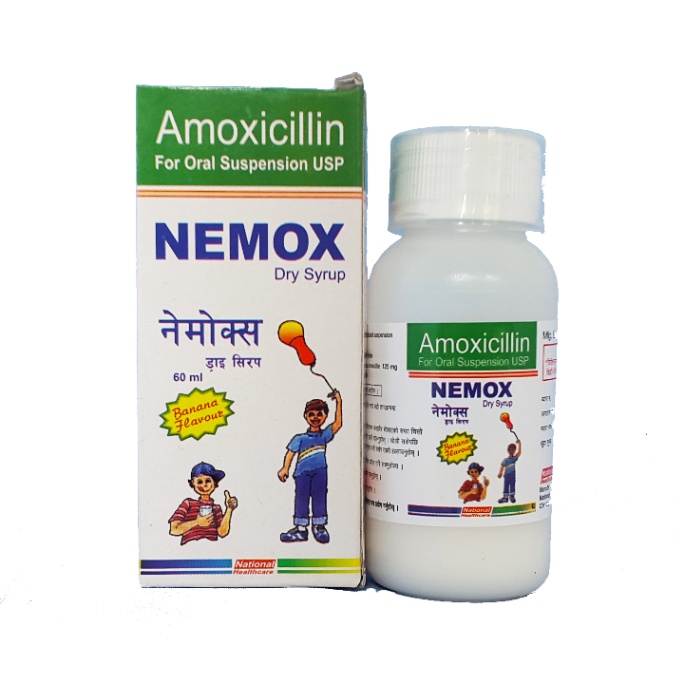
NEMOX
Price: Rs.120.00
10% off
In stock
Loose stock: 0
Description
NEMOX SYR 90ML
Details
Composition
AMOXICILLIN 125 MG
# Amoxicillin 125 mg
## SHORT DESCRIPTION
**Amoxicillin 125 mg** is a **penicillin-type antibiotic** used to treat certain bacterial infections. It works by interfering with bacterial cell-wall formation, which causes susceptible bacteria to die.
It may be prescribed for infections involving the **ears, nose, throat, respiratory tract, skin, urinary tract, and other areas**, depending on the identified or suspected bacteria.
> **Important:** Amoxicillin treats **bacterial infections, not viral infections** such as the common cold or influenza.
---
## KEY BENEFITS
* Effective against many susceptible **bacterial infections**
* Helps treat infections of the **ear, nose, and throat**
* May be used for certain **respiratory tract infections**
* Can treat selected **skin and soft-tissue infections**
* May be prescribed for certain **urinary tract infections**
* Available in pediatric formulations, including **125 mg strength**
* Can be used alone or in specific combination treatment when medically indicated
---
## USES / INDICATIONS
Amoxicillin may be prescribed for susceptible bacterial infections such as:
### Ear, Nose & Throat Infections
* Acute otitis media
* Sinusitis
* Tonsillitis
* Pharyngitis
### Respiratory Tract Infections
* Certain bacterial bronchitis
* Community-acquired pneumonia caused by susceptible organisms
### Dental Infections
Amoxicillin may be used for certain **odontogenic/dental bacterial infections** when clinically appropriate.
### Skin & Soft-Tissue Infections
May be prescribed for susceptible bacterial infections affecting the skin and soft tissues.
### Urinary Tract Infections
May be used for selected urinary tract infections when the causative organism is susceptible.
### Other Indications
Depending on clinical circumstances, amoxicillin may also be used as part of specific combination regimens for **Helicobacter pylori** eradication.
> The appropriate antibiotic depends on the infection, bacterial susceptibility, patient age, kidney function, and local treatment guidelines.
---
## HOW IT WORKS
Amoxicillin is a **beta-lactam antibiotic** belonging to the penicillin group.
It binds to bacterial **penicillin-binding proteins (PBPs)** and interferes with the enzymes responsible for building and maintaining the bacterial cell wall.
This weakens the bacterial cell wall and can cause the bacteria to rupture and die.
**Amoxicillin → binds PBPs → inhibits bacterial cell-wall synthesis → bacterial cell damage → death of susceptible bacteria.**
Because human cells do not have bacterial cell walls, amoxicillin can selectively target bacteria.
---
## DOSAGE & ADMINISTRATION
> **The correct dose depends on the patient's age, weight, kidney function, type of infection, and severity. Use amoxicillin only as prescribed.**
### Amoxicillin 125 mg
A **125 mg strength is commonly used in pediatric formulations**, but the exact dose should be calculated according to the child's weight and infection.
Do **not** assume that 125 mg is an appropriate dose simply based on age.
### General Administration
* Take exactly as prescribed.
* Doses should be spaced evenly throughout the day.
* May generally be taken **with or without food**.
* Taking it at the beginning of a meal may help reduce stomach upset.
* Swallow tablets/capsules with water.
* Complete the prescribed course unless your healthcare professional tells you otherwise.
### Oral Suspension
If using an amoxicillin suspension:
* Shake the bottle well before each dose.
* Measure the dose using an oral syringe or appropriate measuring device.
* Do not use a household teaspoon for accurate dosing.
* Follow the manufacturer's instructions regarding storage after reconstitution.
### Missed Dose
Take the missed dose when remembered unless it is almost time for the next dose.
**Do not take two doses together.**
### Kidney Impairment
Dose adjustment may be necessary in patients with **significant renal impairment**.
---
## SIDE EFFECTS
### Common Side Effects
Possible side effects include:
* Nausea
* Vomiting
* Diarrhea
* Abdominal discomfort
* Mild skin rash
* Headache
### Antibiotic-Associated Diarrhea
Amoxicillin can alter normal intestinal bacteria and may occasionally cause **antibiotic-associated diarrhea**.
Persistent, severe, or bloody diarrhea should be medically evaluated because it can sometimes indicate **Clostridioides difficile-associated diarrhea**.
### Allergic Reactions
Amoxicillin can cause allergic reactions, particularly in people with a history of penicillin allergy.
Seek immediate medical attention for:
* Difficulty breathing
* Wheezing
* Swelling of the face, lips, tongue, or throat
* Severe widespread rash
* Fainting
### Serious Skin Reactions
Rarely, severe skin reactions can occur.
Seek urgent medical care for blistering, peeling skin, extensive rash, or sores involving the mouth or eyes.
---
## PRECAUTIONS & WARNINGS
### Penicillin Allergy
Do not take amoxicillin if you have previously experienced a **serious allergic reaction to penicillin or another beta-lactam antibiotic**, unless specifically evaluated and advised by a healthcare professional.
Tell your doctor about any previous antibiotic allergy.
### Infectious Mononucleosis
Patients with **infectious mononucleosis (glandular fever)** have a higher risk of developing a widespread rash after taking amoxicillin.
Amoxicillin should generally be avoided when infectious mononucleosis is suspected unless specifically advised.
### Kidney Disease
People with impaired kidney function may require a lower dose or adjusted dosing interval.
### Antibiotic Resistance
Using amoxicillin when it is not needed can contribute to **antibiotic resistance**.
Do not use leftover antibiotics or share antibiotics with another person.
### Complete the Prescribed Course
Take the antibiotic for the duration prescribed. Do not routinely stop treatment early simply because symptoms improve unless your healthcare professional advises you to do so.
### Pregnancy
Amoxicillin is commonly used during pregnancy when clinically indicated, but it should be taken under medical supervision.
### Breastfeeding
Amoxicillin generally can be used during breastfeeding when appropriately prescribed, although infants should be monitored for possible diarrhea, rash, or other effects.
---
## DRUG INTERACTIONS
### Warfarin and Other Anticoagulants
Amoxicillin may affect anticoagulation in some patients taking **warfarin**. Additional monitoring may be required.
### Methotrexate
Penicillin antibiotics may reduce the clearance of **methotrexate**, potentially increasing toxicity.
Tell your doctor if you are taking methotrexate.
### Probenecid
Probenecid can reduce renal elimination of amoxicillin and increase its blood concentration.
### Allopurinol
Concurrent use of **allopurinol** may increase the likelihood of skin rash in some patients.
### Oral Contraceptives
Amoxicillin is not generally considered to significantly reduce the effectiveness of hormonal contraception. However, **vomiting or severe diarrhea** can interfere with absorption of oral contraceptive pills.
Follow the contraceptive product's instructions if significant gastrointestinal symptoms occur.
### Other Antibiotics
Combining amoxicillin with other antibiotics should only be done when specifically prescribed.
Always tell your doctor or pharmacist about all prescription medicines, OTC medicines, vitamins, and supplements you take.
---
## STORAGE INFORMATION
### Tablets/Capsules
* Store according to the manufacturer's instructions.
* Keep at room temperature unless the product label specifies otherwise.
* Protect from excessive heat and moisture.
* Keep in the original packaging.
* Keep out of reach of children.
* Do not use after the expiry date.
### Oral Suspension
Storage after reconstitution varies by product.
* Follow the exact instructions printed on the product label.
* Some formulations require refrigeration while others may be stored at room temperature.
* **Do not freeze the suspension.**
* Shake well before each dose.
* Discard the suspension after the manufacturer's specified period.
---
## PRESCRIPTION STATUS
**Amoxicillin 125 mg is generally a prescription antibiotic.**
Prescription and dispensing requirements vary by country.
It should be used under the supervision of a qualified healthcare professional to ensure that an antibiotic is actually required and that the selected dose is appropriate.
---
## GENUINE MEDICINE ASSURANCE
When purchasing **Amoxicillin 125 mg**:
* Buy only from a **licensed pharmacy or authorized medicine supplier**.
* Check the manufacturer's name.
* Verify the medicine name, strength, and dosage form.
* Check the batch/lot number and expiry date.
* Ensure the packaging and seal are intact.
* Do not purchase products with suspicious or altered packaging.
* Do not use expired medicine.
* For liquid formulations, check the appearance and expiry/reconstitution information.
* If you suspect a counterfeit product, consult a pharmacist or contact the manufacturer using the details printed on the packaging.
---
# FAQ – Amoxicillin 125 mg
### 1. What is Amoxicillin 125 mg used for?
Amoxicillin 125 mg is an antibiotic used to treat **susceptible bacterial infections**. It may be prescribed for certain ear, throat, respiratory, skin, dental, and urinary tract infections.
### 2. Is Amoxicillin 125 mg an antibiotic?
Yes. Amoxicillin is a **penicillin-type beta-lactam antibiotic**.
### 3. Does Amoxicillin treat the common cold?
No. The common cold is usually caused by viruses, and **amoxicillin does not treat viral infections**.
### 4. Can Amoxicillin 125 mg treat a cough?
Only if the cough is associated with a **bacterial infection for which amoxicillin is appropriate**. Most coughs caused by viral infections do not require antibiotics.
### 5. Can Amoxicillin treat a sore throat?
It can treat certain bacterial throat infections, such as susceptible **streptococcal infections**, when diagnosed or considered appropriate by a healthcare professional.
### 6. Is Amoxicillin 125 mg suitable for children?
Amoxicillin is commonly prescribed to children, but the dose is usually determined according to **body weight, age, kidney function, and the type/severity of infection**.
### 7. Is 125 mg the correct dose for a child?
Not necessarily. **125 mg is a strength, not a universal pediatric dose.** The prescribed amount and frequency must be determined by a healthcare professional.
### 8. Can Amoxicillin be taken with food?
Yes. Amoxicillin can generally be taken with or without food. Taking it at the beginning of a meal may help reduce stomach upset.
### 9. How often should Amoxicillin 125 mg be taken?
The frequency depends on the infection, age, weight, kidney function, and formulation. Follow the **prescribed dosing schedule** rather than using a standard schedule without medical advice.
### 10. What happens if I miss a dose?
Take the missed dose when remembered unless it is nearly time for the next dose. **Do not double the dose.**
### 11. Can Amoxicillin cause diarrhea?
Yes. Diarrhea is a relatively common antibiotic side effect. Severe, persistent, or bloody diarrhea requires medical evaluation.
### 12. Can Amoxicillin cause a rash?
Yes. A rash can occur. However, a widespread rash accompanied by swelling, breathing difficulty, or other severe symptoms may indicate an allergic reaction and requires urgent medical attention.
### 13. Can I take Amoxicillin if I am allergic to penicillin?
No, not without professional evaluation. People with a history of serious penicillin allergy may be at risk of a potentially severe reaction to amoxicillin.
### 14. Can Amoxicillin be used during pregnancy?
Amoxicillin may be prescribed during pregnancy when clinically indicated. Always consult your healthcare professional before taking an antibiotic during pregnancy.
### 15. Can I take Amoxicillin while breastfeeding?
Amoxicillin is generally considered compatible with breastfeeding when appropriately prescribed. Monitor the infant for diarrhea, rash, or other unusual symptoms and consult a healthcare professional if they occur.
### 16. Can I drink alcohol while taking Amoxicillin?
There is no major direct alcohol interaction comparable to some other antibiotics. However, alcohol may worsen symptoms such as nausea, dizziness, or stomach upset. Avoid excessive alcohol while recovering from an infection.
### 17. Can Amoxicillin treat a tooth infection?
Amoxicillin may be prescribed for certain **bacterial dental infections**, but dental treatment to address the underlying cause is often also necessary.
### 18. Can Amoxicillin treat an ear infection?
Yes, amoxicillin is commonly used for certain **bacterial ear infections**, particularly acute otitis media, when antibiotic treatment is appropriate.
### 19. Can Amoxicillin treat a urinary tract infection?
It can treat some UTIs caused by susceptible bacteria, but resistance is common with certain organisms. The antibiotic should be selected based on clinical assessment and, when appropriate, culture results.
### 20. Can I stop Amoxicillin when I feel better?
Follow the treatment duration prescribed by your healthcare professional. Do not change or stop antibiotic treatment without medical advice.
### 21. Can I use leftover Amoxicillin?
No. Do not use leftover antibiotics for a new illness. The medicine may be inappropriate for the infection, expired, or an incorrect dose.
### 22. Does Amoxicillin kill viruses?
No. Amoxicillin kills or inhibits susceptible **bacteria** and does not treat viruses.
### 23. Can Amoxicillin cause antibiotic resistance?
Improper or unnecessary antibiotic use can contribute to **antibiotic resistance**. Use amoxicillin only when prescribed and exactly as directed.
### 24. Is Amoxicillin 125 mg available without a prescription?
In many countries, amoxicillin is a **prescription-only antibiotic**. Regulations vary by country, but it should be used under professional medical supervision.
### 25. How should Amoxicillin 125 mg suspension be stored?
Storage depends on the specific product. Follow the manufacturer's instructions after reconstitution. Some suspensions require refrigeration, while others can be stored at room temperature. **Do not freeze the suspension.**
---
## MEDICAL DISCLAIMER
This information about **Amoxicillin 125 mg** is provided for educational and informational purposes only. It is **not a substitute for professional medical advice, diagnosis, or treatment**.
Amoxicillin is an antibiotic and should only be used when a bacterial infection is suspected or confirmed and treatment is considered appropriate. It does **not treat viral infections such as the common cold or influenza**.
The appropriate dose, treatment duration, and formulation depend on factors such as the patient's age, body weight, kidney function, infection type, bacterial susceptibility, and local treatment guidelines.
**Do not use amoxicillin if you have a history of serious penicillin allergy unless specifically evaluated by a healthcare professional. Seek urgent medical attention for breathing difficulty, facial or throat swelling, severe allergic reactions, or severe/persistent bloody diarrhea.**
Always follow the **specific product label and the prescription provided by your doctor or pharmacist**.