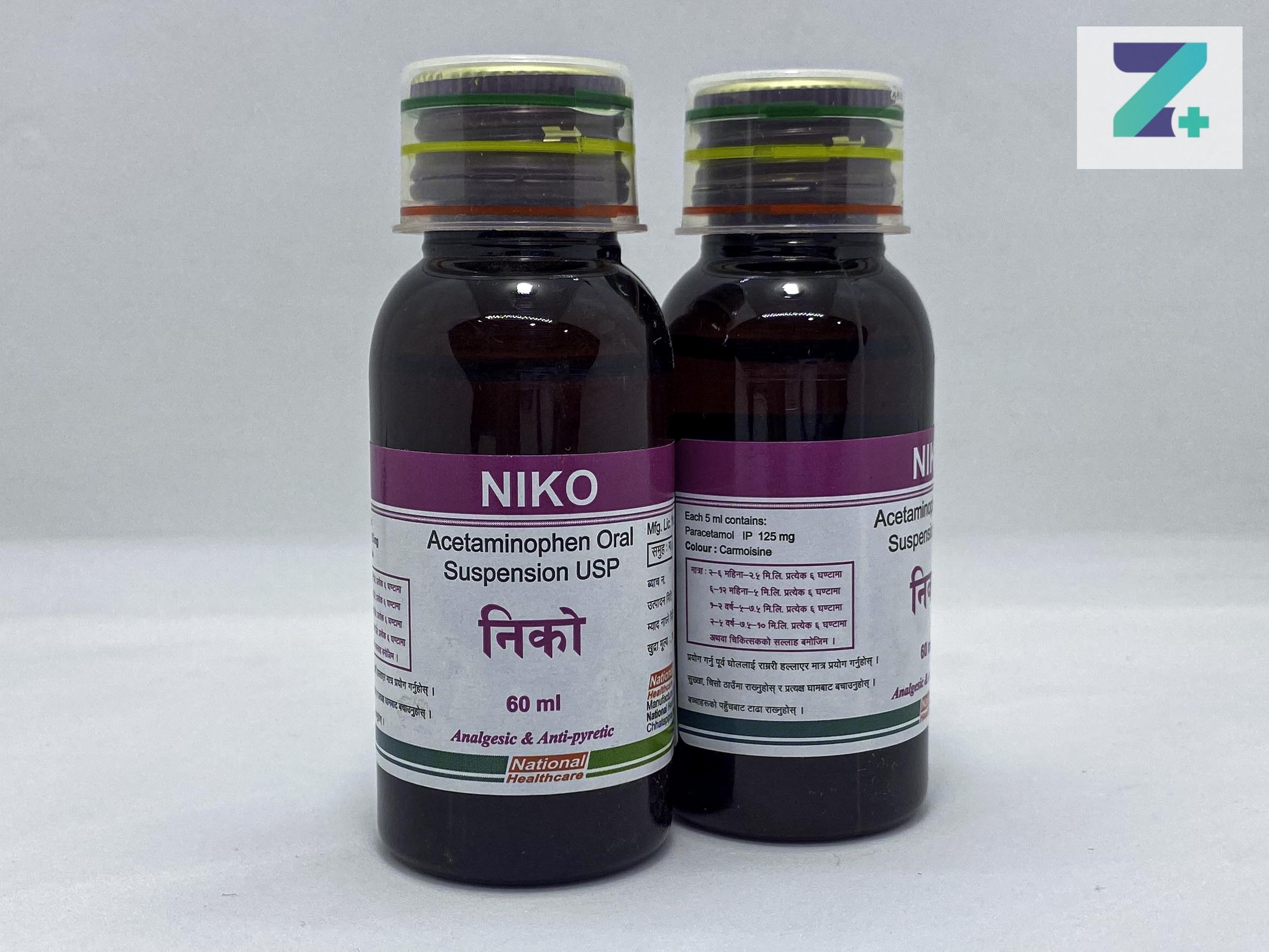
NIKO
Price: Rs.30.00
10% off
In stock
Loose stock: 0
Description
NIKO SYR 60ML
Details
Composition
PARACETAMOL 125 MG
# PARACETAMOL 125 MG
## SHORT DESCRIPTION
**Paracetamol 125 mg** (also known as **acetaminophen**) is a medicine used to reduce **fever** and relieve **mild to moderate pain**. It is commonly available in pediatric formulations, although the appropriate dose depends on the child's **age, weight, formulation, and medical condition**.
Paracetamol does not treat the underlying cause of an infection, but it can help relieve associated fever and pain.
---
## KEY BENEFITS
* Helps reduce **fever**.
* Provides relief from **mild to moderate pain**.
* Commonly used for headaches, toothache, muscle aches, and pain associated with minor illnesses.
* Generally well tolerated when used at the recommended dose.
* Available in formulations suitable for children and adults, depending on the product.
---
## USES / INDICATIONS
Paracetamol 125 mg may be used for:
* **Fever**
* Headache
* Toothache
* Mild muscle aches
* Minor body aches
* Sore throat discomfort
* Pain associated with colds and flu
* Mild pain following minor injuries or procedures
For children, the appropriate dose should be based primarily on **body weight and the specific product formulation**, rather than simply the tablet or liquid strength.
---
## HOW IT WORKS
Paracetamol is an **analgesic (pain reliever)** and **antipyretic (fever reducer)**.
It works mainly by reducing the production of certain chemical messengers involved in pain and temperature regulation in the central nervous system.
**Paracetamol → reduces pain signaling and fever-producing pathways → helps relieve pain and lower elevated body temperature.**
Its anti-inflammatory effects are relatively limited compared with medicines such as ibuprofen.
---
## DOSAGE & ADMINISTRATION
> **Always follow the product label or your healthcare professional's instructions.**
### Children
For children, paracetamol dosing is generally calculated according to **body weight**. A commonly used pediatric dose is approximately **10–15 mg/kg per dose**, with doses separated by appropriate intervals.
The exact maximum daily dose depends on age, weight, formulation, and local prescribing guidance.
**Do not give a child multiple paracetamol-containing medicines at the same time.**
### Adults
A 125 mg strength is usually intended for pediatric dosing, but adults should follow the strength and dose specifically recommended by their healthcare professional.
### How to Take
* Use the measuring device supplied with liquid formulations.
* Do not use a household teaspoon to measure liquid medicine.
* Follow the recommended dosing interval.
* Do not exceed the recommended daily dose.
* Check other medicines for **paracetamol/acetaminophen** before giving another product.
### Missed Dose
Paracetamol is generally taken as needed. If a scheduled dose is missed, give it when remembered if appropriate, while maintaining the recommended interval before the next dose.
**Never give an extra dose to compensate for a missed dose.**
---
## SIDE EFFECTS
Paracetamol is usually well tolerated at recommended doses.
### Common or Mild Side Effects
Occasionally:
* Nausea
* Stomach discomfort
* Mild skin rash
### Serious Side Effects
Serious reactions are uncommon but can include:
* Severe allergic reaction
* Severe skin reactions
* Liver injury, particularly following overdose or prolonged excessive use
Seek urgent medical attention if there is:
* Difficulty breathing
* Swelling of the face, lips, tongue, or throat
* Severe skin rash or blistering
* Yellowing of the skin or eyes
* Severe persistent vomiting
* Severe abdominal pain
### Important Overdose Warning
**Taking too much paracetamol can cause serious and potentially life-threatening liver damage, even if the person initially feels well.**
If an overdose is suspected, seek emergency medical care immediately.
---
## PRECAUTIONS & WARNINGS
### Liver Disease
Tell your healthcare professional if you have **liver disease**, as the safe dose may need adjustment.
### Alcohol
Regular or excessive alcohol consumption can increase the risk of liver injury, particularly when paracetamol is taken in excessive amounts.
### Low Body Weight or Malnutrition
People who are significantly underweight, malnourished, or medically vulnerable may require individualized dosing.
### Multiple Paracetamol Products
Many cold, flu, pain, and fever medicines contain paracetamol.
**Always check the active ingredients to avoid accidental overdose.**
### Children
For children, dose according to **body weight and the specific product instructions**. Never assume that an adult dose is appropriate for a child.
### Prolonged Use
Do not use paracetamol repeatedly for prolonged periods without medical advice, particularly if pain or fever persists.
### Persistent Fever
If a child's fever persists, worsens, or is accompanied by concerning symptoms, seek medical evaluation rather than repeatedly increasing paracetamol doses.
---
## DRUG INTERACTIONS
Tell your doctor or pharmacist about all medicines and supplements being used.
### Other Paracetamol-Containing Medicines
The most important interaction is **duplicate paracetamol use**. Taking multiple products containing paracetamol can result in accidental overdose.
### Warfarin
Regular, prolonged use of paracetamol may affect anticoagulation in people taking **warfarin**. Medical monitoring may be required.
### Certain Medicines Affecting the Liver
Some medicines may increase the risk of liver injury when combined with excessive paracetamol use.
### Enzyme-Inducing Medicines
Certain medicines can affect how paracetamol is metabolized and may increase the risk of toxicity, particularly with excessive dosing.
Always tell your pharmacist about all prescription and non-prescription medicines.
---
## STORAGE INFORMATION
* Store according to the manufacturer's instructions.
* Keep in the original packaging.
* Protect from excessive heat, moisture, and direct sunlight.
* Keep out of reach and sight of children.
* Keep the container tightly closed where applicable.
* For liquid formulations, follow the manufacturer's instructions regarding storage after opening.
* Do not use after the expiry date.
* Do not use a product if its packaging is damaged or tampered with.
---
## PRESCRIPTION STATUS
**Usually an Over-the-Counter Medicine**
Paracetamol is widely available without a prescription in many countries, although prescription requirements can vary according to **strength, formulation, quantity, age group, and local regulations**.
Use pediatric paracetamol according to the product label or advice from a healthcare professional.
---
## GENUINE MEDICINE ASSURANCE
For safe use, purchase **Paracetamol 125 mg** from a licensed pharmacy or authorized medicine supplier.
Before use, check:
* Product name and strength
* Active ingredient
* Manufacturer
* Batch/lot number
* Manufacturing date
* Expiry date
* Packaging and seal
* Regulatory information where applicable
Do not use the product if it is:
* Expired
* Damaged
* Tampered with
* Missing important labeling information
* Unusual in color, appearance, or consistency
Keep medicines securely stored because accidental ingestion by children can result in serious poisoning.
---
# FAQ – PARACETAMOL 125 MG
### 1. What is Paracetamol 125 mg used for?
Paracetamol 125 mg is used to **reduce fever and relieve mild to moderate pain**.
### 2. Is Paracetamol the same as Acetaminophen?
Yes. **Paracetamol and acetaminophen are different names for the same active medicine.**
### 3. Is Paracetamol 125 mg suitable for children?
It may be suitable for children depending on their **weight, age, and the formulation**. Pediatric dosing should follow the product instructions or healthcare professional's advice.
### 4. How much Paracetamol should a child take?
A commonly used pediatric dose is approximately **10–15 mg/kg per dose**, but the appropriate dose and maximum daily amount depend on the child's age, weight, formulation, and local guidance.
### 5. Can Paracetamol 125 mg reduce fever?
Yes. Paracetamol is commonly used to **reduce fever**.
### 6. Does Paracetamol treat infections?
No. Paracetamol can reduce fever and relieve pain, but it **does not treat the underlying bacterial or viral infection**.
### 7. Can Paracetamol be given for a cold?
Yes. It can help relieve fever, headache, sore throat discomfort, and body aches associated with a cold, but it does not cure the cold itself.
### 8. Can Paracetamol be taken with food?
Yes. Paracetamol can generally be taken with or without food.
### 9. Can Paracetamol cause liver damage?
Yes, particularly when taken in **excessive amounts or multiple paracetamol-containing products**. Overdose can cause severe and potentially fatal liver injury.
### 10. Can I give Paracetamol and another cold medicine together?
Only after checking the ingredients. Many cold and flu medicines already contain paracetamol, and combining them can result in an accidental overdose.
### 11. Can Paracetamol be given to a baby?
Paracetamol may be used in infants in certain circumstances, but the dose must be carefully determined according to **age, weight, and formulation**. Seek professional advice for very young infants.
### 12. How often can Paracetamol be given to children?
The dosing interval depends on the child's age, weight, and product instructions. **Do not give doses more frequently than recommended on the product label or by a healthcare professional.**
### 13. What happens if a child receives too much Paracetamol?
An overdose can cause serious liver damage, even if the child initially appears well. **Seek emergency medical attention immediately if an overdose is suspected.**
### 14. Can Paracetamol be taken with ibuprofen?
Paracetamol and ibuprofen are different medicines and may sometimes be used together or alternately, but dosing should be appropriate for the patient's age, weight, and health status. Ask a healthcare professional if unsure.
### 15. Can adults take Paracetamol 125 mg?
The 125 mg strength is generally more convenient for pediatric dosing. Adults usually require a different strength and should follow the recommended adult dose.
### 16. Can Paracetamol be used during pregnancy?
Paracetamol may be used during pregnancy when clinically appropriate, but it should be taken at the **lowest effective dose for the shortest necessary duration** after considering individual circumstances.
### 17. Can Paracetamol be used while breastfeeding?
Paracetamol is generally considered compatible with breastfeeding when used at recommended doses. Consult a healthcare professional if you have concerns.
### 18. Can Paracetamol cause drowsiness?
Paracetamol generally does not cause significant drowsiness when used alone at recommended doses.
### 19. How long does Paracetamol take to work?
It generally begins to provide pain or fever relief within a relatively short period after administration, although the exact onset varies between individuals and formulations.
### 20. What should I do if the fever does not improve?
If fever persists, becomes worse, or is accompanied by concerning symptoms, seek medical evaluation rather than repeatedly increasing the paracetamol dose.
### 21. Can Paracetamol be used for toothache?
Yes. Paracetamol can provide temporary relief from **mild to moderate tooth pain**, but dental treatment may be necessary to address the underlying cause.
### 22. Is Paracetamol 125 mg available without a prescription?
Paracetamol is generally available **without a prescription** in many countries, although regulations vary by country and formulation.
### 23. Can Paracetamol be taken with antibiotics?
Paracetamol can often be used alongside antibiotics, but you should check the specific medicines with a doctor or pharmacist.
### 24. Can Paracetamol be used every day?
Repeated or prolonged use should be discussed with a healthcare professional, particularly in children or people with liver problems.
### 25. What is the most important safety precaution with Paracetamol?
The most important precaution is to **avoid exceeding the recommended dose and avoid taking multiple medicines containing paracetamol at the same time**.
---
## MEDICAL DISCLAIMER
This information about **Paracetamol 125 mg** is provided for general educational and informational purposes only. It is **not a substitute for professional medical advice, diagnosis, or treatment**.
For children, dosing must be determined according to **body weight, age, formulation, and the manufacturer's instructions or healthcare professional's advice**. Do not assume that a 125 mg product is appropriate for every child.
**Do not exceed the recommended dose.** Taking excessive paracetamol or combining several paracetamol-containing medicines can cause severe liver damage. If an overdose is suspected, seek emergency medical attention immediately, even if no symptoms are present.
Always read the product label/package insert and follow the instructions provided by your doctor or pharmacist.