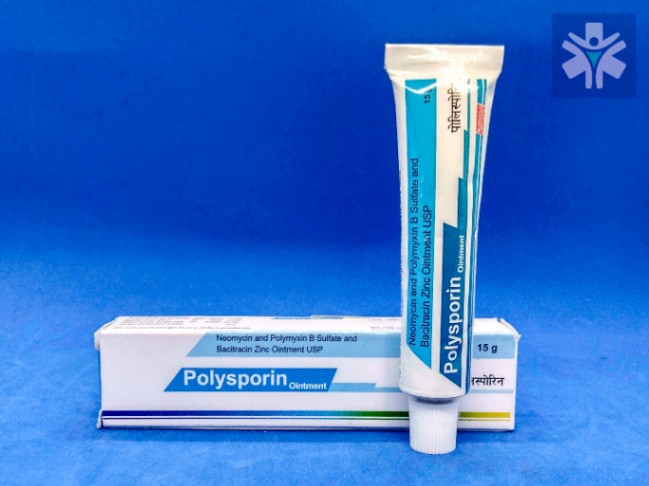
POLYSPORIN
Price: Rs.60.00
10% off
In stock
Loose stock: 0
Description
POLYSPORIN OINT 5GM
Details
Composition
BACITRACIN 400 U,NEOMYCIN 3400 U,POLYMYXIN B 5000 U
# Bacitracin 400 U + Neomycin 3400 U + Polymyxin B 5000 U
## Short Description
**Bacitracin 400 U + Neomycin 3400 U + Polymyxin B 5000 U** is a **topical antibiotic combination** used to help prevent or treat certain **minor bacterial skin infections**. It combines three antibiotics with different antibacterial actions, providing activity against a range of susceptible bacteria.
This medicine is generally intended for **external use on the skin** and should not be used indiscriminately for fungal, viral or non-infected skin conditions.
> **Important:** Use only on the areas and for the duration recommended by a healthcare professional or the product label.
---
## Key Benefits
* Helps prevent infection in **minor cuts, scrapes and superficial wounds**.
* Provides antibacterial activity from three topical antibiotics.
* Covers a range of susceptible **Gram-positive and Gram-negative bacteria**.
* May help reduce the risk of bacterial infection in minor skin injuries.
* Convenient topical application directly to the affected skin.
* May be useful when multiple susceptible organisms are a concern.
---
## Uses / Indications
### 1. Minor Cuts and Scrapes
May be used to help prevent bacterial infection in minor:
* Cuts
* Scratches
* Abrasions
* Superficial skin injuries
### 2. Minor Burns
It may be used for selected **minor superficial burns** when recommended by a healthcare professional or product labeling.
### 3. Minor Skin Wounds
The combination may be used for prevention or treatment of localized bacterial infection associated with certain minor wounds.
### 4. Superficial Bacterial Skin Infections
Depending on the specific formulation and local approval, it may be used for susceptible superficial bacterial infections.
> It is **not appropriate for every wound or skin rash**. Deep wounds, puncture wounds, animal bites, extensive burns or spreading infections require medical evaluation.
---
## How It Works
This medicine contains three antibiotics that work through different mechanisms.
### Bacitracin
Bacitracin interferes with **bacterial cell-wall synthesis**, preventing susceptible bacteria from maintaining their protective cell wall.
### Neomycin
Neomycin is an **aminoglycoside antibiotic** that binds to bacterial ribosomes and interferes with protein synthesis, leading to bacterial cell damage.
### Polymyxin B
Polymyxin B interacts with bacterial cell membranes, particularly those of susceptible **Gram-negative bacteria**, disrupting membrane integrity.
### Simple Mechanism
**Bacitracin → inhibits bacterial cell-wall formation**
**Neomycin → interferes with bacterial protein production**
**Polymyxin B → disrupts bacterial cell membranes**
**Together → provide broad topical antibacterial activity against susceptible organisms.**
---
## Dosage & Administration
> **Follow the specific product label or your healthcare professional's instructions.**
### General Application
For minor skin injuries:
1. Clean the affected area gently with water and mild soap if appropriate.
2. Pat the area dry.
3. Apply a **small/thin amount** of the ointment to the affected area.
4. A sterile bandage may be used if recommended.
5. Wash your hands before and after application.
Topical antibiotic ointments are generally applied **one to three times daily**, depending on the particular product and clinical situation.
### Important
* Do not apply more than recommended.
* Avoid prolonged continuous use unless directed by a healthcare professional.
* Do not use on large areas of the body unless specifically prescribed.
* Do not apply inside the eyes unless the product is specifically formulated and prescribed for ophthalmic use.
### Missed Application
Apply when remembered unless it is nearly time for the next application.
**Do not apply an excessive amount to compensate for a missed application.**
---
## Side Effects
### Common Side Effects
Possible local reactions include:
* Redness
* Mild irritation
* Burning
* Stinging
* Itching
* Dryness
### Allergic Skin Reactions
**Neomycin and bacitracin can cause allergic contact dermatitis** in some people, especially with repeated or prolonged use.
Symptoms may include:
* Increasing redness
* Itching
* Rash
* Swelling
* Blistering
* Skin irritation that becomes worse rather than better
### Serious Side Effects
Stop using the product and seek medical attention for signs of a serious allergic reaction, such as:
* Facial swelling
* Swelling of the lips or tongue
* Difficulty breathing
* Severe widespread rash
Rarely, significant systemic effects can occur if topical antibiotics are absorbed in substantial amounts, particularly when used over **large, damaged areas of skin**.
---
## Precautions & Warnings
### External Use Only
Use this medicine only on the skin unless your specific product is approved for another route.
### Avoid Eyes
Avoid contact with the eyes.
If accidental contact occurs, rinse thoroughly with clean water.
### Large or Deep Wounds
Do not self-treat:
* Deep wounds
* Puncture wounds
* Animal bites
* Serious burns
* Extensive skin injuries
These may require professional treatment.
### Large Areas of Broken Skin
Using topical antibiotics over extensive damaged skin can increase absorption and the risk of adverse effects.
### Allergy to Antibiotics
Do not use if you have previously experienced an allergic reaction to:
* Bacitracin
* Neomycin
* Polymyxin B
* Related antibiotics
Tell your healthcare professional about previous medication allergies.
### Prolonged Use
Prolonged or unnecessary use can increase the risk of:
* Skin sensitization
* Irritation
* Overgrowth of non-susceptible organisms
* Antimicrobial resistance
### Worsening Infection
Seek medical advice if redness, swelling, warmth, pain or drainage increases, or if fever develops.
### Children
Use in children according to the product label or healthcare professional's advice. Keep the medicine out of children's reach.
### Pregnancy
Consult a healthcare professional before using this medicine during pregnancy, particularly when applying it to large or damaged areas.
### Breastfeeding
Consult your healthcare professional before use while breastfeeding. Avoid applying it to the breast or nipple immediately before breastfeeding.
---
## Drug Interactions
Because this combination is applied topically, significant systemic drug interactions are generally less likely when used correctly on small areas of intact or minimally damaged skin.
However, caution may be appropriate with:
### Other Topical Antibiotics
Using multiple topical antibiotics simultaneously may increase skin irritation or sensitization without providing additional benefit.
### Systemic Aminoglycosides
Neomycin is an aminoglycoside. Extensive topical use over damaged skin could theoretically increase systemic exposure and toxicity, particularly when combined with other nephrotoxic or ototoxic aminoglycosides.
### Other Nephrotoxic/Ototoxic Medicines
Large-area or prolonged use may warrant caution in patients receiving medicines that can affect the kidneys or hearing.
> Tell your doctor or pharmacist about all prescription medicines, OTC medicines, vitamins and herbal supplements you use.
---
## Storage Information
* Store according to the manufacturer's instructions.
* Keep the container tightly closed.
* Protect from excessive heat and moisture.
* Keep away from direct sunlight.
* Do not freeze unless specifically instructed.
* Keep out of reach of children.
* Do not use after the expiry date.
* Avoid contaminating the tube tip by allowing it to touch wounds, skin or other surfaces.
---
## Prescription Status
**Bacitracin + Neomycin + Polymyxin B topical preparations may be available as non-prescription or prescription medicines depending on the country, formulation and local regulations.**
Always follow the applicable local medicine regulations and product labeling.
---
## Genuine Medicine Assurance
When purchasing **Bacitracin 400 U + Neomycin 3400 U + Polymyxin B 5000 U**:
* Purchase from a **licensed and reputable pharmacy**.
* Verify the exact ingredients and strengths.
* Check the manufacturer's name.
* Check the batch/lot number and expiry date.
* Ensure the tube and packaging are sealed and undamaged.
* Check the product labeling and registration information where applicable.
* Avoid products with suspicious or altered packaging.
* Do not purchase medicines from unauthorized sellers.
* Follow the manufacturer's storage and application instructions.
* If you suspect a counterfeit product, contact the manufacturer, licensed pharmacy or relevant medicines regulatory authority.
---
# Frequently Asked Questions (FAQ)
### 1. What is Bacitracin + Neomycin + Polymyxin B used for?
It is a topical antibiotic combination used to help prevent or treat certain **minor bacterial skin infections**, including those associated with minor cuts, scrapes and superficial wounds.
### 2. Is Bacitracin + Neomycin + Polymyxin B an antibiotic?
Yes. It contains **three topical antibiotics**: bacitracin, neomycin and polymyxin B.
### 3. Can this medicine be used on cuts?
It may be used for minor cuts when appropriate. Clean the wound first and apply only a thin layer according to the product instructions.
### 4. Can it be used on burns?
It may be appropriate for some minor superficial burns, but extensive, deep or serious burns require professional medical treatment.
### 5. Can this ointment treat fungal infections?
No. It is an **antibacterial** medicine and does not treat fungal infections such as ringworm or candidiasis.
### 6. Can it treat viral skin infections?
No. It does not treat viral infections such as herpes simplex or shingles.
### 7. Can Bacitracin + Neomycin + Polymyxin B cause an allergic reaction?
Yes. Particularly with **neomycin and bacitracin**, allergic contact dermatitis can occur. Increasing redness, itching or rash after application may indicate sensitivity.
### 8. Can I use this ointment on a large area?
Large-area application should be avoided unless specifically directed by a healthcare professional because systemic absorption and adverse effects may increase.
### 9. Can I use it inside my eyes?
No, unless the specific product is specifically formulated and approved for ophthalmic use. Standard skin preparations should not be placed in the eyes.
### 10. How often should I apply the ointment?
The frequency depends on the specific product. Many topical antibiotic preparations are applied **one to three times daily**, but you should follow your product label or prescription.
### 11. Can I cover the treated area with a bandage?
A sterile bandage may be used for appropriate minor wounds when recommended. Avoid airtight or occlusive coverings unless specifically instructed.
### 12. How long should I use this medicine?
Use it for the **shortest appropriate duration** according to the product label or healthcare professional's instructions. Prolonged unnecessary use can increase sensitization and resistance.
### 13. Can children use Bacitracin + Neomycin + Polymyxin B?
Some formulations can be used in children, but age restrictions vary. Follow the specific product labeling or consult a healthcare professional.
### 14. Can I use it during pregnancy?
Consult your healthcare professional before use during pregnancy, particularly if applying it to large or damaged areas.
### 15. Can I use it while breastfeeding?
Ask your healthcare professional before use. Do not apply the medicine directly to the breast or nipple immediately before breastfeeding.
### 16. What should I do if the skin becomes more irritated after applying it?
Stop using the product and seek medical advice if irritation is significant, persistent or worsening, as this may indicate an allergic reaction or another problem.
### 17. Can this medicine prevent wound infection?
It may help prevent bacterial infection in certain minor wounds, but proper wound cleaning and care remain important.
### 18. Can I use leftover topical antibiotics on every cut?
No. Many minor wounds heal well with proper cleaning and protection without topical antibiotics. Unnecessary antibiotic use can cause allergic reactions and contribute to antimicrobial resistance.
### 19. When should I see a doctor for a wound?
Seek medical attention for **deep or puncture wounds, animal bites, extensive burns, spreading redness, severe swelling, increasing pain, pus, fever or wounds that are not healing**.
### 20. Is Bacitracin + Neomycin + Polymyxin B available without a prescription?
Availability depends on the **country, formulation and local regulations**. Some topical preparations may be available without a prescription, while others require one.
---
## Medical Disclaimer
This information about **Bacitracin 400 U + Neomycin 3400 U + Polymyxin B 5000 U** is provided for educational and general informational purposes only. It is **not a substitute for professional medical advice, diagnosis or treatment**.
This medicine is intended for appropriate **topical antibacterial use** and should not be used to treat viral or fungal infections. Topical antibiotics can cause allergic contact dermatitis, particularly with repeated or prolonged exposure.
Deep wounds, puncture wounds, animal bites, extensive burns, spreading skin infections or wounds accompanied by fever require professional medical evaluation.
**Do not use this medicine on large areas, for prolonged periods, or in the eyes unless specifically directed by a qualified healthcare professional or the product is specifically formulated for ophthalmic use.**