PROTEK
Price: Rs.110.00
10% off
In stock
Loose stock: 0
Description
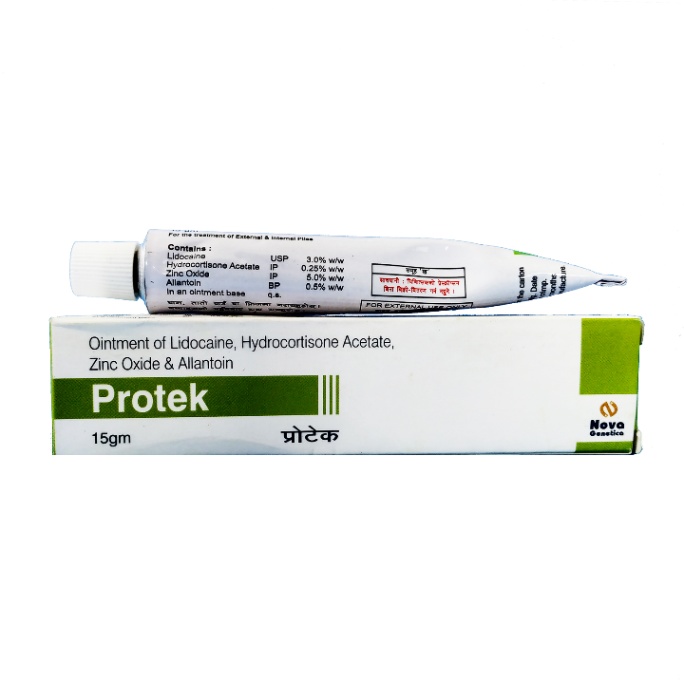
PROTEK CREAM 15GM
Details
Composition
ALLANTOIN 0.5 % W/W,HYDROCORTISONE 0.25 % W/W,LIDOCAINE 3 % W/W,ZINC OXIDE 5 % W/W
# Allantoin 0.5% w/w + Hydrocortisone 0.25% w/w + Lidocaine 3% w/w + Zinc Oxide 5% w/w
## Short Description
**Allantoin 0.5% + Hydrocortisone 0.25% + Lidocaine 3% + Zinc Oxide 5%** is a topical combination preparation designed to provide **soothing, protective, anti-inflammatory, and local anesthetic effects** on irritated skin and affected anorectal areas.
* **Allantoin** helps soothe and protect irritated skin and supports the skin's natural healing process.
* **Hydrocortisone** is a mild corticosteroid that reduces inflammation, redness, itching, and swelling.
* **Lidocaine** is a local anesthetic that provides temporary relief from pain, burning, and itching.
* **Zinc oxide** forms a protective barrier over the skin and helps protect irritated tissue from moisture and further irritation.
The exact approved indication depends on the formulation and local product labeling.
---
## Key Benefits
* Helps provide temporary relief from **itching, burning, and discomfort**
* Reduces mild inflammation, redness, and swelling
* Provides local numbing through lidocaine
* Helps protect irritated skin from moisture and friction
* Supports soothing of damaged or irritated skin
* May be useful for symptomatic relief associated with certain **hemorrhoidal and anorectal conditions**
* Combines protective, anti-inflammatory, anesthetic, and soothing actions
---
## Uses / Indications
This combination may be used for symptomatic relief of:
### **Hemorrhoidal Symptoms**
Depending on the specific product, it may help relieve:
* Anal itching
* Burning
* Mild pain
* Irritation
* Local inflammation
* Discomfort associated with hemorrhoids
### **Irritated Skin**
The protective and soothing components may also be useful for certain forms of minor skin irritation when specifically indicated.
> **Important:** This preparation primarily provides **symptomatic relief**. It does not necessarily treat the underlying cause of hemorrhoids or other anorectal disease.
Persistent, recurrent, or bleeding symptoms should be medically evaluated.
---
## How It Works
### Allantoin 0.5%
Allantoin is a **skin protectant and soothing agent**.
It helps:
* Soothe irritated skin
* Reduce discomfort associated with dryness and irritation
* Support the skin's natural repair processes
### Hydrocortisone 0.25%
Hydrocortisone is a **mild topical corticosteroid**.
It reduces inflammatory activity in the skin, helping decrease:
* Redness
* Swelling
* Itching
* Irritation
### Lidocaine 3%
Lidocaine is a **local anesthetic**.
It temporarily blocks nerve signals responsible for pain and itching in the treated area, providing localized symptomatic relief.
### Zinc Oxide 5%
Zinc oxide acts primarily as a **skin protectant**.
It forms a physical barrier that helps protect irritated tissue against:
* Moisture
* Friction
* Further irritation
### Combined Action
**Allantoin → soothes and supports skin protection**
**Hydrocortisone → reduces inflammation and itching**
**Lidocaine → temporarily numbs pain and itching**
**Zinc oxide → protects irritated tissue**
---
## Dosage & Administration
> **Important:** Follow the instructions on your specific product and the advice of your healthcare professional. The appropriate amount and duration depend on the condition and site being treated.
### General Topical Use
* Clean and gently dry the affected area.
* Apply a **thin layer** of the preparation to the affected area as directed.
* Wash your hands before and after application unless the hands themselves are being treated.
* Do not rub the area aggressively.
* Use only the recommended amount and frequency.
### For Anorectal Use
If specifically labeled for external hemorrhoidal use:
* Clean the area gently after bowel movements.
* Pat dry rather than rubbing.
* Apply a small amount to the affected external area as directed.
* If the product includes an applicator and is specifically labeled for internal use, follow the manufacturer's instructions carefully.
**Do not insert the cream internally unless the specific product is designed and labeled for rectal use.**
### Duration
Hydrocortisone-containing preparations should generally be used for the **shortest duration necessary**, particularly on sensitive areas.
If symptoms do not improve, worsen, or repeatedly return, consult a healthcare professional rather than continuing prolonged self-treatment.
---
## Side Effects
### Common Side Effects
Possible side effects include:
* Temporary burning or stinging
* Mild irritation
* Redness
* Dryness
* Itching
* Skin sensitivity
### Hydrocortisone-Related Effects
Prolonged or excessive topical corticosteroid use may cause:
* Skin thinning
* Stretch marks
* Changes in skin pigmentation
* Easy bruising
* Visible small blood vessels
* Delayed wound healing
* Increased susceptibility to local infections
### Lidocaine-Related Effects
Excessive absorption of lidocaine may rarely cause systemic effects such as:
* Dizziness
* Numbness beyond the application area
* Ringing in the ears
* Drowsiness
* Confusion
* Tremors
* Seizures
* Abnormal heart rhythm
### Serious Allergic Reaction
Stop using the product and seek medical attention if you develop:
* Severe rash
* Facial or throat swelling
* Difficulty breathing
* Severe dizziness
---
## Precautions & Warnings
### For External Use Only Unless Specifically Labeled Otherwise
Do not apply this preparation to the eyes or mouth.
Do not insert it into the rectum unless the product is specifically formulated and labeled for rectal administration.
### Broken or Infected Skin
Do not apply to extensive open wounds, severely damaged skin, or untreated infections unless specifically directed by a healthcare professional.
Hydrocortisone can suppress local immune responses and may worsen certain infections.
### Long-Term Use
Avoid prolonged or excessive use, particularly because the product contains **hydrocortisone**.
Long-term use can cause skin thinning and other corticosteroid-related effects.
### Hemorrhoidal Bleeding
Do not assume all rectal bleeding is caused by hemorrhoids.
Seek medical evaluation for:
* Persistent rectal bleeding
* Heavy bleeding
* Black stools
* Severe rectal pain
* Unexplained changes in bowel habits
* Unexplained weight loss
### Lidocaine Precautions
Do not use excessive amounts or apply over large areas because lidocaine can be absorbed into the bloodstream.
Avoid tight occlusive dressings unless specifically recommended.
### Allergies
Tell your healthcare professional if you have previously experienced an allergic reaction to:
* Lidocaine
* Other local anesthetics
* Hydrocortisone
* Zinc oxide
* Allantoin
* Any ingredient in the product
### Pregnancy
If you are pregnant or planning pregnancy, consult your healthcare professional before using this combination, particularly for prolonged or extensive application.
### Breastfeeding
Ask your healthcare professional before use during breastfeeding. Avoid applying the preparation to the nipple or areas that may come into direct contact with the infant unless specifically advised.
### Children
Children may be more susceptible to systemic absorption of topical corticosteroids, particularly when applied over large areas or under occlusion.
Use in children only according to medical advice or appropriate product labeling.
---
## Drug Interactions
Because this is a topical preparation, significant systemic interactions are generally less likely when used correctly. However, absorption can increase with extensive application, prolonged use, broken skin, or occlusion.
Tell your healthcare professional about all medicines you use.
Potential considerations include:
* **Other topical corticosteroids** — may increase total corticosteroid exposure.
* **Other lidocaine-containing or local anesthetic products** — may increase the risk of excessive local-anesthetic exposure.
* **Certain antiarrhythmic medicines** — systemic lidocaine exposure may be clinically relevant in some circumstances.
* **Other medicines that affect cardiac conduction** — caution may be needed if significant systemic lidocaine absorption occurs.
* **Medicines affecting corticosteroid metabolism** — may be relevant with extensive or prolonged topical corticosteroid exposure.
Avoid using multiple products containing lidocaine or corticosteroids on the same area unless advised by a healthcare professional.
---
## Storage Information
* Store according to the **manufacturer's recommended conditions**.
* Keep at room temperature unless the product label specifies otherwise.
* Protect from excessive heat and direct sunlight.
* Keep the container tightly closed.
* Do not freeze unless specifically permitted by the manufacturer.
* Keep out of reach and sight of children.
* Do not use after the expiry date.
* Do not use if the cream has significantly changed color, consistency, or odor.
---
## Prescription Status
**Prescription status varies by country and formulation.**
Some preparations containing low-strength hydrocortisone may be available without a prescription in certain jurisdictions, while other formulations may require a prescription.
Always follow local pharmacy regulations and the specific product labeling.
---
## Genuine Medicine Assurance
When purchasing **Allantoin 0.5% + Hydrocortisone 0.25% + Lidocaine 3% + Zinc Oxide 5%**:
* Purchase from a **licensed pharmacy or authorized medicine supplier**.
* Verify the active ingredients and concentrations.
* Check the manufacturer's name and product details.
* Check the batch/lot number and expiry date.
* Ensure the tube/container and seal are intact.
* Do not use products with damaged, opened, or suspicious packaging.
* Avoid products from unauthorized sources.
* If authenticity is uncertain, ask a pharmacist or contact the manufacturer using the information printed on the packaging.
---
# FAQ – Allantoin 0.5% + Hydrocortisone 0.25% + Lidocaine 3% + Zinc Oxide 5%
### 1. What is Allantoin + Hydrocortisone + Lidocaine + Zinc Oxide cream used for?
This combination is used for symptomatic relief of **itching, burning, irritation, pain, and inflammation**, particularly in certain hemorrhoidal or anorectal conditions when specifically indicated.
### 2. What does Hydrocortisone do in this cream?
Hydrocortisone is a mild corticosteroid that helps reduce **inflammation, redness, swelling, and itching**.
### 3. What does Lidocaine do?
Lidocaine is a local anesthetic that temporarily reduces nerve signaling, helping relieve **localized pain, burning, and itching**.
### 4. What is the purpose of Zinc Oxide?
Zinc oxide acts as a **protective barrier**, helping shield irritated skin from moisture, friction, and further irritation.
### 5. What does Allantoin do?
Allantoin is a soothing skin-protectant ingredient that helps reduce irritation and supports the skin's natural repair process.
### 6. Can this cream be used for hemorrhoids?
It may be used for symptomatic relief of **itching, burning, pain, and irritation associated with hemorrhoids** when the specific product is labeled for that purpose.
### 7. Does this cream cure hemorrhoids?
No. It primarily provides **symptomatic relief**. Persistent hemorrhoids may require dietary changes, lifestyle measures, medical treatment, or further evaluation.
### 8. Can I use this cream inside the rectum?
Only if the specific product is **formulated and labeled for internal rectal use**. Otherwise, apply it externally as directed.
### 9. How often should I apply this cream?
Follow the product label or your healthcare professional's instructions. Avoid applying it more frequently than recommended because the product contains hydrocortisone and lidocaine.
### 10. Can I use this cream for a long time?
Prolonged use is generally not recommended without medical supervision because hydrocortisone can cause **skin thinning and other corticosteroid-related effects**, while excessive lidocaine exposure can cause systemic toxicity.
### 11. Can this cream stop anal itching?
It may provide temporary relief from anal itching, particularly when inflammation and irritation contribute to the symptoms.
### 12. Can this cream relieve anal pain?
Yes. Lidocaine can provide **temporary local numbing**, while hydrocortisone reduces inflammation that may contribute to discomfort.
### 13. Can this cream be used on broken skin?
Avoid applying it to extensive open wounds or severely damaged skin unless specifically directed by a healthcare professional. Broken skin may increase absorption of the ingredients.
### 14. Can children use this cream?
Children may absorb topical corticosteroids more readily than adults. Use it in children only according to the specific product instructions or medical advice.
### 15. Can I use this cream during pregnancy?
Consult your healthcare professional before use during pregnancy, particularly if prolonged treatment or application over a large area is being considered.
### 16. Can I use this cream while breastfeeding?
Consult your healthcare professional. Avoid applying it to the nipple or areas that could come into direct contact with the baby's mouth unless specifically advised.
### 17. Can this cream cause skin thinning?
Yes. Prolonged or excessive use of hydrocortisone can cause **skin thinning, stretch marks, easy bruising, and other skin changes**.
### 18. Can Lidocaine cream cause numbness?
Yes. Temporary numbness is the intended local effect of lidocaine. Excessive use can cause numbness beyond the treated area and, rarely, more serious systemic effects.
### 19. Can I use another lidocaine product at the same time?
Avoid combining multiple lidocaine-containing products on the same area unless your healthcare professional recommends it. Excessive lidocaine exposure can be harmful.
### 20. Can I use another hydrocortisone cream with this product?
Do not routinely combine additional corticosteroid products on the same area unless advised by a healthcare professional, as this may increase corticosteroid exposure.
### 21. What should I do if I accidentally apply too much?
Remove excess product if appropriate and contact a healthcare professional if a large amount was applied, especially over broken skin or a large area. Seek urgent care if symptoms such as dizziness, severe drowsiness, ringing in the ears, confusion, tremors, or abnormal heartbeat occur.
### 22. Can this cream treat an infection?
No. It is not primarily an antimicrobial treatment. Hydrocortisone can potentially worsen some untreated skin infections.
### 23. What should I do if my hemorrhoids keep bleeding?
Persistent or significant rectal bleeding should be **medically evaluated**. Do not assume that all rectal bleeding is caused by hemorrhoids.
### 24. How quickly does this cream work?
Lidocaine may provide relatively rapid temporary local numbing, while the anti-inflammatory effect of hydrocortisone may take longer. Response varies depending on the cause and severity of symptoms.
### 25. When should I see a doctor?
Seek medical evaluation for **persistent or severe pain, significant bleeding, black stools, fever, pus, worsening swelling, unexplained weight loss, changes in bowel habits, or symptoms that do not improve with appropriate treatment**.
---
## Medical Disclaimer
This information is provided for **educational and informational purposes only** and is not a substitute for professional medical advice, diagnosis, or treatment.
This combination contains **hydrocortisone, a corticosteroid, and lidocaine, a local anesthetic**. Use only the recommended amount and duration. Excessive or prolonged use, application to large areas, broken skin, or use under occlusion can increase absorption and the risk of adverse effects.
Do not apply the preparation to the eyes or internally unless the specific product is designed and labeled for that route. Persistent or unexplained rectal bleeding, severe pain, or worsening symptoms require medical evaluation rather than prolonged self-treatment.
Seek urgent medical attention for **severe allergic reactions, difficulty breathing, severe dizziness, confusion, seizures, abnormal heartbeat, or other signs of significant lidocaine toxicity**.