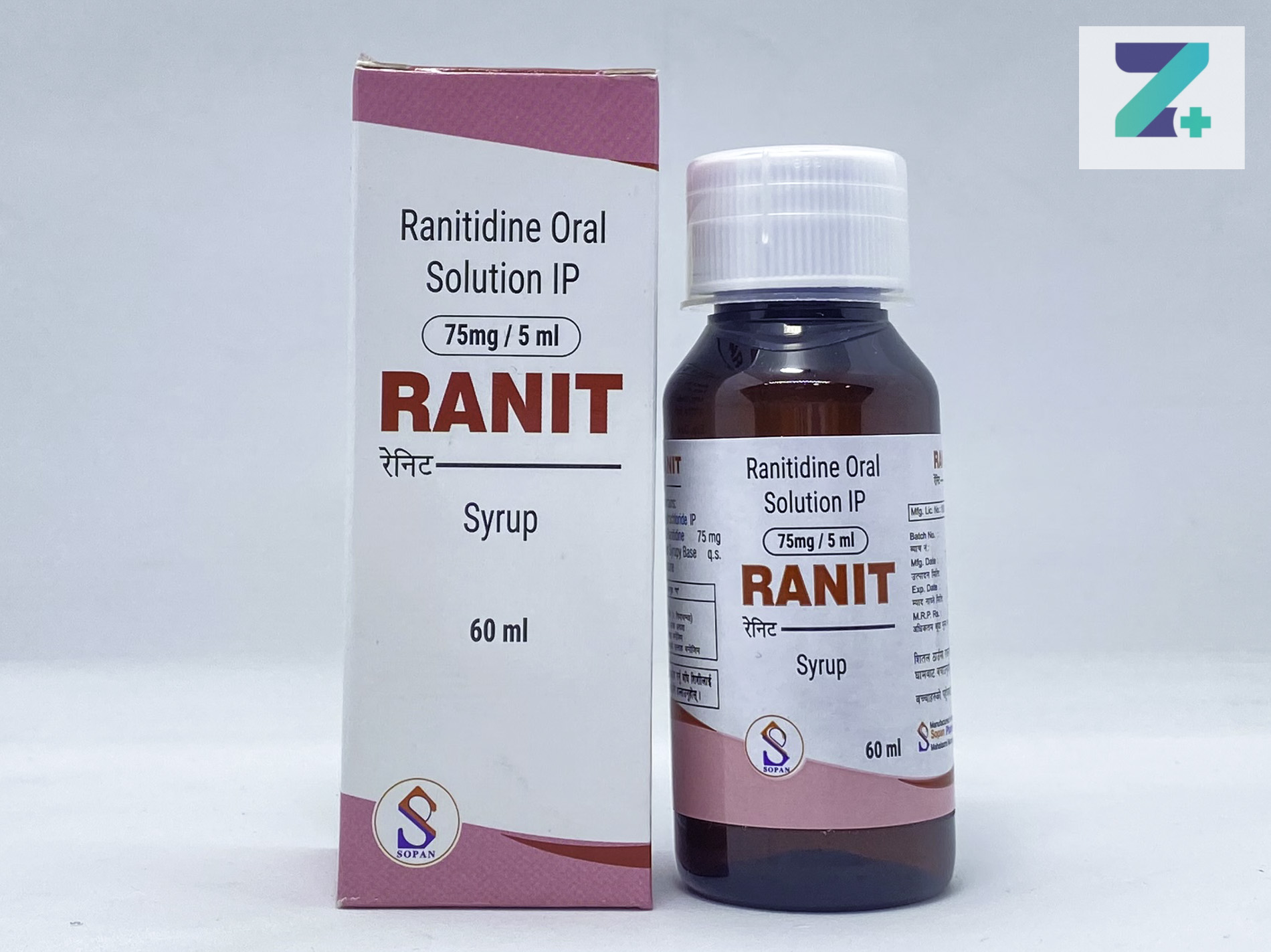
RANIT
Price: Rs.75.00
10% off
In stock
Loose stock: 0
Description
RANIT SYR 60ML
Details
Composition
RANITIDINE 75 MG
# Ranitidine 75 mg
## SHORT DESCRIPTION
**Ranitidine 75 mg** is an **H2-receptor antagonist (H2 blocker)** that reduces the production of stomach acid. Historically, ranitidine was used for conditions such as **heartburn, acid reflux, gastroesophageal reflux disease (GERD), and stomach or duodenal ulcers**. ([European Medicines Agency (EMA)][1])
### Important Safety & Availability Update
The status of ranitidine has changed substantially because of concerns about the impurity **N-nitrosodimethylamine (NDMA)**. Older ranitidine products were withdrawn or suspended in many markets. However, in **November 2025, the U.S. FDA approved a reformulated ranitidine tablet after a safety review and manufacturing changes intended to address previous NDMA-formation concerns**. ([U.S. Food and Drug Administration][2])
Therefore, information about **Ranitidine 75 mg should always be matched to the specific manufacturer's currently approved formulation and local regulatory status**.
## KEY BENEFITS
For an appropriately approved ranitidine formulation, potential benefits include:
* Reduces excessive **stomach acid production**.
* May relieve **heartburn and acid reflux**.
* May help manage symptoms associated with **GERD**.
* May promote healing of certain acid-related ulcers.
* May be used in selected patients for prevention of recurrent acid-related ulcers.
* H2 blockers generally provide acid suppression without directly neutralizing existing stomach acid.
## USES / INDICATIONS
Historically and for currently approved formulations where applicable, ranitidine may be used for:
* **Heartburn**
* **Acid reflux**
* **Gastroesophageal reflux disease (GERD)**
* Gastric ulcers
* Duodenal ulcers
* Conditions involving excessive gastric acid production, such as **Zollinger–Ellison syndrome**
The approved uses for a particular **75 mg product depend on its formulation, manufacturer, country, and regulatory approval**. ([European Medicines Agency (EMA)][1])
## HOW IT WORKS
Ranitidine is an **H2-receptor antagonist**.
It blocks histamine from activating H2 receptors on the acid-producing cells of the stomach. This decreases gastric acid secretion and can reduce acid-related irritation and symptoms.
Unlike antacids, which neutralize acid that is already present, ranitidine **reduces the amount of new acid produced by the stomach**. ([European Medicines Agency (EMA)][1])
## DOSAGE & ADMINISTRATION
**Dosage depends on the specific approved product and indication.**
For a currently approved ranitidine product, follow the manufacturer's package instructions or your healthcare professional's prescription.
* Take only the recommended amount.
* Swallow tablets with water unless the product instructions state otherwise.
* Follow the recommended timing in relation to meals or symptoms.
* Do not exceed the labeled or prescribed dose.
* Do not substitute an older ranitidine product for a currently approved formulation.
* If symptoms persist or repeatedly return, seek medical evaluation rather than continuing self-treatment indefinitely.
**Do not use historical dosing information from older ranitidine products as a substitute for the instructions accompanying a currently approved product.**
## SIDE EFFECTS
Possible side effects of ranitidine may include:
* Headache
* Dizziness
* Nausea
* Abdominal discomfort
* Constipation
* Diarrhea
Less common but potentially serious reactions may include:
* Allergic reactions
* Confusion or mental-status changes, particularly in susceptible or older patients
* Liver-related abnormalities
* Changes in heart rhythm in susceptible individuals
Seek medical attention if you experience severe allergic symptoms, fainting, significant confusion, unusual weakness, or other serious or persistent symptoms.
### Important NDMA consideration
The major historical safety concern with ranitidine was the potential presence or formation of **NDMA**, a probable human carcinogen. Regulators found that NDMA levels in some older products could increase over time and with higher temperatures. ([U.S. Food and Drug Administration][3])
The FDA's newer reformulated ranitidine was approved in 2025 following testing and manufacturing changes specifically addressing previous NDMA concerns. ([U.S. Food and Drug Administration][2])
## PRECAUTIONS & WARNINGS
* **Verify that the product is a currently authorized ranitidine formulation in your country.**
* Do not use an old or recalled ranitidine product simply because it has not reached its printed expiry date.
* Check the manufacturer's storage and handling requirements carefully.
* Tell your doctor if you have **kidney or liver disease**.
* Older adults may be more susceptible to certain adverse effects.
* Persistent heartburn should be medically evaluated, especially when accompanied by difficulty swallowing, unexplained weight loss, recurrent vomiting, anemia, or gastrointestinal bleeding.
* Seek urgent medical attention for vomiting blood or passing black/tarry stools.
* Do not use acid-suppressing medicines to mask potentially serious symptoms without appropriate evaluation.
## DRUG INTERACTIONS
Ranitidine may interact with other medicines or alter the absorption of medicines that depend on stomach acidity.
Tell your doctor or pharmacist about all medicines you use, particularly:
* Prescription medicines
* Antacids
* Other acid-reducing medicines
* Medicines with absorption affected by gastric acidity
* Medicines requiring careful dosing or monitoring
Patients with **kidney impairment** may require particular attention to dosing with ranitidine.
Always check the interaction information for the **specific currently approved formulation**, because product labeling may differ between formulations and jurisdictions.
## STORAGE INFORMATION
Storage requirements depend on the specific approved ranitidine product.
For the **reformulated U.S. ranitidine tablets approved in 2025**, FDA labeling includes specific storage and handling instructions:
* Keep tablets in the **original container**.
* Protect from moisture.
* Keep the bottle tightly closed.
* Keep the desiccant in the bottle.
* Open only one bottle at a time when multiple bottles are dispensed.
* After opening, unused tablets should be discarded after **90 days or by the expiration date, whichever comes first**, according to the FDA-approved storage instructions. ([U.S. Food and Drug Administration][2])
**Always follow the storage instructions printed on the particular product package.**
## PRESCRIPTION STATUS
**Prescription status varies according to country and formulation.**
Older ranitidine products were available both by prescription and over the counter in some markets. ([European Medicines Agency (EMA)][4])
Because ranitidine's regulatory status has changed following the NDMA issue and subsequent reformulation, **do not assume that a Ranitidine 75 mg product is OTC or prescription-only without checking its current local authorization**.
## GENUINE MEDICINE ASSURANCE
When purchasing Ranitidine 75 mg:
* Purchase only from a **licensed pharmacy or authorized medicine supplier**.
* Verify that the product is a **currently approved formulation** in your country.
* Check the manufacturer's name and regulatory information.
* Check the **batch/lot number and expiry date**.
* Ensure the packaging and security seals are intact.
* Follow the manufacturer's current storage instructions.
* Do not purchase old, recalled, or unidentified ranitidine products.
* If there is uncertainty about whether a product is an older formulation, ask a pharmacist before using it.
## FAQ SECTION
### 1. What is Ranitidine 75 mg used for?
Ranitidine is an H2 blocker that reduces stomach acid. Depending on the currently authorized formulation, it may be used for **heartburn, acid reflux, GERD, and certain acid-related ulcers**.
### 2. Is Ranitidine 75 mg still available?
Availability depends on the country and product. Many older ranitidine products were withdrawn or suspended because of NDMA concerns. In the U.S., the FDA approved a **reformulated ranitidine tablet in November 2025** after additional safety testing and manufacturing changes. ([U.S. Food and Drug Administration][2])
### 3. Why was ranitidine withdrawn?
Older ranitidine products were withdrawn in several markets because testing found the impurity **NDMA**, and regulators were concerned that NDMA levels could increase over time and with higher temperatures. ([U.S. Food and Drug Administration][3])
### 4. Is the new ranitidine the same as the old ranitidine?
The active drug is ranitidine, but the **newly approved formulation has been reformulated and subjected to additional manufacturing and safety controls** intended to address the previous NDMA impurity-formation concerns. ([U.S. Food and Drug Administration][2])
### 5. Is Ranitidine 75 mg safe?
Safety depends on the **specific formulation and regulatory approval**. Older products were withdrawn because of NDMA concerns, while the FDA approved a reformulated product in 2025 following a comprehensive safety review. ([U.S. Food and Drug Administration][2])
### 6. Does Ranitidine 75 mg reduce stomach acid?
Yes. Ranitidine blocks **H2 receptors** in the stomach, reducing gastric acid secretion. ([European Medicines Agency (EMA)][1])
### 7. Can Ranitidine 75 mg help heartburn?
Ranitidine was historically used to reduce acid-related heartburn and is approved for similar acid-related uses in applicable formulations. Always follow the instructions for the specific product available in your market.
### 8. Is Ranitidine a proton pump inhibitor?
No. Ranitidine is an **H2-receptor antagonist**, whereas medicines such as omeprazole and rabeprazole are proton pump inhibitors (PPIs).
### 9. Can I take old Ranitidine 75 mg tablets that I have at home?
**Do not automatically use an old ranitidine product.** Older products may have been subject to withdrawal or recall because of NDMA concerns. Ask a pharmacist to identify the product and determine whether it is currently authorized for use.
### 10. What is NDMA in ranitidine?
**N-nitrosodimethylamine (NDMA)** is a chemical impurity classified as a probable human carcinogen. Regulators found that NDMA levels could increase in some older ranitidine products over time and with higher temperatures. ([U.S. Food and Drug Administration][3])
### 11. Can Ranitidine be used for GERD?
Ranitidine has historically been used for **GERD and other acid-related disorders**. Whether a particular Ranitidine 75 mg product can be used for GERD depends on its current regulatory approval and labeling. ([U.S. Food and Drug Administration][2])
### 12. What are alternatives to ranitidine?
Depending on the condition, alternatives may include other **H2 blockers such as famotidine** or proton pump inhibitors such as **omeprazole, pantoprazole, or rabeprazole**. A healthcare professional can recommend the most appropriate option.
### 13. Can Ranitidine be taken during pregnancy?
If you are pregnant or breastfeeding, consult your healthcare professional before taking ranitidine. The decision should be based on the specific formulation and your individual medical circumstances.
### 14. Can Ranitidine interact with other medicines?
Yes. Ranitidine can affect the absorption or handling of some medicines. Tell your doctor or pharmacist about all medicines and supplements you use before starting treatment.
### 15. What should I do if my heartburn keeps coming back?
Frequent or persistent heartburn should be evaluated by a healthcare professional. Recurrent symptoms may indicate **GERD or another underlying condition** and should not be managed indefinitely through self-medication.
## MEDICAL DISCLAIMER
This information is provided for **general educational and product-information purposes only** and is not a substitute for professional medical advice, diagnosis, or treatment.
**Ranitidine has an important regulatory history related to NDMA contamination.** The information above should not be used to justify the sale or use of an older ranitidine product. Always verify that the specific Ranitidine 75 mg product is **currently authorized in the relevant country**, and follow its current approved labeling.
For patients with persistent or severe digestive symptoms, consult a qualified healthcare professional. Do not start, stop, or substitute acid-reducing treatment without appropriate medical advice.
[1]: https://www.ema.europa.eu/en/medicines/human/referrals/ranitidine-containing-medicinal-products?utm_source=chatgpt.com "Ranitidine-containing medicinal products - referral | European Medicines Agency (EMA)"
[2]: https://www.fda.gov/drugs/drug-safety-and-availability/fda-approves-reformulated-ranitidine-following-comprehensive-safety-review?utm_source=chatgpt.com "FDA Approves Reformulated Ranitidine Following Comprehensive Safety Review | FDA"
[3]: https://www.fda.gov/drugs/drug-safety-and-availability/questions-and-answers-ndma-impurities-ranitidine-commonly-known-zantac?utm_source=chatgpt.com "Questions and Answers: NDMA impurities in ranitidine (commonly known as Zantac) | FDA"
[4]: https://www.ema.europa.eu/en/news/ema-review-ranitidine-medicines-following-detection-ndma?utm_source=chatgpt.com "EMA to review ranitidine medicines following detection of NDMA | European Medicines Agency (EMA)"