SALMOL-4
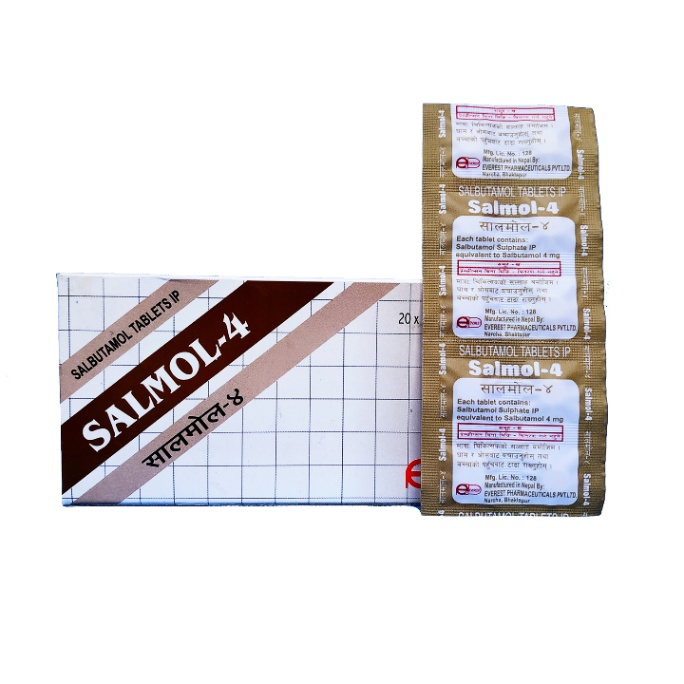
Price: Rs.20.00
10% off
In stock
Loose stock: 0
Description
SALMOL-4 TAB 10
Details
Composition
SALBUTAMOL 4 MG
# Salbutamol 4 mg
## SHORT DESCRIPTION
**Salbutamol 4 mg** is a **short-acting beta-2 adrenergic agonist (SABA)** used as a bronchodilator to help relieve breathing difficulties caused by reversible narrowing of the airways. It relaxes the muscles surrounding the airways, helping them open and making breathing easier.
Oral Salbutamol 4 mg may be prescribed for conditions such as **asthma and chronic obstructive airway diseases** when bronchodilator treatment is appropriate. Oral formulations are generally less commonly preferred than inhaled Salbutamol for rapid relief.
## KEY BENEFITS
* Helps **relax and widen the airways**
* Provides relief from **bronchospasm**
* Helps reduce wheezing and breathing difficulty caused by reversible airway narrowing
* May help relieve chest tightness associated with bronchospasm
* Supports improved airflow through the lungs
* Provides bronchodilator action without being a corticosteroid
## USES / INDICATIONS
Salbutamol 4 mg may be prescribed for:
* **Bronchial asthma**
* Reversible bronchospasm
* Wheezing associated with airway narrowing
* Certain chronic obstructive airway conditions
* Other respiratory conditions involving reversible bronchoconstriction, as determined by a healthcare professional
## HOW IT WORKS
Salbutamol selectively stimulates **beta-2 receptors** in the smooth muscles of the airways.
This causes the airway muscles to relax, resulting in:
**Airway muscle relaxation → Bronchodilation → Improved airflow → Easier breathing**
Salbutamol primarily provides relief from **bronchospasm**. It does not treat the underlying airway inflammation that may be responsible for conditions such as asthma.
## DOSAGE & ADMINISTRATION
* Take Salbutamol 4 mg **exactly as prescribed by your doctor**.
* Swallow the tablet with water.
* It may generally be taken with or without food.
* Take doses at evenly spaced times as directed.
* Do not take more than the prescribed dose.
* Do not increase the frequency of treatment if breathing symptoms are not adequately controlled.
* If a dose is missed, take it when remembered unless it is nearly time for the next dose. Do not take a double dose.
The appropriate dose varies according to **age, medical condition, response to treatment, and other medicines being used**. Children require age- and weight-appropriate dosing determined by a healthcare professional.
**Important:** Oral Salbutamol is not generally the preferred option for rapid relief of an acute asthma attack. Follow your prescribed rescue-inhaler or emergency asthma plan when applicable.
## SIDE EFFECTS
Possible side effects include:
* Tremor or shakiness
* Headache
* Nervousness or restlessness
* Dizziness
* Increased heart rate
* Palpitations
* Muscle cramps
* Nausea
* Difficulty sleeping
Less commonly, Salbutamol may cause:
* Low potassium levels
* Changes in blood glucose
* Irregular heartbeat
* Chest discomfort
* Paradoxical bronchospasm
Seek immediate medical attention if breathing suddenly becomes worse after taking the medicine, or if you experience severe chest pain, fainting, or a significant abnormal heartbeat.
## PRECAUTIONS & WARNINGS
* Use Salbutamol only according to your healthcare professional's instructions.
* Tell your doctor if you have **heart disease, abnormal heart rhythm, high blood pressure, hyperthyroidism, diabetes, or low potassium levels**.
* Salbutamol can increase heart rate and may cause palpitations.
* Excessive use can increase the risk of cardiovascular and metabolic adverse effects.
* If you need Salbutamol more frequently than usual, your respiratory condition may not be adequately controlled and your treatment should be reviewed.
* Do not use it as a substitute for prescribed **controller or anti-inflammatory asthma treatment**.
* Tell your doctor if you are pregnant or breastfeeding.
* Inform your doctor about all medicines and supplements you are taking.
* Seek urgent medical attention if your breathing symptoms are severe or rapidly worsening.
## DRUG INTERACTIONS
Salbutamol may interact with:
* **Beta-blockers**, which may reduce or oppose its bronchodilator effect
* Other sympathomimetic medicines, which may increase cardiovascular side effects
* **Diuretics**, which may increase the risk of low potassium
* Corticosteroids, particularly with prolonged or high-dose treatment, which may contribute to potassium reduction
* **Digoxin**, as changes in potassium levels may affect cardiac risk
* Certain antidepressants, including **tricyclic antidepressants and MAO inhibitors**, which may enhance cardiovascular effects
* Other medicines that affect heart rhythm
Always tell your doctor or pharmacist about prescription medicines, over-the-counter medicines, vitamins, and herbal supplements you use.
## STORAGE INFORMATION
* Store at room temperature according to the manufacturer's instructions.
* Keep away from excessive heat, moisture, and direct sunlight.
* Keep the medicine in its original packaging.
* Keep out of reach and sight of children.
* Do not use after the expiry date printed on the package.
* Dispose of expired or unused medicine according to local pharmacy recommendations.
## PRESCRIPTION STATUS
**Salbutamol 4 mg is generally a prescription medicine**, although availability and prescription requirements vary by country and formulation.
## GENUINE MEDICINE ASSURANCE
To help ensure that you receive genuine Salbutamol 4 mg:
* Purchase it from a **licensed and reputable pharmacy**.
* Check the medicine name, strength, manufacturer, batch number, and expiry date.
* Ensure the packaging is sealed and free from signs of tampering.
* Do not use products with damaged, altered, or suspicious packaging.
* If you suspect the medicine may be counterfeit, consult a pharmacist or healthcare professional before use.
## FAQ – FREQUENTLY ASKED QUESTIONS
### What is Salbutamol 4 mg used for?
Salbutamol 4 mg is used to help relieve **bronchospasm and breathing difficulties caused by reversible narrowing of the airways**, including in conditions such as asthma.
### Is Salbutamol a steroid?
No. Salbutamol is a **bronchodilator** belonging to the beta-2 agonist class. It is not a corticosteroid.
### Does Salbutamol help with asthma?
Yes. Salbutamol relaxes airway muscles and helps relieve bronchospasm associated with asthma. However, it does not treat the underlying airway inflammation, so many people with asthma also require controller medication.
### Does Salbutamol stop coughing?
Salbutamol is not primarily a cough medicine. It may reduce coughing when the cough is caused by **bronchospasm or narrowed airways**, but it will not treat every cause of cough.
### How does Salbutamol work?
Salbutamol stimulates beta-2 receptors in airway muscles, causing them to relax and allowing the airways to open more easily.
### Does Salbutamol increase heart rate?
Yes. Increased heart rate and palpitations can occur because Salbutamol can affect beta receptors outside the lungs, particularly at higher doses.
### Can Salbutamol cause shaking?
Yes. **Tremor or shakiness** is a relatively common side effect of Salbutamol.
### Can I take Salbutamol 4 mg every day?
Take it only according to your doctor's instructions. If you regularly need Salbutamol or require it more frequently than prescribed, your respiratory condition should be reassessed.
### Is oral Salbutamol better than an inhaler?
For many patients with asthma or bronchospasm, **inhaled Salbutamol is preferred** because it delivers the medicine directly to the airways and generally produces fewer systemic effects. Your doctor will determine which formulation is appropriate.
### Can Salbutamol be used during an asthma attack?
For acute asthma symptoms, an appropriately prescribed **inhaled rapid-acting bronchodilator** is generally preferred. Oral Salbutamol should not be relied upon for emergency relief unless specifically instructed by a healthcare professional.
### Can Salbutamol be taken with other asthma medicines?
Yes, it may be used alongside other asthma medicines when prescribed. The combination depends on the severity and type of respiratory disease.
### Can I take Salbutamol with a beta-blocker?
Beta-blockers can reduce the bronchodilator effect of Salbutamol and may worsen bronchospasm in susceptible individuals. Tell your doctor if you take a beta-blocker.
### Can Salbutamol lower potassium?
Higher or repeated doses can cause **low blood potassium levels**, particularly when combined with other medicines that also lower potassium.
### Can people with diabetes take Salbutamol?
People with diabetes may use Salbutamol when medically appropriate, but it can sometimes affect blood glucose levels. Inform your healthcare professional if you have diabetes.
### What should I do if I miss a dose?
Take the missed dose when you remember unless it is nearly time for the next scheduled dose. Do not take an extra dose to compensate for a missed dose.
### What should I do if Salbutamol does not relieve my breathing problems?
If breathing difficulty is severe, rapidly worsening, or not responding to your prescribed rescue treatment, **seek urgent medical attention**. Do not repeatedly increase your Salbutamol dose without medical advice.
## MEDICAL DISCLAIMER
This information about **Salbutamol 4 mg** is provided for general educational purposes and does not replace professional medical advice, diagnosis, or treatment. The correct dose depends on the patient's age, condition, response to treatment, and other medicines. Oral Salbutamol should be used only as prescribed. If breathing symptoms become severe, worsen suddenly, or are not adequately controlled with prescribed treatment, seek urgent medical care.