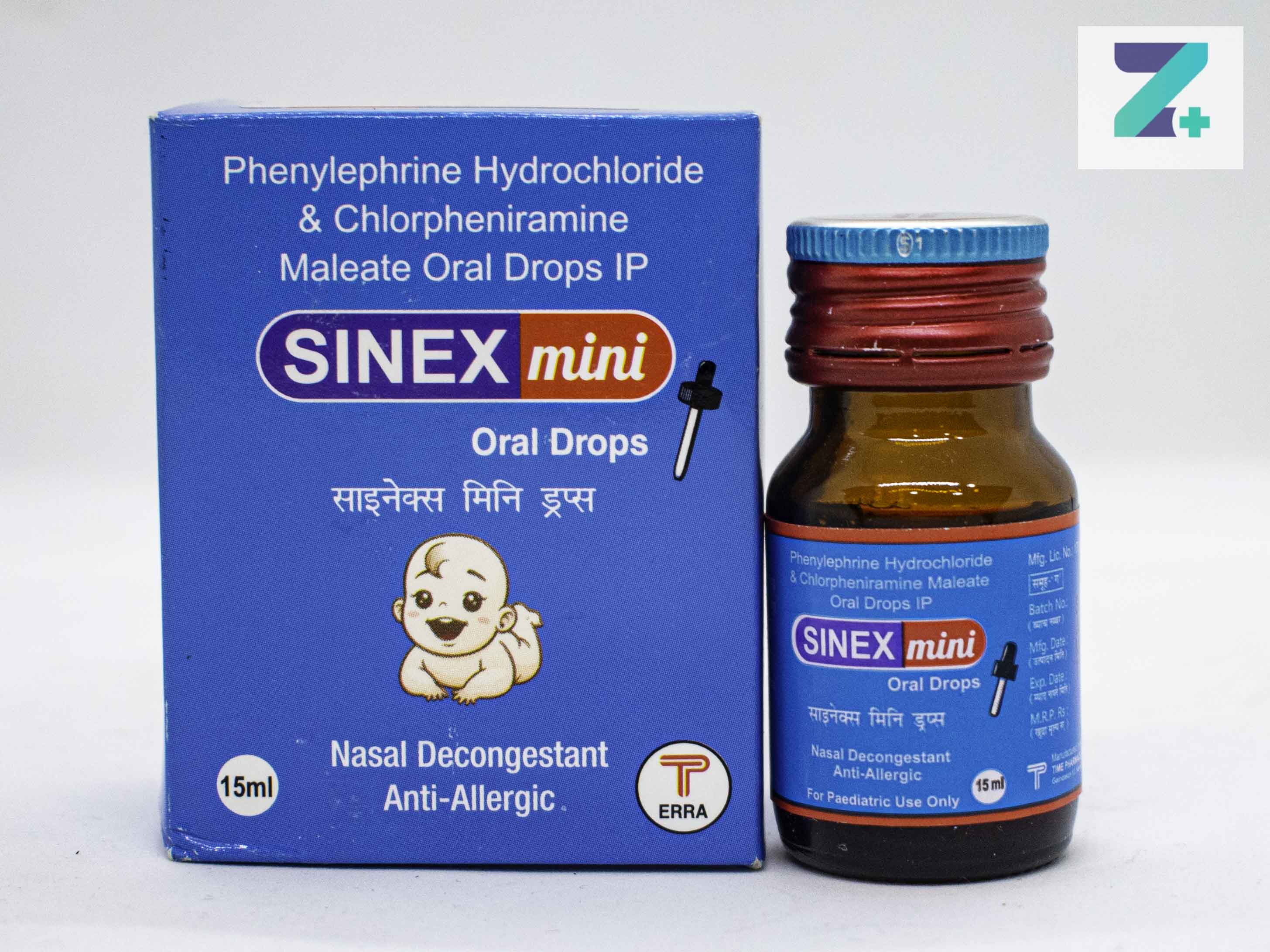
SINEX MINI
Price: Rs.110.00
10% off
In stock
Loose stock: 0
Description
SINEX MINI DROP 15ML
Details
Composition
CHLORPHENIRAMINE 1 MG,PHENYLEPHRINE 2.5 MG
# CHLORPHENIRAMINE 1 MG + PHENYLEPHRINE 2.5 MG
## Short Description
**Chlorpheniramine 1 mg + Phenylephrine 2.5 mg** is a combination medicine containing an **antihistamine** and a **nasal decongestant**. It is commonly used for temporary relief of symptoms associated with **colds, allergies, and upper respiratory congestion**.
* **Chlorpheniramine** helps relieve allergy symptoms such as sneezing, runny nose, and watery or itchy eyes.
* **Phenylephrine** helps reduce nasal congestion by narrowing swollen blood vessels in the nasal passages.
> **Important:** This combination is commonly found in pediatric or liquid formulations, but the appropriate dose depends heavily on the patient's **age, weight, formulation, and product label**. Do not use an adult cold medicine in young children unless specifically directed by a healthcare professional.
## Key Benefits
* Helps relieve **runny nose**.
* Reduces **sneezing** associated with allergies and colds.
* Helps relieve **itchy or watery eyes** caused by allergies.
* Provides temporary relief from **nasal congestion**.
* Helps reduce swelling of the nasal passages.
* Combines antihistamine and decongestant effects in one medicine.
* May provide symptomatic relief during common colds and allergic rhinitis.
## Uses / Indications
Chlorpheniramine + phenylephrine may be used for temporary relief of:
* **Common cold symptoms**.
* **Allergic rhinitis** (hay fever).
* Runny nose.
* Sneezing.
* Nasal congestion.
* Sinus/nasal stuffiness associated with colds or allergies.
* Watery or itchy eyes associated with allergies.
### Important
This medicine **relieves symptoms but does not cure the underlying viral infection** causing a common cold.
It should not be used simply because a person has a cough, fever, or congestion without considering the underlying cause.
## How It Works
### Chlorpheniramine 1 mg
Chlorpheniramine is a **first-generation H1 antihistamine**.
It blocks histamine at H1 receptors, reducing allergy symptoms such as:
* Sneezing.
* Runny nose.
* Watery eyes.
* Nasal itching.
Because chlorpheniramine can enter the brain, it may also cause **drowsiness**.
### Phenylephrine 2.5 mg
Phenylephrine is a **sympathomimetic nasal decongestant**.
It stimulates alpha-adrenergic receptors, causing blood vessels in the nasal passages to constrict. This reduces swelling of the nasal lining and helps improve airflow.
### Combined Action
**Chlorpheniramine → reduces allergy symptoms**
**Phenylephrine → reduces nasal congestion**
## Dosage & Administration
The correct dose depends on:
* Age.
* Body weight.
* Formulation.
* Severity of symptoms.
* Other medicines being taken.
For this reason, **do not determine the dose from the ingredient strengths alone**, particularly for children.
### General Administration Instructions
* Use exactly according to the product label or healthcare professional's instructions.
* Measure liquid formulations with the supplied measuring device rather than a household spoon.
* Do not exceed the recommended dose.
* Do not use multiple cold/allergy medicines containing **chlorpheniramine or phenylephrine** at the same time.
* Use for the shortest period necessary to control symptoms.
### Children
Extra caution is required with children. Many combination cough-and-cold medicines are **not recommended for young children**, and age restrictions vary by country and product.
For infants and young children, consult a healthcare professional before use.
### If You Miss a Dose
For scheduled dosing, take the missed dose when remembered unless it is close to the next dose. **Do not double the dose.**
## Side Effects
Possible side effects include:
### Chlorpheniramine-Related
* Drowsiness.
* Sleepiness.
* Dizziness.
* Dry mouth.
* Dry throat.
* Blurred vision.
* Constipation.
* Difficulty urinating.
* Thickened respiratory secretions.
### Phenylephrine-Related
* Nervousness.
* Restlessness.
* Headache.
* Tremor.
* Increased blood pressure.
* Fast or pounding heartbeat.
* Difficulty sleeping.
Most side effects are mild, but individual responses vary.
### Serious Side Effects
Seek medical attention if you experience:
* Severe allergic reaction.
* Difficulty breathing.
* Severe or persistent palpitations.
* Chest pain.
* Severe headache.
* Fainting.
* Significant increase in blood pressure.
* Severe confusion or unusual behavior.
## Precautions & Warnings
### Drowsiness
Chlorpheniramine may cause significant drowsiness.
Avoid driving, cycling, or operating machinery until you know how the medicine affects you.
### High Blood Pressure
Phenylephrine can increase blood pressure. Tell your healthcare professional if you have:
* Hypertension.
* Heart disease.
* Arrhythmias.
* Hyperthyroidism.
### Glaucoma
Antihistamines may worsen certain forms of **narrow-angle glaucoma**.
### Urinary Problems
Chlorpheniramine may make urination more difficult, particularly in people with:
* Enlarged prostate.
* Urinary retention.
* Certain bladder disorders.
### Children
Use in children requires particular caution because dosing errors and adverse effects can be more significant.
Do not give cough-and-cold combinations to young children unless specifically recommended by a healthcare professional.
### Older Adults
Older adults may be more sensitive to:
* Drowsiness.
* Confusion.
* Dizziness.
* Urinary retention.
* Constipation.
### Pregnancy and Breastfeeding
Tell your healthcare professional if you are pregnant, planning pregnancy, or breastfeeding before using this combination.
## Drug Interactions
### Other Antihistamines
Do not routinely combine with other antihistamines because this may increase:
* Drowsiness.
* Dry mouth.
* Blurred vision.
* Urinary retention.
### Sedatives and CNS Depressants
Chlorpheniramine can increase drowsiness when combined with:
* Sleeping medicines.
* Opioid pain medicines.
* Benzodiazepines.
* Sedating antidepressants.
* Alcohol.
### MAO Inhibitors
Phenylephrine should generally **not be used with MAO inhibitors or shortly after stopping them**, as the combination can cause a dangerous increase in blood pressure.
Examples include certain medicines used to treat depression or Parkinson's disease.
### Other Decongestants
Avoid combining phenylephrine with other decongestants unless specifically advised by a healthcare professional.
### Blood Pressure Medicines
Phenylephrine may interfere with the effects of certain medicines used to control blood pressure.
Tell your doctor or pharmacist about all:
* Prescription medicines.
* OTC medicines.
* Vitamins.
* Herbal products.
* Dietary supplements.
## Storage Information
* Store according to the manufacturer's instructions.
* Keep at room temperature unless the product label specifies otherwise.
* Protect from excessive heat, moisture, and direct sunlight.
* Keep the container tightly closed.
* Keep out of reach of children.
* Do not use after the expiry date.
* For liquid formulations, use only within the recommended period after opening.
## Prescription Status
**Chlorpheniramine + Phenylephrine may be available without a prescription in some countries**, while certain formulations or strengths may have different regulatory requirements.
Availability and age restrictions vary by country and product.
Always follow the local product label and pharmacist/healthcare professional's advice.
## Genuine Medicine Assurance
When purchasing Chlorpheniramine 1 mg + Phenylephrine 2.5 mg, obtain it from a **licensed pharmacy or authorized medicine supplier**.
Check:
* Correct active ingredients and strengths.
* Manufacturer information.
* Batch/lot number.
* Manufacturing and expiry dates.
* Intact packaging and seals.
* Clear dosing instructions.
* Proper storage conditions.
For liquid medicines, verify that the bottle is properly sealed and that the liquid looks and smells consistent with the manufacturer's description.
Do not use products with damaged, tampered, or suspicious packaging.
## Frequently Asked Questions (FAQ)
### 1. What is Chlorpheniramine 1 mg + Phenylephrine 2.5 mg used for?
This combination is used for temporary relief of **runny nose, sneezing, allergy symptoms, and nasal congestion** associated with colds or allergic rhinitis.
### 2. What does chlorpheniramine do?
Chlorpheniramine is an antihistamine that blocks histamine and helps reduce **sneezing, runny nose, itching, and watery eyes**.
### 3. What does phenylephrine do?
Phenylephrine is a **nasal decongestant** that reduces swelling in the nasal passages, helping relieve stuffiness.
### 4. Does this medicine cure a cold?
No. It provides **temporary symptom relief** but does not cure the viral infection responsible for most common colds.
### 5. Does chlorpheniramine make you sleepy?
Yes. Chlorpheniramine is a first-generation antihistamine and can cause **drowsiness and reduced alertness**.
### 6. Can I drive after taking this medicine?
Avoid driving or operating machinery if you experience **drowsiness, dizziness, blurred vision, or reduced alertness**.
### 7. Can this medicine increase blood pressure?
Yes. Phenylephrine can increase blood pressure and heart rate in some people. People with **uncontrolled hypertension or heart disease** should seek medical advice before using it.
### 8. Can children take Chlorpheniramine + Phenylephrine?
The appropriate age and dose depend on the specific formulation. Many combination cold medicines have **age restrictions for young children**. Consult a healthcare professional before giving this medicine to a child.
### 9. Can babies take this medicine?
Do not give combination cough-and-cold medicines to **infants or very young children** unless specifically directed by a healthcare professional.
### 10. Can I take this medicine for allergies?
Yes. Chlorpheniramine can relieve allergy symptoms, while phenylephrine may temporarily relieve associated nasal congestion.
### 11. Can I take this medicine for a blocked nose?
Yes. Phenylephrine is included specifically to help reduce **nasal congestion**.
### 12. Can I take this medicine with paracetamol?
It may be possible, but check the complete ingredient list of your cold medicine. Some combination products already contain paracetamol, and taking another paracetamol-containing product could result in an accidental overdose.
### 13. Can I take it with another cold medicine?
Avoid doing so unless a healthcare professional confirms that the combination is appropriate. Many cold medicines contain overlapping ingredients such as **antihistamines or decongestants**.
### 14. Can I drink alcohol while taking this medicine?
Alcohol can significantly increase **drowsiness and impaired coordination** caused by chlorpheniramine. Avoid or limit alcohol while using this medicine.
### 15. Can this medicine cause dry mouth?
Yes. **Dry mouth and throat** are common antihistamine-related effects.
### 16. Can this medicine cause constipation?
Yes. Chlorpheniramine can reduce gastrointestinal movement and may cause **constipation**.
### 17. Can phenylephrine cause a fast heartbeat?
Yes. Some people may experience **palpitations or increased heart rate** after taking phenylephrine.
### 18. Can I take this medicine if I have high blood pressure?
Ask your healthcare professional before using it. Phenylephrine can raise blood pressure and may not be appropriate for people with certain cardiovascular conditions.
### 19. Can I take this medicine during pregnancy?
Consult your healthcare professional before use during pregnancy. The potential benefits and risks of both ingredients should be considered.
### 20. Can I take it while breastfeeding?
Discuss use with your healthcare professional before breastfeeding while taking this combination, particularly with repeated or prolonged use.
### 21. What should I do if I miss a dose?
Take the missed dose when remembered unless it is nearly time for the next dose. **Do not take a double dose.**
### 22. What happens if I take too much?
An overdose can be dangerous and may cause severe drowsiness, agitation, rapid heartbeat, high blood pressure, abnormal heart rhythm, seizures, or other serious effects. Seek **urgent medical attention** if an overdose is suspected.
### 23. How long can I take Chlorpheniramine + Phenylephrine?
It is generally intended for **short-term symptomatic relief**. If congestion, fever, cough, or other symptoms persist or worsen, seek medical evaluation rather than continuing treatment indefinitely.
### 24. Is Chlorpheniramine 1 mg + Phenylephrine 2.5 mg available without a prescription?
Some formulations may be available **over the counter**, but regulations and age restrictions vary between countries.
### 25. Can this medicine be used for COVID-19?
It may temporarily relieve symptoms such as congestion or runny nose, but it **does not treat or cure COVID-19**. Follow appropriate testing and medical guidance when COVID-19 is suspected.
## Medical Disclaimer
This information about **Chlorpheniramine 1 mg + Phenylephrine 2.5 mg** is provided for general educational and informational purposes only. It is not a substitute for professional medical advice, diagnosis, or treatment.
This combination is intended for **temporary symptomatic relief** and does not treat the underlying cause of most viral respiratory infections. Chlorpheniramine can cause significant drowsiness, while phenylephrine can increase blood pressure and heart rate.
Extra caution is required in **young children, older adults, people with hypertension or heart disease, glaucoma, thyroid disorders, urinary retention, or those taking sedatives or MAO inhibitors**. Always follow the specific product label and recommended age-based dosing. Seek urgent medical attention for severe allergic reactions, chest pain, severe palpitations, fainting, seizures, or suspected overdose.