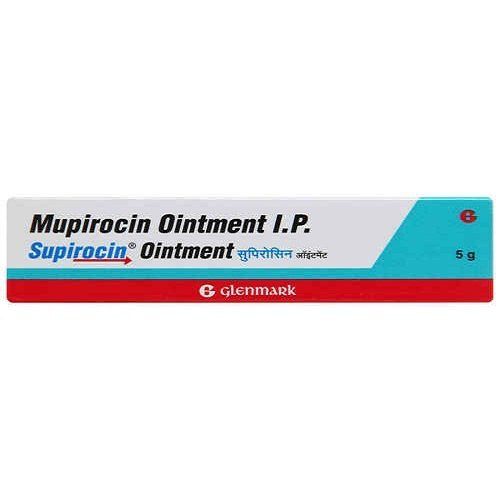
SUPIROCIN
Price: Rs.184.92
10% off
In stock
Loose stock: 0
Description
SUPIROCIN OINT 5GM
Details
Composition
MUPIROCIN 2%W/W
# MUPIROCIN 2% W/W
## SHORT DESCRIPTION
**Mupirocin 2% w/w** is a topical antibiotic used to treat certain **bacterial skin infections**. It is particularly effective against susceptible strains of **Staphylococcus aureus** and **Streptococcus pyogenes**.
Mupirocin is commonly used for localized bacterial skin infections such as **impetigo, infected minor cuts, wounds, and other superficial skin infections**, when prescribed or recommended by a healthcare professional.
It is **not effective against fungal or viral skin infections**.
---
## KEY BENEFITS
* Helps treat certain **bacterial skin infections**.
* Effective against susceptible **Staphylococcus** and **Streptococcus** bacteria.
* Commonly used for **impetigo and localized superficial skin infections**.
* Can help reduce bacterial growth at the site of infection.
* Applied directly to the affected skin.
* Generally has limited systemic absorption when used appropriately on intact skin.
---
## USES / INDICATIONS
Mupirocin 2% w/w may be used for:
* **Impetigo**
* Localized bacterial skin infections
* Infected minor cuts and abrasions
* Infected wounds
* Certain superficial skin infections caused by susceptible bacteria
* Other localized bacterial infections when specifically prescribed
### Important
Mupirocin should **not** be used routinely for:
* Fungal infections such as ringworm
* Viral infections such as herpes
* Most non-infected rashes
* Acne unless specifically prescribed
---
## HOW IT WORKS
Mupirocin works by inhibiting **bacterial protein synthesis**.
It blocks a bacterial enzyme called **isoleucyl-tRNA synthetase**, which bacteria need to produce essential proteins.
This prevents susceptible bacteria from growing and surviving, helping the body's immune system clear the infection.
### In Simple Terms
**Mupirocin → blocks bacterial protein production → stops bacterial growth → helps clear the skin infection.**
---
## DOSAGE & ADMINISTRATION
### General Use
For many localized skin infections, mupirocin 2% is commonly applied as a **small amount to the affected area 2–3 times daily**, usually for a limited treatment period.
However, the exact frequency and duration should follow the **specific product label or healthcare professional's instructions**.
### How to Apply
1. Wash your hands before application.
2. Gently clean and dry the affected area.
3. Apply a small amount of mupirocin as a thin layer.
4. Wash your hands after application unless the hands themselves are being treated.
5. If advised, the area may be covered with a clean dressing.
### Important
* Do not apply more than recommended.
* Avoid using it over large areas unless specifically instructed.
* Do not mix it with other creams or ointments on the same area unless advised.
* Complete the prescribed course even if the infection appears to improve early.
### Missed Application
Apply the missed dose when remembered unless it is nearly time for the next application.
**Do not apply extra medicine to compensate.**
---
## SIDE EFFECTS
### Common Side Effects
Some people may experience:
* Burning
* Stinging
* Itching
* Redness
* Dryness
* Mild irritation at the application site
These reactions are usually temporary.
### Serious Side Effects
Stop using mupirocin and seek medical advice if you develop:
* Severe or persistent skin irritation
* Significant swelling
* Severe rash
* Blistering
* Signs of an allergic reaction
### Severe Diarrhea
Although uncommon with topical use, prolonged antibiotic exposure can rarely be associated with **antibiotic-associated diarrhea**, including *Clostridioides difficile*-associated diarrhea.
Seek medical attention for severe or persistent diarrhea, particularly if it occurs during or after treatment.
---
## PRECAUTIONS & WARNINGS
### For External Use Only
Mupirocin skin preparations are intended for use on the **skin** unless a specific formulation has been prescribed for another site.
Do not swallow the product.
### Avoid Eyes and Mucous Membranes
Avoid contact with:
* Eyes
* Mouth
* Inside of the nose unless specifically using a nasal formulation
* Other mucous membranes
If the medicine accidentally enters the eyes, rinse thoroughly with water.
### Kidney Disease
Some mupirocin formulations contain **polyethylene glycol (PEG)**. Large amounts applied to extensive or damaged skin may result in systemic absorption of PEG.
People with significant kidney problems should use mupirocin over large or damaged areas only under medical supervision.
### Prolonged Use
Do not use mupirocin for longer than recommended.
Prolonged or repeated use of antibiotics may contribute to **antibiotic resistance** or allow overgrowth of non-susceptible organisms.
### Lack of Improvement
Contact a healthcare professional if:
* The infection becomes worse.
* There is spreading redness or swelling.
* Fever develops.
* Pus or drainage increases.
* There is no improvement after the prescribed treatment period.
### Allergy
Tell your healthcare professional if you have previously experienced an allergic reaction to mupirocin or other topical antibiotics.
---
## DRUG INTERACTIONS
Mupirocin applied to the skin has **minimal systemic absorption**, so significant interactions with oral medicines are uncommon.
However:
* Avoid applying other topical medicines to the same area unless advised.
* Do not mix mupirocin with other creams or ointments because this may reduce its effectiveness or alter the formulation.
* Inform your healthcare professional about all medicines, supplements, and topical products you use.
---
## STORAGE INFORMATION
* Store according to the **manufacturer's instructions**.
* Keep the tube/container tightly closed.
* Store at the recommended room temperature.
* Protect from excessive heat.
* Keep away from direct sunlight.
* Do not freeze unless the product labeling specifically permits it.
* Keep out of reach of children.
* Do not use after the expiry date.
* Do not use if the tube or packaging is damaged.
---
## PRESCRIPTION STATUS
**Mupirocin 2% w/w is prescription-only in many countries**, although availability and regulatory status may vary by jurisdiction.
Use it according to local regulations and the instructions provided by a qualified healthcare professional.
---
## GENUINE MEDICINE ASSURANCE
When purchasing Mupirocin 2% w/w:
* Purchase from a **licensed pharmacy or authorized medicine supplier**.
* Check that the packaging is sealed and intact.
* Verify the medicine name and strength.
* Check the **batch/lot number and expiry date**.
* Confirm the manufacturer's information.
* Avoid products with damaged packaging or unclear labeling.
* Do not purchase antibiotics from unverified sources.
---
# FAQ – MUPIROCIN 2% W/W
### 1. What is Mupirocin 2% used for?
Mupirocin 2% is a topical antibiotic used to treat certain **bacterial skin infections**, including impetigo and localized infections caused by susceptible bacteria.
### 2. Is Mupirocin an antibiotic?
Yes. Mupirocin is a **topical antibiotic** specifically used against susceptible bacteria.
### 3. Is Mupirocin effective for fungal infections?
No. Mupirocin does not treat fungal infections such as **ringworm, athlete's foot, or candidiasis**.
### 4. Can Mupirocin be used for acne?
Mupirocin is **not routinely recommended for acne**. It should only be used for acne-related bacterial infection if specifically prescribed by a healthcare professional.
### 5. Can Mupirocin be used on wounds?
It may be prescribed for **certain infected wounds or minor skin injuries**, but it should not be routinely applied to every wound.
### 6. How often should Mupirocin 2% be applied?
Depending on the infection and product instructions, it is commonly applied **2–3 times daily for a limited period**. Follow your healthcare professional's instructions.
### 7. How long should I use Mupirocin?
Treatment duration depends on the infection. Use it for the **full prescribed course** and do not continue treatment unnecessarily.
### 8. Can Mupirocin be used on the face?
It can sometimes be used on facial skin when prescribed, but avoid the **eyes, lips, and mucous membranes**.
### 9. Can Mupirocin be used inside the nose?
Regular **Mupirocin 2% skin ointment is not automatically interchangeable with nasal mupirocin formulations**. Use it inside the nose only if your healthcare professional specifically instructs you to do so and the formulation is appropriate.
### 10. Can Mupirocin treat boils?
Mupirocin may be prescribed for certain localized bacterial skin infections, but larger or recurrent boils may require medical evaluation, drainage, or another treatment.
### 11. Does Mupirocin stop itching?
Mupirocin is an antibiotic and is not primarily an anti-itch medicine. It may reduce symptoms when itching is caused by a susceptible bacterial infection.
### 12. Can Mupirocin be used for eczema?
Mupirocin does not treat eczema itself. It may sometimes be prescribed when eczema has developed a **secondary bacterial infection**.
### 13. Can I use Mupirocin with other creams?
Avoid applying other topical medicines to the same area unless your healthcare professional recommends them.
### 14. What happens if I use Mupirocin for too long?
Prolonged or unnecessary antibiotic use can increase the risk of **antibiotic resistance** and may cause irritation or overgrowth of organisms that are not susceptible to mupirocin.
### 15. Can Mupirocin cause skin irritation?
Yes. Burning, stinging, redness, itching, and irritation can occur at the application site.
### 16. Can I use Mupirocin during pregnancy?
If you are pregnant or planning pregnancy, consult your healthcare professional before using mupirocin. The potential benefits and risks should be considered.
### 17. Can I use Mupirocin while breastfeeding?
Discuss its use with your healthcare professional. Avoid applying it to the **breast or nipple area** if the infant could come into contact with the medicine.
### 18. Is Mupirocin available without a prescription?
In many countries, Mupirocin is a **prescription medicine**, although regulations vary by location.
### 19. What should I do if the infection does not improve?
Contact a healthcare professional. The infection may involve bacteria that are resistant to mupirocin, may require a different treatment, or may not be bacterial in origin.
### 20. Can Mupirocin be used to prevent infection?
Routine use of topical antibiotics to prevent infection is generally discouraged unless specifically recommended by a healthcare professional, because unnecessary antibiotic use can contribute to resistance.
---
## MEDICAL DISCLAIMER
This information about **Mupirocin 2% w/w** is provided for educational and informational purposes only and does not replace professional medical advice, diagnosis, or treatment.
Mupirocin is an **antibiotic and should be used only when appropriate for a susceptible bacterial infection**. It should not be used for fungal or viral infections and should not be used unnecessarily or for longer than recommended because of the risk of antibiotic resistance.
Seek medical attention if an infection spreads, becomes increasingly painful or swollen, produces significant drainage, is associated with fever, or does not improve with treatment.
Always follow the specific product label and the instructions of your doctor or pharmacist.