TACNI 0.1%
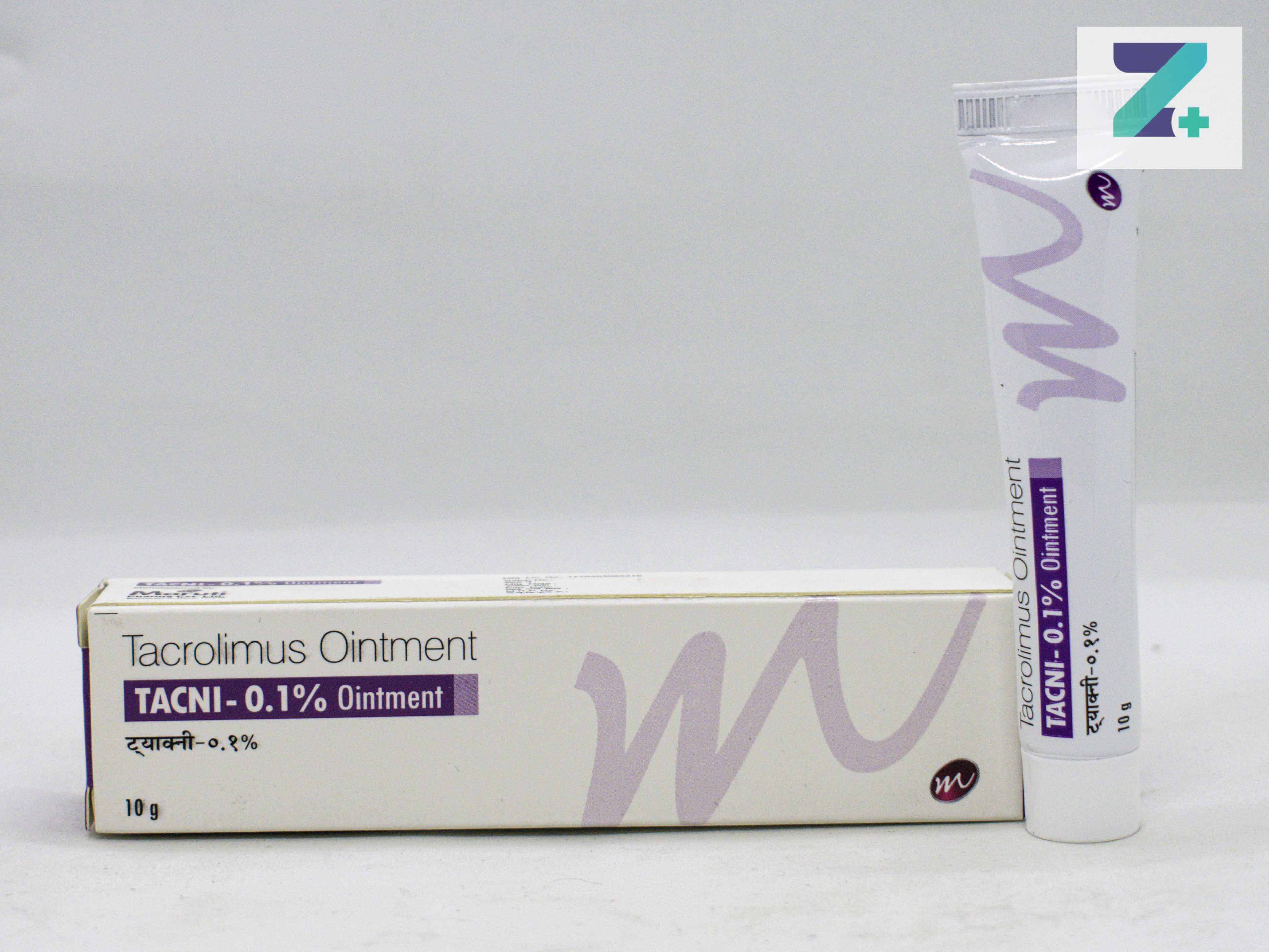
Price: Rs.500.00
10% off
In stock
Loose stock: 0
Description
TACNI 0.1% OINT 10GM
Details
Composition
TACROLIMUS 0.01%
# TACROLIMUS 0.01% OINTMENT
## SHORT DESCRIPTION
**Tacrolimus 0.01% ointment** is a topical calcineurin inhibitor used to help manage certain inflammatory skin conditions, particularly **atopic dermatitis (eczema)**. It reduces excessive immune activity in the skin, helping relieve redness, itching, and inflammation.
Tacrolimus ointment is a **non-steroidal topical treatment**, making it useful in situations where prolonged or repeated topical corticosteroid use may be undesirable.
> **Important:** The approved strength, age indication, and prescribing recommendations for tacrolimus 0.01% can vary by country. Follow the product-specific prescribing information.
---
## KEY BENEFITS
* Helps reduce **eczema-related inflammation and itching**.
* Non-steroidal topical treatment.
* Helps control redness, irritation, and skin inflammation.
* May be useful for sensitive areas such as the **face, neck, and skin folds** when prescribed.
* Does not cause the same type of skin thinning associated with prolonged topical corticosteroid use.
* Can be used for intermittent treatment of atopic dermatitis according to medical advice.
* May help maintain control of eczema when used as part of an appropriate treatment plan.
---
## USES / INDICATIONS
Tacrolimus ointment may be prescribed for:
### Atopic Dermatitis (Eczema)
* Treatment of **moderate-to-severe atopic dermatitis** in appropriately selected patients.
* Control of inflammatory skin symptoms such as:
* Itching
* Redness
* Dryness
* Inflammation
* Irritation
### Sensitive Skin Areas
Under medical supervision, tacrolimus may be particularly useful when eczema affects areas where prolonged corticosteroid use may be problematic, such as:
* Face
* Eyelids
* Neck
* Skin folds
### Other Uses
Dermatologists may sometimes prescribe topical tacrolimus for other inflammatory skin disorders. Such uses may be **off-label** and should only be undertaken under specialist guidance.
---
## HOW IT WORKS
Tacrolimus is a **topical calcineurin inhibitor**.
It penetrates the skin and inhibits calcineurin-dependent activation of **T lymphocytes**. This reduces the production and release of inflammatory cytokines.
As inflammation decreases, symptoms such as:
* Itching
* Redness
* Swelling
* Skin irritation
can improve.
### In simple terms:
**Tacrolimus → reduces excessive immune activity in the skin → decreases inflammation and itching.**
Unlike topical corticosteroids, tacrolimus does not work primarily by causing vasoconstriction and does not have the same skin-thinning mechanism associated with prolonged topical steroid use.
---
## DOSAGE & ADMINISTRATION
* Apply a **thin layer** to the affected areas as directed by your healthcare professional.
* Use only on areas affected by eczema or other conditions for which it has been prescribed.
* Wash and dry your hands before application unless the hands themselves are being treated.
* Wash your hands after application if the hands are not being treated.
* Avoid contact with the **eyes, mouth, and mucous membranes**.
* Do not cover the treated area with airtight or occlusive dressings unless specifically instructed.
### Application Frequency
The frequency depends on the patient's age, formulation, treatment response, and local prescribing recommendations.
**Tacrolimus 0.01% is a lower-strength formulation, but age-specific recommendations vary by product and country.**
Follow the prescribed instructions rather than applying it more frequently than recommended.
### Moisturizers
Moisturizers are often an important part of eczema management. If using a moisturizer together with tacrolimus, follow your healthcare professional's instructions regarding application timing.
### Missed Application
If you forget an application, apply it when remembered unless it is nearly time for the next scheduled application.
**Do not apply an excessive amount to compensate.**
---
## SIDE EFFECTS
### Common Side Effects
The most common effects are usually localized to the application site and may include:
* Burning
* Stinging
* Warmth
* Itching
* Redness
* Tingling
These reactions are often more noticeable during the first few days of treatment and may improve as the skin becomes accustomed to the medicine.
### Other Possible Effects
* Folliculitis
* Acne
* Increased skin sensitivity
* Skin infection
* Cold sore or herpes simplex infection
### Serious Side Effects
Seek medical advice if you develop:
* Severe or persistent skin irritation
* Signs of bacterial infection
* Painful blisters or sores
* Worsening herpes infection
* Swollen lymph nodes
* Severe allergic reaction
Seek urgent care for facial swelling, difficulty breathing, or other signs of a severe allergic reaction.
---
## PRECAUTIONS & WARNINGS
### Avoid Infected Skin
Tacrolimus should generally not be applied to **actively infected skin** unless specifically directed by a healthcare professional.
Bacterial, viral, or fungal infections may require separate treatment.
### Sun and UV Exposure
Minimize exposure to:
* Direct sunlight
* Tanning beds
* Other unnecessary ultraviolet (UV) radiation
Use appropriate protective clothing and sunscreen as advised.
### Alcohol
Some patients experience **facial flushing, warmth, or irritation after consuming alcohol** while using topical tacrolimus.
### Lymphoma and Skin Cancer Warning
Topical calcineurin inhibitors carry warnings concerning a potential association with **lymphoma and skin malignancies**. A direct causal relationship has not been established, but prolonged or inappropriate use should be avoided.
Use the **lowest amount and duration necessary** to control the condition as directed by a healthcare professional.
### Immunocompromised Patients
Tell your doctor if you have a weakened immune system or take medicines that suppress immunity.
### Lymphadenopathy
Inform your healthcare professional if you develop **persistent or unexplained swollen lymph nodes**.
### Children
Age restrictions and approved strengths vary by country. Tacrolimus 0.01% should be used in children only according to the applicable product labeling and healthcare professional's advice.
### Pregnancy and Breastfeeding
Tell your healthcare professional if you are pregnant, planning pregnancy, or breastfeeding. The potential benefits and risks should be evaluated before use.
---
## DRUG INTERACTIONS
Because tacrolimus ointment is applied to the skin, systemic exposure is generally much lower than with oral tacrolimus. However, interactions may still be relevant, particularly when large areas of skin are treated or the skin barrier is significantly damaged.
### Immunosuppressive Medicines
Tell your doctor if you use other medicines that suppress the immune system.
### Systemic Tacrolimus
Do not use topical tacrolimus together with oral or injectable tacrolimus unless specifically instructed by your healthcare professional.
### CYP3A4 Inhibitors
Medicines that strongly inhibit CYP3A4 may theoretically increase tacrolimus exposure, particularly if significant systemic absorption occurs.
Examples include certain:
* Macrolide antibiotics
* Azole antifungals
* Other CYP3A4 inhibitors
### Vaccinations
Tell your healthcare professional about tacrolimus use when discussing vaccination, particularly if you are receiving other immunosuppressive treatment.
Always provide your doctor or pharmacist with a complete list of **prescription medicines, OTC medicines, supplements, and herbal products** you use.
---
## STORAGE INFORMATION
* Store Tacrolimus 0.01% ointment according to the **manufacturer's instructions**.
* Keep the tube tightly closed.
* Store at the recommended temperature stated on the package.
* Protect from excessive heat and direct sunlight.
* Keep out of reach of children.
* Do not use after the expiry date.
* Do not use the ointment if the tube or packaging is damaged or contaminated.
---
## PRESCRIPTION STATUS
**Tacrolimus 0.01% ointment is generally a prescription medicine.**
Because it is an immunomodulating topical medicine with specific age restrictions, warnings, and usage requirements, it should be used under the supervision of a qualified healthcare professional.
---
## GENUINE MEDICINE ASSURANCE
When purchasing Tacrolimus 0.01% ointment, ensure that:
* The product comes in **original, sealed manufacturer packaging**.
* The label clearly states **Tacrolimus 0.01%**.
* The manufacturer's name and information are present.
* The **batch/lot number and expiry date** are clearly visible.
* The packaging shows no signs of tampering.
* The ointment is purchased from a **licensed pharmacy or authorized medicine supplier**.
* The product has the appropriate regulatory authorization for the market.
* The formulation and strength match the prescription.
Do not use a product if the seal is broken, packaging is damaged, labeling appears altered, or the medicine has expired.
---
# FAQ – TACROLIMUS 0.01% OINTMENT
### 1. What is Tacrolimus 0.01% ointment used for?
Tacrolimus 0.01% is a topical medicine used to help manage **inflammatory skin conditions such as atopic dermatitis (eczema)** when prescribed.
### 2. Is Tacrolimus 0.01% a steroid?
**No.** Tacrolimus is a topical calcineurin inhibitor and is **not a corticosteroid**.
### 3. How does Tacrolimus ointment work?
It suppresses excessive activation of certain immune cells in the skin, reducing the release of inflammatory substances and helping relieve **itching and inflammation**.
### 4. Can Tacrolimus be used on the face?
It may be prescribed for eczema affecting the **face or other sensitive areas**, where prolonged topical corticosteroid use may be undesirable. Use it only as directed by your healthcare professional.
### 5. Can Tacrolimus be used around the eyes?
It may sometimes be prescribed for eczema affecting the eyelids, but it should **not get into the eyes**. Use carefully according to medical instructions.
### 6. Does Tacrolimus thin the skin?
Tacrolimus does not have the same skin-thinning effect associated with prolonged topical corticosteroid treatment. However, it can cause temporary burning, stinging, or redness at the application site.
### 7. Does Tacrolimus cure eczema permanently?
No. Atopic dermatitis is a chronic condition that can have periods of improvement and flare-ups. Tacrolimus helps **control inflammation and symptoms** but does not permanently cure the underlying condition.
### 8. Does Tacrolimus burn or sting when applied?
Yes. **Burning or stinging is common during the first few days** of treatment and often becomes less noticeable as treatment continues.
### 9. Can I use moisturizer with Tacrolimus?
Moisturizers are commonly used as part of eczema management. Ask your healthcare professional how to coordinate moisturizer use with tacrolimus for your particular treatment plan.
### 10. Can I use Tacrolimus on infected skin?
Do not apply it to an actively infected area unless specifically instructed by your healthcare professional. Skin infections may require separate treatment.
### 11. Can I go in the sun while using Tacrolimus?
Limit unnecessary exposure to sunlight and **avoid tanning beds and UV light therapy unless specifically recommended**. Protective clothing and sunscreen may be appropriate.
### 12. Can I drink alcohol while using Tacrolimus ointment?
Some people experience **facial flushing, warmth, or irritation after alcohol consumption** while using tacrolimus. Avoid or limit alcohol if this reaction occurs.
### 13. Can Tacrolimus be used every day?
The frequency and duration depend on the formulation, age, severity of the condition, and prescribing instructions. **Use it exactly as directed** rather than applying it more frequently.
### 14. Is Tacrolimus 0.01% safe for children?
Age approvals vary by country and product. Children should use tacrolimus only according to the applicable product information and a healthcare professional's advice.
### 15. Can Tacrolimus be used during pregnancy?
Tell your doctor if you are pregnant or planning pregnancy. Your healthcare professional should determine whether the expected benefits outweigh potential risks.
### 16. Can Tacrolimus be used while breastfeeding?
Discuss its use with your healthcare professional. If prescribed during breastfeeding, avoid applying it to areas where the infant could directly contact the treated skin.
### 17. Can Tacrolimus cause skin cancer?
Topical tacrolimus carries warnings about a **potential association with lymphoma and skin malignancies**, although a direct causal relationship has not been established. Avoid unnecessary UV exposure and use the medicine only as directed.
### 18. What should I do if I forget to apply Tacrolimus?
Apply it when you remember unless it is close to the next scheduled application. **Do not apply extra ointment** to make up for a missed application.
### 19. How long does Tacrolimus take to work?
It may begin reducing itching and inflammation within days, although improvement varies between individuals. Continue treatment according to your prescribed regimen.
### 20. Is Tacrolimus 0.01% available without a prescription?
In many markets, **topical tacrolimus is prescription-only**. Regulatory status and approved strengths can vary by country.
---
## MEDICAL DISCLAIMER
This information about **Tacrolimus 0.01% ointment** is provided for educational and informational purposes only and is not a substitute for professional medical advice, diagnosis, or treatment.
The appropriate strength, frequency, duration, and age eligibility depend on the **specific product, country-specific labeling, patient's age, skin condition, treatment history, and other medical factors**.
**Do not start, stop, or change tacrolimus treatment without consulting a qualified healthcare professional.** Avoid unnecessary UV exposure, do not use the medicine on infected skin unless specifically instructed, and seek medical advice for persistent infections, unexplained swollen lymph nodes, severe skin reactions, or signs of an allergic reaction.