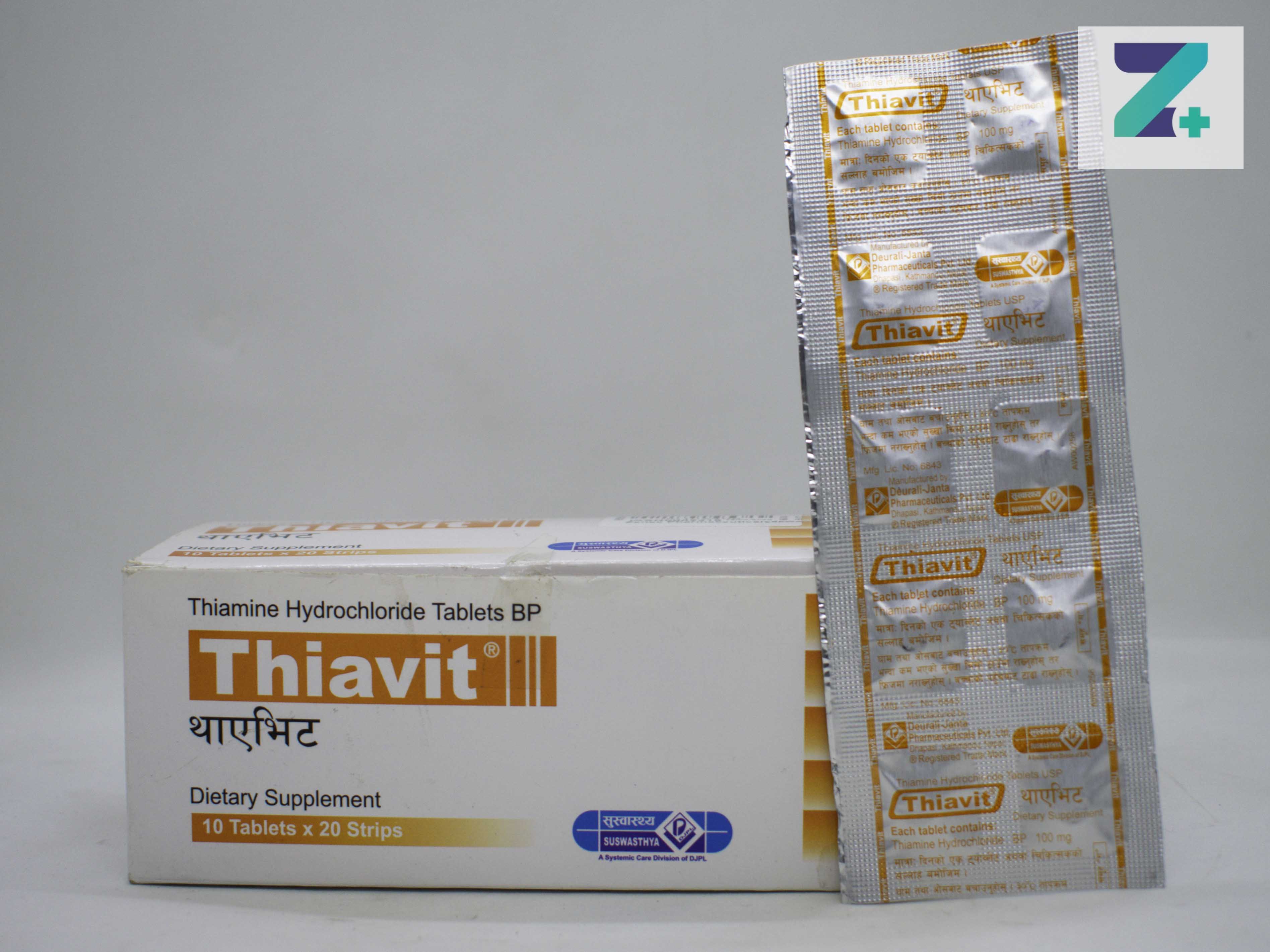
THIAVIT
Price: Rs.73.00
15% off
In stock
Loose stock: 5
Description
THIAVIT TAB 10
Details
Composition
THIAMINE 100 MG
# THIAMINE 100 MG
## SHORT DESCRIPTION
**Thiamine 100 mg (Vitamin B1)** is a water-soluble vitamin essential for normal **energy metabolism, carbohydrate metabolism, nerve function, and heart function**. It is used to prevent or treat **thiamine deficiency** and may be recommended when dietary intake or absorption is inadequate.
Thiamine is particularly important for tissues with high energy requirements, including the **brain, nerves, and heart**.
---
## KEY BENEFITS
* Helps prevent and correct **Vitamin B1 (thiamine) deficiency**.
* Supports normal **energy production** from carbohydrates.
* Supports healthy **nerve and brain function**.
* Contributes to normal **heart and muscle function**.
* Supports carbohydrate metabolism.
* Helps maintain normal cellular enzyme activity.
* May be used when increased thiamine requirements or inadequate absorption create a risk of deficiency.
---
## USES / INDICATIONS
Thiamine 100 mg may be used for:
* **Prevention and treatment of thiamine deficiency**
* Dietary deficiency or inadequate nutritional intake
* Increased nutritional requirements
* Certain conditions associated with impaired thiamine absorption or utilization
* **Beriberi**, when thiamine deficiency is responsible
* As part of treatment for **Wernicke encephalopathy**, typically requiring urgent medical management and appropriate parenteral thiamine rather than relying on an oral 100 mg tablet
* Supplementation in individuals at risk of deficiency, when recommended by a healthcare professional
### Important
Thiamine is not a general treatment for all types of nerve pain or fatigue. Its greatest benefit is expected when **thiamine deficiency or increased nutritional requirements** are present.
---
## HOW IT WORKS
After absorption, thiamine is converted into active forms, particularly **thiamine pyrophosphate (TPP)**.
TPP acts as a coenzyme in several important metabolic reactions involved in:
* Carbohydrate metabolism
* Production of cellular energy
* Amino-acid metabolism
* Normal nerve function
Thiamine is also important for the normal function of nerve cells and the cardiovascular system.
Because the body stores only relatively small amounts of thiamine, regular dietary intake is important.
---
## DOSAGE & ADMINISTRATION
* Take Thiamine 100 mg **exactly as directed by your healthcare professional or according to the product label**.
* The appropriate dose depends on whether the medicine is being used for routine supplementation, deficiency, or a specific medical condition.
* It can generally be taken **with or without food**.
* Swallow the tablet with water.
* Do not exceed the recommended dose unless specifically instructed by your healthcare professional.
### Missed Dose
If you forget a dose, take it when you remember unless it is nearly time for the next scheduled dose.
**Do not take two doses at once** to make up for a missed dose.
### Important
Severe thiamine deficiency or suspected **Wernicke encephalopathy** requires urgent medical assessment and may require injectable thiamine. Oral thiamine should not be relied upon as emergency treatment in these situations.
---
## SIDE EFFECTS
Thiamine is generally well tolerated, particularly when taken at recommended doses.
### Possible Side Effects
Some people may experience:
* Nausea
* Stomach discomfort
* Diarrhea
* Headache
* Restlessness or mild irritation
### Allergic Reactions
Rarely, hypersensitivity reactions can occur, particularly with injectable forms.
Seek immediate medical attention if you develop:
* Facial, lip, tongue, or throat swelling
* Difficulty breathing
* Severe rash
* Fainting or severe dizziness
---
## PRECAUTIONS & WARNINGS
* Do not use thiamine if you have a known **allergy or hypersensitivity** to thiamine or any ingredient in the formulation.
* Tell your healthcare professional about all vitamins, supplements, and medicines you take.
* If you have persistent fatigue, numbness, weakness, confusion, or neurological symptoms, seek medical evaluation rather than assuming they are caused by vitamin B1 deficiency.
* People with severe nutritional deficiency may require medical supervision and additional nutritional support.
* **Wernicke encephalopathy is a medical emergency** and requires prompt professional treatment.
* Tell your doctor if you are pregnant, planning pregnancy, or breastfeeding.
* Keep supplements away from children.
---
## DRUG INTERACTIONS
Thiamine generally has **few clinically significant drug interactions**.
However, inform your healthcare professional about all medicines and supplements you take, including:
* Multivitamins
* Vitamin B-complex products
* Nutritional supplements
* Medicines being used to treat nutritional deficiencies
Taking several products containing thiamine at the same time may unnecessarily increase total vitamin intake.
Thiamine may be administered alongside other vitamins and nutritional therapies when medically appropriate.
---
## STORAGE INFORMATION
* Store Thiamine 100 mg according to the conditions specified on the **product packaging**.
* Keep tablets in their original container.
* Protect from excessive heat, moisture, and direct sunlight.
* Keep the container tightly closed.
* Keep out of reach of children and pets.
* Do not use after the expiry date.
* Do not use tablets if they appear damaged, discolored, or otherwise abnormal.
---
## PRESCRIPTION STATUS
**Thiamine 100 mg may be available as an over-the-counter medicine or dietary supplement in many countries**, although prescription requirements can vary depending on the formulation and local regulations.
Higher-dose or injectable thiamine used for significant deficiency or neurological emergencies generally requires **medical supervision**.
---
## GENUINE MEDICINE ASSURANCE
When purchasing Thiamine 100 mg, ensure that:
* The product comes in **original, sealed manufacturer packaging**.
* The active ingredient **thiamine (Vitamin B1)** and strength are clearly stated.
* The **batch/lot number and expiry date** are visible.
* Packaging is intact and free from signs of tampering.
* Tablets have the expected appearance described by the manufacturer.
* The product is purchased from a **licensed and reputable pharmacy or authorized supplier**.
* The product supplied matches the product description and labeling.
Do not use a product that appears counterfeit, expired, damaged, or improperly stored.
---
# FAQ – THIAMINE 100 MG
### 1. What is Thiamine 100 mg?
Thiamine 100 mg is a preparation of **Vitamin B1**, an essential water-soluble vitamin involved in energy metabolism and normal nervous-system and cardiovascular function.
### 2. What is Thiamine 100 mg used for?
It is primarily used to **prevent or treat thiamine deficiency** and may be prescribed or recommended for conditions associated with inadequate thiamine intake, absorption, or increased requirements.
### 3. What are the benefits of Vitamin B1?
Vitamin B1 supports **energy production, carbohydrate metabolism, normal nerve function, brain function, and cardiovascular function**.
### 4. Can Thiamine 100 mg help with nerve problems?
Thiamine is essential for normal nerve function. Supplementation can be beneficial when **thiamine deficiency contributes to neurological problems**, but it is not a treatment for every cause of neuropathy or nerve pain.
### 5. Can Thiamine help with fatigue?
Thiamine deficiency can contribute to fatigue and weakness. If fatigue is caused by thiamine deficiency, supplementation may help correct it. Persistent fatigue has many possible causes and should be medically evaluated.
### 6. How should I take Thiamine 100 mg?
Take it according to your doctor's instructions or the product label. It can generally be taken **with or without food**.
### 7. Can I take Thiamine 100 mg every day?
Thiamine can be taken daily when recommended or when included in an appropriate supplementation regimen. The appropriate duration depends on the reason for use.
### 8. Is Thiamine 100 mg safe?
Thiamine is generally well tolerated at recommended doses. As with any medicine or supplement, allergic reactions are possible, although they are uncommon with oral preparations.
### 9. Can Thiamine be taken during pregnancy?
Thiamine is an essential nutrient during pregnancy. However, supplementation should be discussed with your healthcare professional to ensure that the dose and overall vitamin intake are appropriate.
### 10. Can Thiamine be taken while breastfeeding?
Thiamine is an essential vitamin and is present naturally in breast milk. Consult your healthcare professional before taking high-dose supplementation during breastfeeding.
### 11. Does Thiamine cause weight gain?
Thiamine itself is **not generally associated with weight gain**. It does not provide significant calories and is not a weight-gain medicine.
### 12. Does Thiamine increase appetite?
Correcting a nutritional deficiency may improve general wellbeing and appetite in some people, but thiamine is **not specifically an appetite stimulant**.
### 13. Can I take Thiamine with other B vitamins?
Yes. Thiamine is commonly included in **Vitamin B-complex** products. Check the labels of all supplements to avoid unnecessarily duplicating ingredients.
### 14. What happens if I miss a dose of Thiamine?
Take the missed dose when you remember unless it is close to the next scheduled dose. **Do not double the dose.**
### 15. What happens if I take too much Thiamine?
Thiamine has a generally favorable safety profile, and significant toxicity from oral supplementation is uncommon. However, taking unnecessarily high doses is not recommended without medical advice.
### 16. Can Thiamine deficiency affect the brain?
Yes. Severe thiamine deficiency can cause serious neurological conditions, including **Wernicke encephalopathy** and, if untreated, potentially permanent neurological damage.
### 17. What are the symptoms of Thiamine deficiency?
Possible symptoms include:
* Fatigue and weakness
* Poor appetite
* Irritability
* Numbness or tingling
* Muscle weakness
* Confusion or memory problems
* Cardiovascular symptoms in severe deficiency
Severe neurological symptoms require urgent medical assessment.
### 18. Is oral Thiamine enough for severe deficiency?
Not always. Severe deficiency or suspected **Wernicke encephalopathy** may require high-dose injectable thiamine under medical supervision. Oral 100 mg should not be relied upon as emergency treatment.
### 19. Can children take Thiamine 100 mg?
Children have different nutritional requirements. A 100 mg dose should be given to a child **only when recommended by a healthcare professional**.
### 20. How long does Thiamine 100 mg take to work?
The response depends on whether a deficiency is present and how severe it is. Some deficiency-related symptoms may improve after treatment begins, while neurological complications may require prolonged treatment and medical monitoring.
---
## MEDICAL DISCLAIMER
This information about **Thiamine 100 mg (Vitamin B1)** is provided for educational and informational purposes only. It is not a substitute for professional medical advice, diagnosis, or treatment.
Thiamine supplementation is most beneficial when there is **deficiency or an increased nutritional requirement**. Persistent fatigue, weakness, numbness, confusion, or other neurological symptoms should not be self-treated with vitamins without appropriate medical evaluation.
**Severe thiamine deficiency and suspected Wernicke encephalopathy require urgent medical treatment and may require injectable thiamine.** Do not start, stop, or change treatment for a medical condition without consulting a qualified healthcare professional.