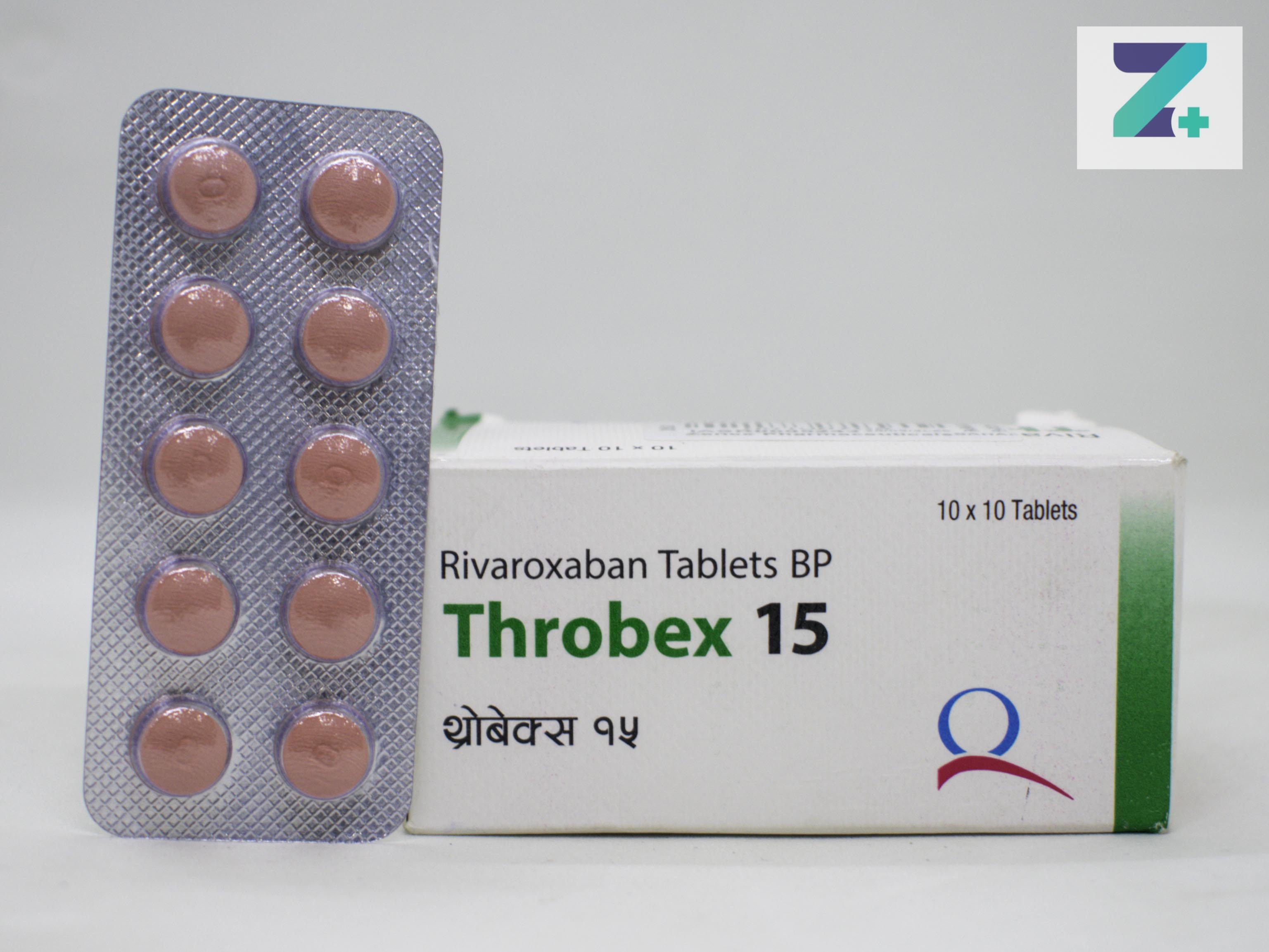
THROBEX 15
Price: Rs.800.00
15% off
In stock
Loose stock: 0
Description
THROBEX 15 TAB 10
Details
Composition
RIVAROXABAN 15 MG
# RIVAROXABAN 15 MG
## Short Description
**Rivaroxaban 15 mg** is an oral anticoagulant belonging to the **direct oral anticoagulant (DOAC)** class. It is a **direct Factor Xa inhibitor** that helps prevent blood clots from forming or growing.
Rivaroxaban may be prescribed for conditions such as **deep vein thrombosis (DVT), pulmonary embolism (PE), and prevention of stroke and systemic embolism in certain patients with non-valvular atrial fibrillation**. The appropriate strength and dosing schedule depend on the indication and kidney function.
## Key Benefits
* Helps prevent and treat certain **blood clots**.
* Helps reduce the risk of **stroke and systemic embolism** in eligible patients with non-valvular atrial fibrillation.
* Used in the treatment of **deep vein thrombosis (DVT)**.
* Used in the treatment of **pulmonary embolism (PE)**.
* Helps prevent recurrence of DVT and PE when continued as prescribed.
* Provides predictable anticoagulant activity without routine INR monitoring for most patients.
## Uses / Indications
Rivaroxaban 15 mg may be prescribed for:
* **Prevention of stroke and systemic embolism** in adults with non-valvular atrial fibrillation and appropriate risk factors.
* **Treatment of DVT**.
* **Treatment of pulmonary embolism (PE)**.
* **Reduction in the risk of recurrent DVT or PE** in appropriate patients.
* Other specific cardiovascular indications depending on the formulation, patient characteristics, and local prescribing guidelines.
**Important:** Rivaroxaban 15 mg is not the correct dose for every indication. Some conditions require 2.5 mg, 10 mg, or 20 mg dosing.
## How It Works
Rivaroxaban selectively and directly inhibits **Factor Xa**, an important enzyme in the blood-clotting process.
Factor Xa is involved in the conversion of prothrombin to thrombin. By inhibiting Factor Xa, rivaroxaban reduces thrombin generation and therefore decreases the formation of **fibrin blood clots**.
Unlike warfarin, rivaroxaban does not work by blocking vitamin K and generally does not require routine INR monitoring.
## Dosage & Administration
The correct dose depends on the medical condition, kidney function, age, and other factors.
### Important examples of dosing
* **Atrial fibrillation:** Rivaroxaban is commonly prescribed as **15 mg once daily with the evening meal** in adults with reduced kidney function within the approved range; patients with better kidney function may require 20 mg once daily.
* **Treatment of DVT/PE:** Treatment commonly begins with a higher initial dose before transitioning to a maintenance dose. **15 mg twice daily for the first 21 days** is a commonly used regimen, followed by 20 mg once daily.
* Other indications have different dosing schedules.
### Administration
* Take rivaroxaban **exactly as prescribed**.
* **15 mg and 20 mg tablets should be taken with food** to improve absorption.
* Swallow the tablet with water.
* Take it at approximately the same time each day.
* Do not stop rivaroxaban without medical advice because stopping anticoagulation suddenly can increase the risk of serious blood clots.
* If you miss a dose, follow the instructions specific to your prescribed regimen. Do not routinely double a once-daily dose.
**Do not change between 15 mg and 20 mg doses without medical advice.**
## Side Effects
The most important adverse effect of rivaroxaban is **bleeding**.
Common or possible side effects include:
* Easy bruising.
* Nosebleeds.
* Bleeding gums.
* Prolonged bleeding from minor cuts.
* Heavy menstrual bleeding.
* Anemia.
* Nausea.
* Gastrointestinal discomfort.
### Serious Side Effects
Seek immediate medical attention for:
* Severe or uncontrolled bleeding.
* Vomiting blood or material resembling coffee grounds.
* Black, tarry stools.
* Red or dark urine.
* Severe headache, dizziness, weakness, or fainting.
* Unexplained severe bruising.
* Coughing up blood.
* Severe abdominal pain.
* Signs of a stroke, such as sudden weakness, difficulty speaking, or facial drooping.
Spinal or epidural bleeding is a rare but serious complication associated with neuraxial anesthesia or spinal procedures.
## Precautions & Warnings
* Rivaroxaban can cause **serious and potentially life-threatening bleeding**.
* Tell your doctor if you have active bleeding or a condition that significantly increases bleeding risk.
* Inform your healthcare professional about any history of stomach ulcers, gastrointestinal bleeding, liver disease, or kidney disease.
* Kidney function should be assessed when determining the appropriate dose.
* Some liver diseases may make rivaroxaban unsuitable.
* Avoid unnecessary use of medicines that increase bleeding risk, particularly NSAIDs, unless advised by your doctor.
* Inform your dentist and other healthcare professionals that you are taking rivaroxaban before procedures.
* **Do not stop rivaroxaban abruptly** without medical advice.
* Seek urgent medical attention after a significant head injury, especially if you develop headache, confusion, weakness, vomiting, or unusual drowsiness.
* Tell your doctor if you are pregnant, planning pregnancy, or breastfeeding.
* Rivaroxaban is not generally recommended for patients with **mechanical heart valves** or certain types of significant valvular disease.
* Discuss any upcoming surgery, dental procedure, spinal injection, or epidural anesthesia with your healthcare team.
## Drug Interactions
Rivaroxaban has clinically important interactions with medicines that affect bleeding or alter rivaroxaban levels.
### Medicines that may increase bleeding risk
* **Aspirin**.
* Clopidogrel and other antiplatelet medicines.
* NSAIDs such as ibuprofen or naproxen.
* Other anticoagulants, including warfarin, heparin, and other DOACs.
* Certain antidepressants, including SSRIs and SNRIs, may increase bleeding risk.
### Medicines that may increase rivaroxaban levels
Strong inhibitors of CYP3A4 and P-glycoprotein may increase rivaroxaban exposure, including certain:
* Azole antifungals.
* HIV protease inhibitors.
* Other potent enzyme/transporter inhibitors.
### Medicines that may reduce rivaroxaban effectiveness
Strong CYP3A4/P-glycoprotein inducers can reduce rivaroxaban levels, including:
* Rifampicin.
* Carbamazepine.
* Phenytoin.
* Phenobarbital.
* St. John's wort.
Always tell your doctor or pharmacist about **all prescription medicines, over-the-counter medicines, vitamins, and herbal supplements** you take.
## Storage Information
* Store at room temperature according to the manufacturer's instructions.
* Keep in the original packaging.
* Protect from excessive heat and moisture.
* Keep the medicine away from direct sunlight.
* Keep out of reach of children.
* Do not use after the expiry date.
* Dispose of unused medicine according to local pharmacy guidance.
## Prescription Status
**Rivaroxaban 15 mg is a prescription-only anticoagulant in most countries.**
It should be taken only under the supervision of a qualified healthcare professional because the dose depends on the indication, kidney function, and individual bleeding/clotting risks.
## Genuine Medicine Assurance
When purchasing Rivaroxaban 15 mg, obtain it from a **licensed pharmacy or authorized medicine supplier**.
Before using the medicine, verify:
* Correct medicine name and **15 mg strength**.
* Manufacturer information.
* Batch or lot number.
* Manufacturing and expiry dates.
* Intact packaging and seals.
* Clear labeling and instructions.
Do not use tablets from packaging that appears damaged, opened, tampered with, or suspicious.
## Frequently Asked Questions (FAQ)
### 1. What is Rivaroxaban 15 mg used for?
Rivaroxaban 15 mg is an anticoagulant used for certain patients with **atrial fibrillation**, and as part of specific treatment regimens for **DVT and pulmonary embolism**.
### 2. Is rivaroxaban a blood thinner?
Yes. Rivaroxaban is commonly called a **blood thinner**, although it does not literally thin the blood. It reduces the blood's ability to form clots.
### 3. How does Rivaroxaban 15 mg work?
It directly blocks **Factor Xa**, reducing thrombin production and preventing the formation and growth of blood clots.
### 4. Should Rivaroxaban 15 mg be taken with food?
Yes. **15 mg and 20 mg rivaroxaban tablets should be taken with food** to ensure adequate absorption.
### 5. What is Rivaroxaban 15 mg used for in atrial fibrillation?
It may be used to reduce the risk of **stroke and systemic embolism** in eligible patients with non-valvular atrial fibrillation.
### 6. Can rivaroxaban treat a blood clot?
Yes. Rivaroxaban is used in approved treatment regimens for **DVT and pulmonary embolism**. The treatment schedule may begin with a different dose before transitioning to a maintenance dose.
### 7. Can I stop Rivaroxaban 15 mg suddenly?
**Do not stop rivaroxaban without medical advice.** Stopping anticoagulation prematurely can increase the risk of blood clots, stroke, DVT, or PE.
### 8. Does rivaroxaban cause bleeding?
Yes. Bleeding is the most important potential adverse effect. Seek urgent medical attention for severe, uncontrolled, or unusual bleeding.
### 9. Can I take aspirin with rivaroxaban?
Aspirin can increase bleeding risk when combined with rivaroxaban. Some patients are intentionally prescribed both, but **do not start aspirin without discussing it with your healthcare professional**.
### 10. Can I take ibuprofen while taking rivaroxaban?
Ibuprofen and other NSAIDs can increase bleeding risk. Ask your doctor or pharmacist before taking NSAIDs while using rivaroxaban.
### 11. Can I drink alcohol while taking rivaroxaban?
Alcohol can increase the risk of bleeding, particularly with heavy or frequent consumption. Discuss alcohol use with your healthcare professional.
### 12. Does rivaroxaban require regular INR testing?
Unlike warfarin, rivaroxaban generally **does not require routine INR monitoring** to adjust its anticoagulant effect. Kidney function and other clinical factors may still need monitoring.
### 13. Can rivaroxaban be taken during pregnancy?
Rivaroxaban is generally **not recommended during pregnancy** because anticoagulation requirements during pregnancy are different and there may be potential risks. If you are pregnant or planning pregnancy, contact your healthcare professional.
### 14. Can rivaroxaban be used while breastfeeding?
Discuss breastfeeding with your healthcare professional before taking rivaroxaban. An alternative anticoagulant may be preferred depending on the circumstances.
### 15. What happens if I miss a Rivaroxaban 15 mg dose?
The instructions depend on **why you are taking rivaroxaban and how often it is prescribed**. Follow the missed-dose instructions provided by your doctor or pharmacist. Do not automatically double a once-daily dose.
### 16. Can rivaroxaban cause stomach bleeding?
Yes. Rivaroxaban can cause gastrointestinal bleeding. Seek medical attention for black stools, vomiting blood, or persistent abdominal symptoms with signs of bleeding.
### 17. Is Rivaroxaban 15 mg safe for elderly people?
Older adults may use rivaroxaban when appropriately prescribed, but age-related changes in kidney function and increased bleeding risk need to be considered. The dose should be determined by a healthcare professional.
### 18. Can I undergo surgery while taking rivaroxaban?
You may need to temporarily stop rivaroxaban before certain surgical or dental procedures. **Never stop it on your own.** Your doctor will determine when it should be stopped and restarted.
### 19. Is Rivaroxaban 15 mg available without a prescription?
No. Rivaroxaban is generally a **prescription-only anticoagulant** and should only be used under appropriate medical supervision.
### 20. What should I do if I accidentally take too much rivaroxaban?
An overdose can significantly increase the risk of serious bleeding. Contact a healthcare professional or emergency medical service immediately, particularly if you develop bleeding, dizziness, weakness, vomiting blood, or black stools.
## Medical Disclaimer
This information about **Rivaroxaban 15 mg** is provided for general educational and informational purposes only. It is not a substitute for professional medical advice, diagnosis, or treatment.
Rivaroxaban is a **potent anticoagulant**, and incorrect dosing or discontinuation can result in serious bleeding or potentially dangerous blood clots. The appropriate dose depends on the condition being treated and factors such as kidney function and bleeding risk.
**Always take rivaroxaban exactly as prescribed. Do not start, stop, or change the dose without consulting your healthcare professional.** Seek urgent medical attention for severe or uncontrolled bleeding, signs of stroke, coughing or vomiting blood, black stools, or other serious symptoms.