TRANCAP 250
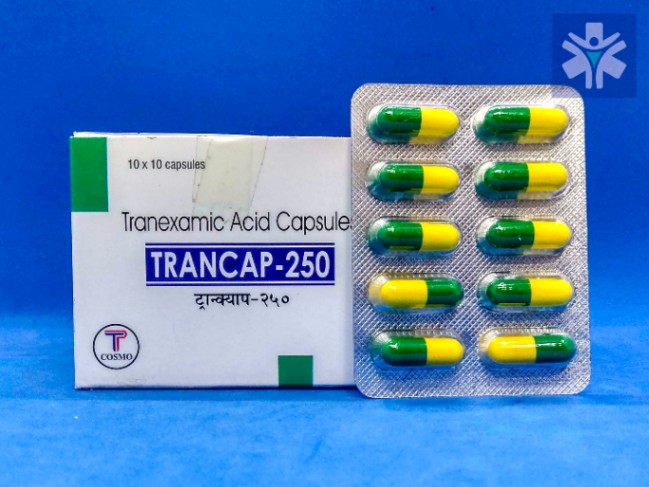
Price: Rs.120.00
10% off
In stock
Loose stock: 0
Description
TRANCAP 250 CAP 10
Details
Composition
TRANEXAMIC ACID 250 MG
# Tranexamic Acid 250 mg
## Short Description
**Tranexamic Acid 250 mg** is an antifibrinolytic medicine used to help **reduce or prevent excessive bleeding**. It works by helping stabilize blood clots that have already formed, thereby reducing the breakdown of clots.
It may be prescribed for conditions involving excessive bleeding, including certain menstrual bleeding disorders, dental or surgical bleeding, and other bleeding conditions when medically appropriate.
---
## Key Benefits
* Helps **reduce excessive bleeding**.
* Helps stabilize blood clots and prevent their premature breakdown.
* May reduce heavy menstrual bleeding.
* Can be used to control bleeding associated with certain surgical or dental procedures.
* May be useful in selected bleeding disorders under medical supervision.
* Helps reduce blood loss without directly increasing clot formation in the same way as traditional pro-clotting medicines.
---
## Uses / Indications
Tranexamic Acid 250 mg may be prescribed for:
* **Heavy menstrual bleeding (menorrhagia)**
* Bleeding associated with certain dental procedures
* Surgical bleeding
* Nosebleeds (epistaxis) in selected circumstances
* Bleeding associated with certain trauma or medical conditions
* Other conditions involving excessive bleeding, as determined by a healthcare professional
The indication and treatment duration depend on the **cause and severity of bleeding**.
> **Important:** Unexplained or unusually heavy bleeding should be medically evaluated rather than repeatedly treated with tranexamic acid without identifying the cause.
---
## How It Works
Tranexamic acid is an **antifibrinolytic medicine**.
When bleeding occurs, the body forms a blood clot to stop blood loss. The body also naturally produces a substance called **plasmin**, which breaks down fibrin, an important component of blood clots.
Tranexamic acid blocks the interaction of plasminogen/plasmin with fibrin. This helps:
**Reduce fibrin breakdown → stabilize the blood clot → reduce ongoing bleeding**
Tranexamic acid does not work by directly creating a new blood clot; rather, it helps prevent existing clots from breaking down too quickly.
---
## Dosage & Administration
**Take Tranexamic Acid 250 mg exactly as prescribed by your doctor.**
The dose varies substantially depending on the condition being treated.
### General Administration
* Take orally with water.
* It may generally be taken with or without food.
* Swallow tablets whole unless the product instructions state otherwise.
* Follow the prescribed dosing schedule.
* Do not take more tablets than prescribed.
* Do not continue treatment longer than recommended.
### For Heavy Menstrual Bleeding
The exact dose and treatment schedule should be determined by your healthcare professional based on the severity of bleeding and the specific formulation.
### Missed Dose
Take the missed dose when remembered unless it is nearly time for your next dose.
**Do not take a double dose to make up for a missed dose.**
### Important
People with **kidney impairment may require dose adjustment** because tranexamic acid is primarily eliminated through the kidneys.
---
## Side Effects
### Common Side Effects
Possible side effects include:
* Nausea
* Vomiting
* Diarrhea
* Abdominal discomfort
* Headache
* Dizziness
* Fatigue
### Less Common but Important Side Effects
* Visual disturbances
* Changes in color vision
* Low blood pressure, particularly with rapid intravenous administration
* Allergic reactions
### Serious Side Effects
Seek urgent medical attention if you develop symptoms suggestive of a blood clot, such as:
* Sudden chest pain
* Difficulty breathing
* Coughing blood
* Sudden weakness or numbness
* Difficulty speaking
* Severe headache
* Sudden vision changes
* Painful swelling or redness in an arm or leg
These symptoms may indicate **thrombosis** and require immediate medical evaluation.
---
## Precautions & Warnings
* **History of blood clots:** Tell your doctor if you have previously had deep-vein thrombosis, pulmonary embolism, stroke, or other thrombotic disease.
* **Kidney disease:** Dose adjustment may be required.
* **Visual disturbances:** Report changes in vision or color perception promptly.
* **Seizure history:** High doses, particularly in certain surgical settings, have been associated with an increased risk of seizures.
* **Blood in urine:** Tranexamic acid requires particular caution in some cases of urinary tract bleeding because clot formation can potentially obstruct the urinary tract.
* **Unexplained bleeding:** The underlying cause should be investigated.
* **Heavy menstrual bleeding:** Seek medical evaluation if bleeding is new, unusually severe, or associated with significant pain or other symptoms.
* **Pregnancy:** Use only when recommended by a healthcare professional.
* **Breastfeeding:** Consult your doctor before use.
* Do not exceed the prescribed dose.
* Tell your doctor about all medicines and supplements you are taking.
---
## Drug Interactions
Tranexamic acid may interact with certain medicines.
### Hormonal Contraceptives
Combined hormonal contraceptives containing **estrogen and/or progestin** may increase the risk of blood clots. Using them together with tranexamic acid may require careful medical assessment, particularly in people with other thrombotic risk factors.
### Other Medicines Affecting Blood Clotting
Tell your healthcare professional if you take:
* Anticoagulants
* Antiplatelet medicines
* Other antifibrinolytic medicines
* Medicines affecting blood clotting
The clinical significance of these combinations varies, so treatment should be individualized.
### Other Important Medicines
Always inform your doctor if you take prescription medicines, OTC medicines, vitamins, herbal products, or dietary supplements.
---
## Storage Information
* Store according to the manufacturer's instructions.
* Keep the tablets in their **original packaging**.
* Protect from excessive heat, moisture, and direct sunlight.
* Keep out of reach and sight of children.
* Do not use after the expiry date.
* Keep the container tightly closed where applicable.
* Do not use the medicine if the packaging is damaged or the tablets appear abnormal.
---
## Prescription Status
**Tranexamic Acid 250 mg is generally a prescription medicine, although availability and legal status vary between countries and formulations.**
Because tranexamic acid affects the body's clot-stabilization system and may not be appropriate for people at increased risk of thrombosis, it should be used according to professional medical advice.
---
## Genuine Medicine Assurance
When purchasing **Tranexamic Acid 250 mg**, obtain it from a **licensed pharmacy or authorized medicine supplier**.
Before using the product, check:
* Product name and strength
* Manufacturer details
* Batch/lot number
* Manufacturing date
* Expiry date
* Packaging integrity
* Product registration/authorization details where applicable
* Security or authenticity features, if provided
Avoid purchasing prescription medicines from unknown or unauthorized sources.
---
# FAQ – Tranexamic Acid 250 mg
### 1. What is Tranexamic Acid 250 mg used for?
Tranexamic acid is used to **reduce or control excessive bleeding** in certain conditions, including heavy menstrual bleeding and bleeding associated with some surgical or dental procedures.
### 2. Is Tranexamic Acid a blood thinner?
No. Tranexamic acid is **not a blood thinner**. It is an antifibrinolytic medicine that helps prevent blood clots from breaking down too quickly.
### 3. How does Tranexamic Acid stop bleeding?
It helps stabilize blood clots by reducing the breakdown of **fibrin**, an important structural component of a blood clot.
### 4. Is Tranexamic Acid used for heavy periods?
Yes. It is commonly prescribed to help reduce **heavy menstrual bleeding** in appropriate patients.
### 5. Does Tranexamic Acid stop menstruation?
No. It does not normally stop menstruation completely. It helps **reduce excessive menstrual blood loss**.
### 6. How quickly does Tranexamic Acid work?
The onset depends on the condition and formulation. When used for heavy menstrual bleeding, it is generally taken during the days of heavy bleeding according to the prescribed schedule.
### 7. Can Tranexamic Acid be taken every day?
The appropriate treatment duration depends on the medical condition. It should **not be taken continuously or long-term unless specifically prescribed**.
### 8. Can Tranexamic Acid cause blood clots?
Tranexamic acid stabilizes blood clots rather than directly creating them. However, people with certain thrombotic conditions or risk factors may require special caution.
### 9. Can I take Tranexamic Acid if I have had a blood clot before?
Tell your doctor if you have a history of **deep-vein thrombosis, pulmonary embolism, stroke, or other blood clots**. Your doctor will determine whether tranexamic acid is appropriate.
### 10. Can Tranexamic Acid be taken with birth-control pills?
Some hormonal contraceptives may increase the risk of blood clots. The combination with tranexamic acid should therefore be discussed with a healthcare professional, particularly if you have additional clotting risk factors.
### 11. Can Tranexamic Acid be used during pregnancy?
Tranexamic acid should be used during pregnancy **only when recommended by a healthcare professional**.
### 12. Can Tranexamic Acid be used while breastfeeding?
Consult your healthcare professional before using tranexamic acid while breastfeeding.
### 13. What are the common side effects of Tranexamic Acid?
Common side effects may include **nausea, vomiting, diarrhea, abdominal discomfort, headache, dizziness, and fatigue**.
### 14. Can Tranexamic Acid affect vision?
Visual disturbances can occur. **Changes in vision or color perception should be reported to a healthcare professional promptly.**
### 15. Can Tranexamic Acid be used for nosebleeds?
It may be used for certain nosebleeds under medical supervision. Recurrent or unexplained nosebleeds should be evaluated to identify the underlying cause.
### 16. Can Tranexamic Acid be used after dental procedures?
Yes, it may be prescribed in selected patients to help control bleeding following dental procedures, particularly in certain bleeding disorders.
### 17. What should I do if I miss a dose?
Take the missed dose when you remember unless it is nearly time for the next dose. **Do not take two doses together.**
### 18. What happens if I take too much Tranexamic Acid?
An overdose may cause nausea, vomiting, dizziness, low blood pressure, or other serious effects. High exposure may also increase the risk of seizures or other complications. **Seek urgent medical attention if an overdose is suspected.**
### 19. Can people with kidney disease take Tranexamic Acid?
Yes, it may sometimes be used, but **dose adjustment is often necessary** because tranexamic acid is primarily eliminated by the kidneys.
### 20. When should I seek urgent medical help while taking Tranexamic Acid?
Seek immediate medical attention for **chest pain, difficulty breathing, coughing blood, sudden weakness or numbness, severe headache, sudden vision changes, or painful swelling of an arm or leg**.
---
## Medical Disclaimer
**This information is provided for educational and informational purposes only and is not a substitute for professional medical advice, diagnosis, or treatment.**
Tranexamic Acid 250 mg should be used according to the instructions of a qualified healthcare professional. The appropriate dose and duration depend on the cause and severity of bleeding, kidney function, medical history, and other medicines being taken.
Patients with a history of **blood clots, kidney disease, seizures, or visual problems** should inform their healthcare professional before using tranexamic acid. Seek urgent medical attention for symptoms that could indicate a blood clot or serious adverse reaction.
Do not use tranexamic acid repeatedly for unexplained bleeding without medical evaluation.
**Always read the manufacturer's package insert and follow the approved prescribing information applicable to your country.**