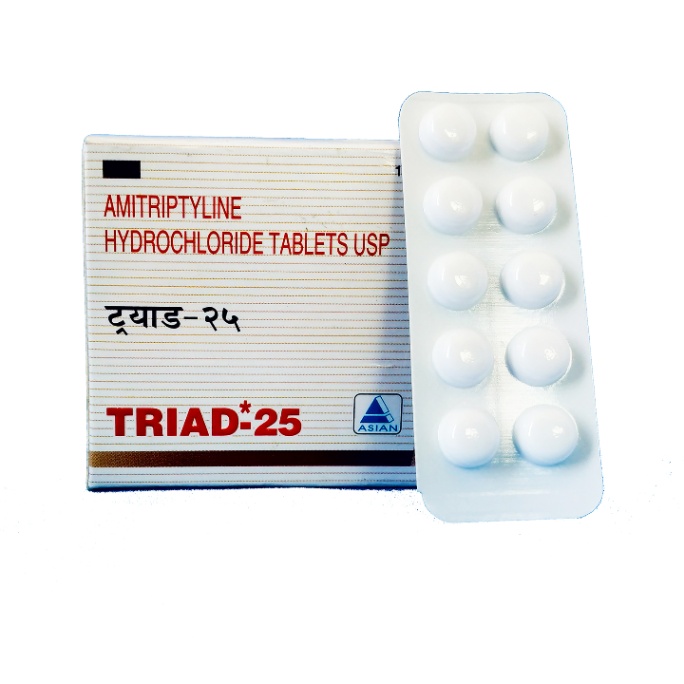
TRIAD-25
Price: Rs.38.00
10% off
In stock
Loose stock: 0
Description
TRIAD-25 TAB 10
Details
Composition
AMITRIPTYLINE HYDROCHLORIDE25
# Amitriptyline Hydrochloride 25 mg
## SHORT DESCRIPTION
Amitriptyline Hydrochloride 25 mg is a **tricyclic antidepressant (TCA)** medicine. Although originally developed to treat depression, it is also commonly prescribed at lower doses for certain types of **nerve pain**, migraine prevention and other conditions when clinically appropriate.
Amitriptyline affects neurotransmitters such as **serotonin and norepinephrine** in the brain and nervous system. It can also have sedative and anticholinergic effects.
## KEY BENEFITS
* Helps manage **certain types of nerve pain**
* May help reduce symptoms of depression when prescribed at an appropriate dose
* May help prevent certain types of migraine
* Can improve sleep when pain or other conditions interfere with sleep
* May help reduce persistent pain associated with some chronic conditions
* Provides effects on serotonin and norepinephrine pathways involved in mood and pain processing
## USES / INDICATIONS
Amitriptyline Hydrochloride 25 mg may be prescribed for:
* **Depression**
* Neuropathic or nerve pain
* Certain chronic pain conditions
* Prevention of migraine or recurrent headache in selected patients
* Certain sleep problems when associated with an underlying condition, when prescribed by a healthcare professional
The appropriate indication and dose depend on the patient's condition.
## HOW IT WORKS
Amitriptyline inhibits the reuptake of **serotonin and norepinephrine** in the nervous system. This increases the activity of these neurotransmitters and contributes to its antidepressant and pain-modulating effects.
It also acts on several other receptors, which contributes to effects such as:
* Sedation
* Dry mouth
* Reduced intestinal activity
* Changes in heart rate
For nerve pain, its effects on pain-processing pathways can reduce abnormal pain signaling even when the patient does not have depression.
## DOSAGE & ADMINISTRATION
* Take Amitriptyline 25 mg exactly as prescribed.
* It is commonly taken **once daily**, often in the evening because it can cause drowsiness.
* Swallow the tablet with water.
* It can generally be taken with or without food.
* Take it at approximately the same time each day.
* Do not increase or decrease the dose without medical advice.
* Do not stop long-term treatment suddenly without consulting your doctor.
The dose varies considerably depending on whether it is being used for depression, nerve pain, migraine prevention or another condition.
### Missed Dose
Take the missed dose when remembered unless it is nearly time for the next dose. Do not take two doses together to compensate.
## SIDE EFFECTS
Common side effects may include:
* Drowsiness
* Dry mouth
* Constipation
* Blurred vision
* Dizziness
* Headache
* Increased sweating
* Fatigue
* Nausea
* Difficulty urinating
* Increased appetite or weight gain
* Changes in blood pressure
Many side effects may improve as the body becomes accustomed to the medicine.
### Serious Side Effects
Seek medical attention for:
* Fast, irregular or pounding heartbeat
* Fainting
* Severe dizziness
* Seizures
* Severe confusion or agitation
* Significant difficulty passing urine
* Severe allergic reaction
* Severe mood changes or suicidal thoughts
## PRECAUTIONS & WARNINGS
* Amitriptyline can cause **drowsiness and dizziness**. Avoid driving or operating machinery until you know how it affects you.
* Alcohol can increase sedation and other central nervous system effects.
* Use cautiously in people with heart disease or abnormal heart rhythms.
* Tell your doctor if you have glaucoma, particularly **angle-closure glaucoma**.
* Inform your doctor if you have difficulty urinating or prostate-related urinary problems.
* Use caution if you have epilepsy or a history of seizures.
* Tell your doctor about liver disease.
* Older adults may be more sensitive to dizziness, confusion, constipation and urinary difficulties.
* Antidepressants may increase the risk of **suicidal thoughts or behavior**, particularly in children, adolescents and young adults. Seek urgent medical help for new or worsening suicidal thoughts or major behavioral changes.
* Do not stop the medicine suddenly after prolonged treatment unless advised by your doctor.
* Amitriptyline should not generally be used with **MAO inhibitors**.
* Tell your healthcare professional about all medicines and supplements you take.
## DRUG INTERACTIONS
Important interactions may occur with:
* **MAO inhibitors** — potentially dangerous interaction; these medicines should not generally be combined.
* Other antidepressants — may increase serotonin-related or other adverse effects.
* **SSRIs**, particularly fluoxetine and paroxetine — may increase amitriptyline concentrations.
* Opioids such as codeine, tramadol or morphine — may increase drowsiness and, with some opioids, the risk of serotonin toxicity.
* Alcohol — may increase sedation and impaired coordination.
* Sleeping medicines and sedatives — may increase central nervous system depression.
* Antihistamines with sedating or anticholinergic properties — may increase drowsiness, dry mouth and other anticholinergic effects.
* Certain heart medicines — may increase the risk of abnormal heart rhythms.
* Other medicines that prolong the **QT interval** — may increase the risk of cardiac rhythm disturbances.
* Anticholinergic medicines — may increase dry mouth, constipation, blurred vision and urinary retention.
Always provide your doctor or pharmacist with a complete list of your prescription medicines, OTC medicines, vitamins and herbal supplements.
## STORAGE INFORMATION
* Store according to the manufacturer's instructions.
* Keep at the recommended room temperature.
* Protect from excessive heat, moisture and direct sunlight.
* Keep the tablets in their original packaging.
* Keep out of reach of children.
* Do not use after the expiry date.
* Do not use tablets if the packaging is damaged.
## PRESCRIPTION STATUS
**Prescription medicine.**
Amitriptyline Hydrochloride 25 mg should be used under the supervision of a qualified healthcare professional because of its potential effects on the heart, nervous system and other body systems.
## GENUINE MEDICINE ASSURANCE
For safe and genuine Amitriptyline Hydrochloride 25 mg:
* Purchase from a licensed and reputable pharmacy.
* Check the medicine name and strength.
* Verify the manufacturer's details.
* Check the batch number and expiry date.
* Confirm the expiry date before use.
* Ensure the packaging and seal are intact.
* Avoid products with damaged or suspicious packaging.
* Purchase prescription medicines only from authorized sources.
* Consult a pharmacist if you have concerns about product authenticity.
## FAQ
### What is Amitriptyline Hydrochloride 25 mg used for?
Amitriptyline 25 mg may be prescribed for **nerve pain, migraine prevention, depression and certain chronic pain conditions**. The appropriate use depends on the individual patient.
### Is Amitriptyline a sleeping tablet?
No. Amitriptyline is an **antidepressant**, not a conventional sleeping tablet. However, it can cause drowsiness and may be prescribed in some situations where sleep is affected by pain or another condition.
### Is Amitriptyline used for nerve pain?
Yes. Amitriptyline is commonly prescribed for certain forms of **neuropathic pain**, even when depression is not present.
### Does Amitriptyline help with migraine?
Amitriptyline may be prescribed to **prevent migraine attacks** and reduce their frequency in some patients. It is generally not used to provide immediate relief from an acute migraine attack.
### How does Amitriptyline work for nerve pain?
It changes the activity of serotonin and norepinephrine pathways involved in pain processing, helping reduce abnormal pain signals in the nervous system.
### When should Amitriptyline 25 mg be taken?
It is often taken in the **evening or at bedtime** because it can cause drowsiness. Follow the timing prescribed by your doctor.
### Does Amitriptyline cause sleepiness?
Yes. **Drowsiness is a common effect**, particularly when treatment is started or the dose is increased.
### Can I drive after taking Amitriptyline?
Do not drive or operate machinery until you know how the medicine affects you. Amitriptyline can cause drowsiness, dizziness and impaired alertness.
### Can Amitriptyline cause weight gain?
Yes. Increased appetite and **weight gain** can occur in some people taking amitriptyline.
### Does Amitriptyline cause dry mouth?
Yes. Dry mouth is a common anticholinergic effect of amitriptyline. Drinking water regularly and maintaining good oral hygiene may help.
### Can Amitriptyline cause constipation?
Yes. Constipation can occur because of its anticholinergic effects. Adequate fluids, dietary fiber and physical activity may help where appropriate.
### Can I drink alcohol while taking Amitriptyline?
Alcohol may increase **drowsiness, dizziness and impaired coordination**. It is generally best to avoid or limit alcohol and discuss alcohol use with your healthcare professional.
### Can Amitriptyline be taken with other antidepressants?
Sometimes antidepressants are combined under specialist supervision, but certain combinations can cause serious interactions. Never combine antidepressants without medical advice.
### Can Amitriptyline be taken with painkillers?
Some pain medicines can be used with amitriptyline, but interactions are possible. In particular, certain opioids can increase sedation and may increase the risk of serotonin toxicity.
### Can Amitriptyline be stopped suddenly?
Stopping amitriptyline suddenly after regular long-term use may cause withdrawal symptoms or recurrence of the treated condition. Your doctor may recommend gradually reducing the dose.
### How long does Amitriptyline take to work?
For pain and migraine prevention, improvement may take **several days to several weeks**. Antidepressant effects generally take longer to become apparent.
### Can Amitriptyline be used during pregnancy?
Discuss amitriptyline use with your doctor if you are pregnant or planning pregnancy. Your healthcare professional will weigh the potential benefits and risks.
### Can Amitriptyline be used while breastfeeding?
Amitriptyline may be used in some breastfeeding patients, but medical advice is recommended to determine whether it is appropriate for you and to monitor the infant when necessary.
### What happens if I take too much Amitriptyline?
Amitriptyline overdose can be **life-threatening** and may cause severe drowsiness, seizures, abnormal heart rhythms, low blood pressure, unconsciousness or other serious effects. Seek emergency medical attention immediately if an overdose is suspected.
### What should I do if I miss an Amitriptyline dose?
Take it when remembered unless it is nearly time for the next dose. Do not take a double dose to compensate for a missed tablet.
### How should Amitriptyline 25 mg be stored?
Store it according to the manufacturer's instructions, generally at room temperature and protected from heat, moisture and direct sunlight. Keep it out of reach of children.
## MEDICAL DISCLAIMER
This information is provided for educational and informational purposes only and does not replace professional medical advice, diagnosis or treatment. **Amitriptyline Hydrochloride 25 mg is a prescription medicine and should be used only as directed by a qualified healthcare professional.** It can cause drowsiness, anticholinergic effects and, in susceptible individuals, potentially serious heart rhythm problems. Antidepressant treatment may also require monitoring for significant mood changes or suicidal thoughts. Do not start, stop or change the dose without medical advice. Always follow the specific product label and your healthcare professional's instructions.