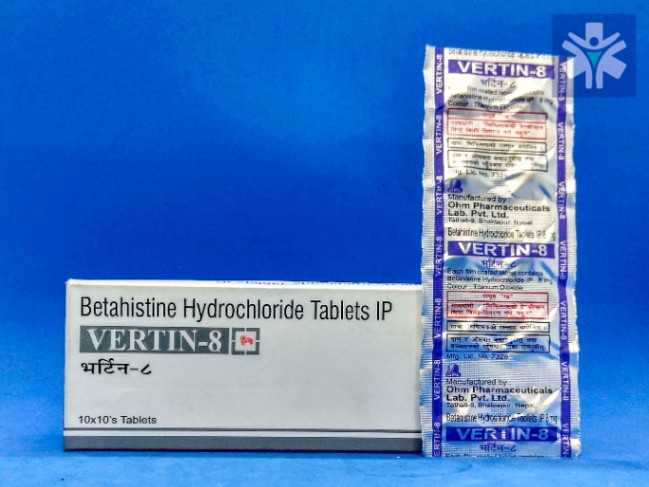
VERTIN-8
Price: Rs.100.00
15% off
In stock
Loose stock: 0
Description
VERTIN-8 TAB 10
Details
Composition
BETAHISTINE 8 MG
# BETAHISTINE 8 MG
## SHORT DESCRIPTION
**Betahistine 8 mg** is a medicine commonly used to manage symptoms associated with **Ménière's disease and other vestibular disorders**, particularly **vertigo (spinning sensation), tinnitus (ringing in the ears), and hearing-related symptoms**.
Betahistine is a histamine analogue that is thought to improve blood flow in the inner ear and help regulate pressure in the endolymphatic system.
---
## KEY BENEFITS
* Helps reduce the frequency and severity of **vertigo attacks** in appropriate patients.
* May help manage **tinnitus** associated with Ménière's disease.
* May help improve ear-related pressure or fullness.
* Can support management of vestibular symptoms associated with Ménière's disease.
* May improve balance-related symptoms over continued treatment in some patients.
> Betahistine is generally intended for **regular treatment**, rather than immediate relief of a sudden severe vertigo attack.
---
## USES / INDICATIONS
Betahistine may be prescribed for:
* **Ménière's disease**
* Recurrent vestibular vertigo associated with Ménière's disease
* Vertigo associated with certain inner-ear disorders
* Tinnitus or a feeling of pressure/fullness in the ear when associated with an underlying vestibular disorder
### Typical Symptoms of Ménière's Disease
Ménière's disease can involve:
* Episodes of spinning vertigo
* Tinnitus
* Hearing loss
* Ear fullness or pressure
The exact indication depends on the patient's diagnosis and local prescribing guidelines.
---
## HOW IT WORKS
Betahistine is structurally related to **histamine** and acts primarily as a **histamine H1 receptor agonist and H3 receptor antagonist**.
Its effects are thought to include increased blood flow in the inner ear and modulation of vestibular signaling.
### In Simple Terms
**Betahistine → influences histamine receptors → may improve inner-ear microcirculation and vestibular regulation → may reduce recurrent vertigo symptoms.**
The exact mechanism by which betahistine improves Ménière's symptoms is not completely established.
---
## DOSAGE & ADMINISTRATION
* Take **Betahistine 8 mg exactly as prescribed**.
* The dose and frequency vary depending on the severity of symptoms and the patient's response.
* Betahistine is commonly taken **with or after food** to reduce the likelihood of stomach discomfort.
* Swallow tablets with water.
* Take doses at regular intervals as directed.
### Missed Dose
Take the missed dose when remembered unless it is nearly time for the next dose.
**Do not take two doses together to make up for a missed dose.**
### Important
Betahistine may require **regular use over a period of time** before the full therapeutic benefit becomes apparent. Do not discontinue treatment simply because symptoms improve unless advised by your healthcare professional.
---
## SIDE EFFECTS
### Common Side Effects
Possible side effects include:
* Headache
* Nausea
* Indigestion
* Stomach discomfort
* Bloating
Taking betahistine with food may help reduce gastrointestinal symptoms.
### Rare but Serious Side Effects
Seek immediate medical attention if you experience symptoms of a serious allergic reaction, such as:
* Swelling of the face, lips, tongue, or throat
* Difficulty breathing
* Severe rash
* Fainting
---
## PRECAUTIONS & WARNINGS
### Asthma
Betahistine should be used with caution in people with **bronchial asthma**, as histamine-related effects may potentially affect bronchial function.
### Peptic Ulcer Disease
Tell your healthcare professional if you have a history of:
* Stomach ulcers
* Duodenal ulcers
* Recurrent severe gastritis
Betahistine may cause gastrointestinal irritation in some people.
### Pheochromocytoma
Betahistine is generally **contraindicated in patients with pheochromocytoma**, a rare tumor of the adrenal gland.
### Pregnancy
Tell your doctor if you are pregnant or planning pregnancy. Betahistine should generally be used during pregnancy only when clearly needed and recommended by a healthcare professional.
### Breastfeeding
Discuss betahistine use with your healthcare professional if breastfeeding because adequate information about its presence in breast milk is limited.
### Children
Betahistine is generally not recommended for children unless specifically prescribed by a specialist.
### Driving and Operating Machinery
Vertigo itself can impair driving and balance. If betahistine causes headache, dizziness, or other symptoms that affect alertness, avoid driving or operating machinery until you feel safe.
---
## DRUG INTERACTIONS
### Antihistamines
Antihistamines may theoretically reduce some of the effects of betahistine because they act on histamine receptors.
Examples include:
* Cetirizine
* Loratadine
* Fexofenadine
* Chlorpheniramine
The clinical significance of this interaction may vary.
### MAO Inhibitors
**Monoamine oxidase (MAO) inhibitors** may potentially increase exposure to betahistine or its effects. Inform your healthcare professional if you take medicines such as certain antidepressants or medicines used for Parkinson's disease.
### Other Medicines
Tell your doctor or pharmacist about all:
* Prescription medicines
* OTC medicines
* Antihistamines
* Antidepressants
* Herbal supplements
* Vitamins
Do not start or stop regular medicines without professional advice.
---
## STORAGE INFORMATION
* Store according to the **manufacturer's instructions**.
* Keep the tablets in their original packaging.
* Store in a cool, dry place.
* Protect from excessive heat, moisture, and direct sunlight.
* Keep out of reach of children.
* Keep the container tightly closed.
* Do not use after the expiry date.
* Do not use tablets if the packaging is damaged or the tablets have visibly deteriorated.
---
## PRESCRIPTION STATUS
**Betahistine 8 mg is a prescription medicine in many countries**, although its legal classification varies by country.
It should be used following appropriate assessment of the cause of vertigo, especially when symptoms are new, severe, persistent, or associated with hearing or neurological changes.
---
## GENUINE MEDICINE ASSURANCE
When purchasing Betahistine 8 mg:
* Buy from a **licensed pharmacy or authorized medicine supplier**.
* Check that the packaging is original and properly sealed.
* Verify the medicine name and strength.
* Check the **batch/lot number and expiry date**.
* Ensure the manufacturer's details are clearly displayed.
* Check for signs of tampering or damaged packaging.
* Ensure the medicine has been stored appropriately.
Do not use expired, damaged, or suspicious medicines.
---
# FAQ – BETAHISTINE 8 MG
### 1. What is Betahistine 8 mg used for?
Betahistine is commonly prescribed to manage symptoms associated with **Ménière's disease**, including recurrent vertigo, tinnitus, hearing-related symptoms, and ear fullness.
### 2. Is Betahistine used for vertigo?
Yes. Betahistine is commonly prescribed for certain types of **vestibular vertigo**, particularly vertigo associated with Ménière's disease.
### 3. Does Betahistine cure Ménière's disease?
Betahistine does not cure Ménière's disease. It is used to **help control symptoms and reduce the frequency or severity of vertigo attacks** in appropriate patients.
### 4. How does Betahistine work?
It acts on histamine receptors and is thought to influence **inner-ear circulation and vestibular signaling**.
### 5. How should Betahistine 8 mg be taken?
Take it exactly as prescribed, usually at regular intervals. Taking it **with or after food** may help reduce stomach discomfort.
### 6. Can Betahistine be taken on an empty stomach?
It can be taken that way if prescribed, but taking it with or after food may help reduce gastrointestinal side effects.
### 7. How long does Betahistine take to work?
The response varies. Some patients may notice improvement after treatment begins, while others may require **several weeks of regular treatment**.
### 8. Can Betahistine stop a sudden vertigo attack immediately?
Betahistine is generally used as a **regular preventive/symptom-control treatment**, rather than as an immediate rescue medicine for an acute vertigo attack.
### 9. Can Betahistine help tinnitus?
It may help tinnitus when the tinnitus is associated with **Ménière's disease or an underlying vestibular disorder**, but it does not reliably treat every cause of tinnitus.
### 10. Can Betahistine improve hearing loss?
Betahistine is not primarily a treatment for permanent hearing loss. Hearing symptoms associated with Ménière's disease should be evaluated by an appropriate healthcare professional.
### 11. Can I take Betahistine with Cetirizine?
Cetirizine is an antihistamine. Antihistamines may theoretically reduce some effects of betahistine. Discuss the combination with your doctor or pharmacist before using them together regularly.
### 12. Can people with asthma take Betahistine?
People with asthma should tell their healthcare professional before taking betahistine. It may require additional caution.
### 13. Can people with stomach ulcers take Betahistine?
People with a history of peptic ulcers should inform their healthcare professional. Betahistine may cause gastrointestinal discomfort in some patients.
### 14. Who should not take Betahistine?
Betahistine is generally contraindicated in people with **pheochromocytoma** and may not be suitable for some people with asthma or active peptic ulcer disease without medical supervision.
### 15. Can Betahistine cause sleepiness?
Sleepiness is not among its most characteristic adverse effects, but individual responses can vary. If you feel impaired, avoid driving or operating machinery.
### 16. Can Betahistine be taken during pregnancy?
Consult your healthcare professional before taking betahistine during pregnancy. It should generally be used only when clearly indicated.
### 17. Can Betahistine be taken while breastfeeding?
Discuss its use with your healthcare professional because information regarding betahistine during breastfeeding is limited.
### 18. What should I do if I miss a Betahistine dose?
Take the missed dose when remembered unless it is close to the next dose. **Do not double the dose.**
### 19. Can Betahistine be taken long term?
It may be prescribed for longer-term symptom management in some patients with Ménière's disease. The duration should be determined by your healthcare professional.
### 20. Is Betahistine 8 mg available without a prescription?
Betahistine is **prescription-only in many countries**, although regulations differ between countries.
---
## MEDICAL DISCLAIMER
This information about **Betahistine 8 mg** is provided for educational and informational purposes only and is not a substitute for professional medical advice, diagnosis, or treatment.
Vertigo can have many different causes. Betahistine is not appropriate for every type of dizziness or balance problem. New or severe vertigo, especially when accompanied by **severe headache, weakness, difficulty speaking, fainting, chest pain, new hearing loss, or other neurological symptoms**, requires prompt medical assessment.
Patients with **asthma, peptic ulcer disease, pheochromocytoma, pregnancy, or breastfeeding** should consult a healthcare professional before use.
Always take Betahistine according to the prescribed dose and the instructions provided with the specific product.