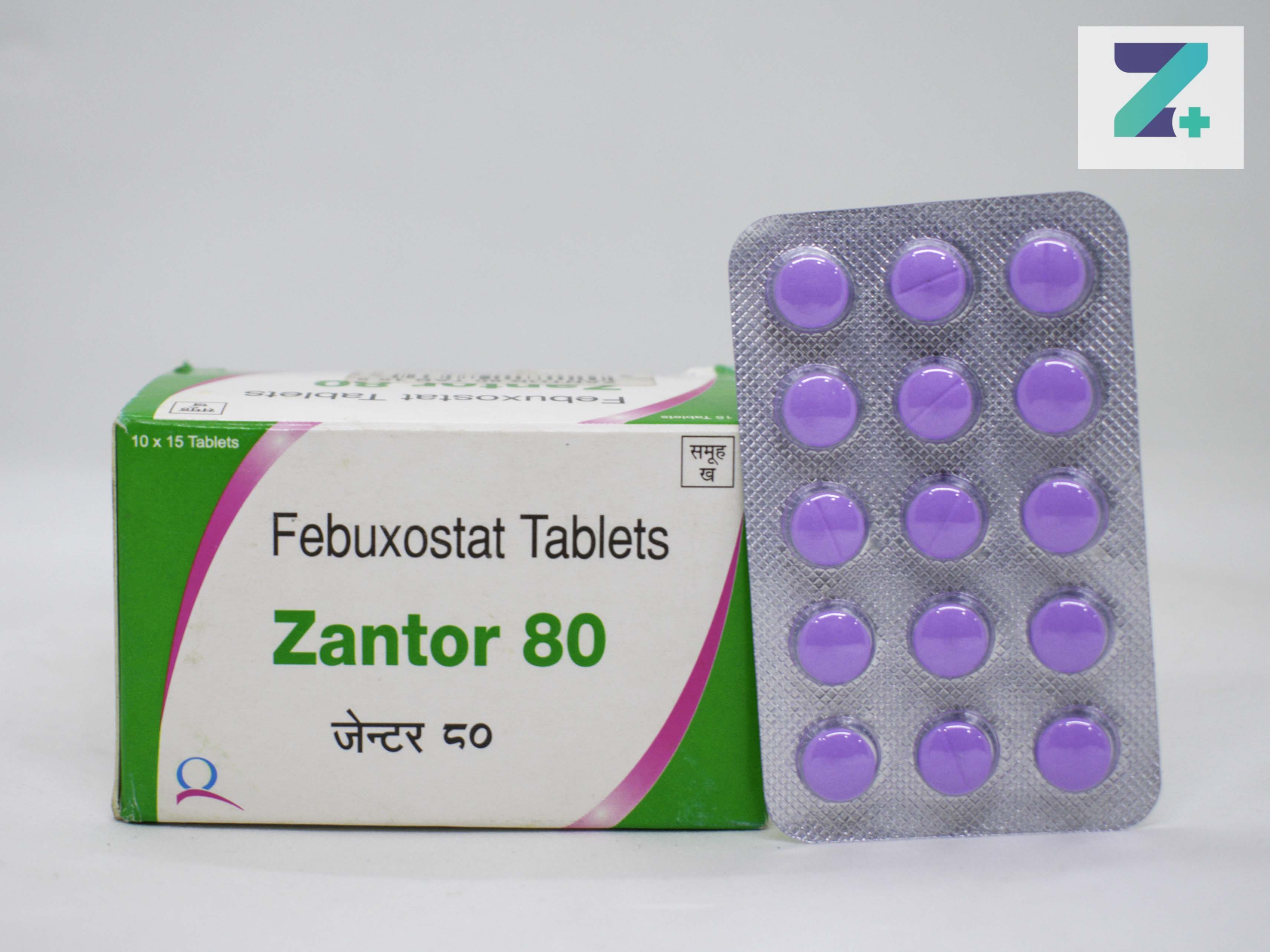
ZANTOR 80
Price: Rs.225.00
15% off
In stock
Loose stock: 0
Description
ZANTOR 80 TAB 15
Details
Composition
FEBUXOSTAT 80 MG
# FEBUXOSTAT 80 MG
## SHORT DESCRIPTION
**Febuxostat 80 mg** is a prescription medicine used to lower **uric acid levels in the blood** in people with **gout and hyperuricemia**. It belongs to a class of medicines called **xanthine oxidase inhibitors**.
Febuxostat reduces the body's production of uric acid and helps prevent the formation of urate crystals that cause gout attacks and related complications. It is generally used for **long-term urate-lowering treatment**, not for immediate relief of acute gout pain.
---
## KEY BENEFITS
* Helps lower elevated **blood uric acid levels**.
* Helps prevent the formation of urate crystals.
* Supports long-term management of **chronic gout**.
* Helps reduce the risk of recurrent gout attacks over time.
* May help prevent complications associated with persistent hyperuricemia, including **urate crystal deposits (tophi)**.
* Can be used in patients for whom certain other urate-lowering medicines are unsuitable, depending on clinical circumstances.
---
## USES / INDICATIONS
Febuxostat 80 mg may be prescribed for:
* **Chronic gout**
* Hyperuricemia associated with gout
* Long-term prevention of recurrent gout attacks
* Management of urate crystal deposition and tophi as part of appropriate gout treatment
Febuxostat is **not intended to provide immediate pain relief during an acute gout attack**.
---
## HOW IT WORKS
Febuxostat selectively inhibits **xanthine oxidase**, an enzyme involved in the production of uric acid.
Normally, xanthine oxidase helps convert purine breakdown products into uric acid.
**Febuxostat → inhibits xanthine oxidase → decreases uric acid production → lowers blood uric acid → reduces urate crystal formation.**
With continued treatment, lowering uric acid can gradually dissolve existing urate deposits and reduce the frequency of gout attacks.
---
## DOSAGE & ADMINISTRATION
### Usual Adult Dose
The appropriate dose depends on the product labeling, clinical response, and local treatment guidelines.
For many adult patients, treatment may be started at **40 mg once daily**, with an increase to **80 mg once daily** if the serum uric acid target is not achieved.
**Febuxostat 80 mg once daily** may therefore be used as a maintenance or adjusted dose in appropriate patients.
### How to Take
* Take exactly as prescribed.
* Usually taken **once daily**.
* It can generally be taken with or without food.
* Swallow the tablet with water.
* Take it at approximately the same time each day.
* Do not change the dose without medical advice.
### During an Acute Gout Attack
Febuxostat can be continued if already prescribed during a gout flare, unless your healthcare professional tells you otherwise. It is **not an acute pain-relieving medicine**.
Your doctor may prescribe an anti-inflammatory medicine or colchicine to help prevent or manage gout flares when starting urate-lowering therapy.
### Missed Dose
Take the missed dose when remembered unless it is nearly time for the next dose.
**Do not take two doses together.**
---
# SIDE EFFECTS
## Common Side Effects
Possible side effects include:
* Gout flare, particularly when treatment is first started
* Nausea
* Diarrhea
* Headache
* Skin rash
* Joint pain
* Abnormal liver function tests
A temporary increase in gout attacks can occur because changing uric acid levels can cause movement of urate crystals.
## Serious Side Effects
Seek medical attention if you experience:
* Severe skin rash
* Blistering or peeling skin
* Swelling of the face, lips, tongue, or throat
* Difficulty breathing
* Yellowing of the skin or eyes
* Severe or persistent abdominal symptoms
* Unusual chest pain or pressure
* Sudden weakness, difficulty speaking, or other symptoms suggestive of stroke
---
# PRECAUTIONS & WARNINGS
## Cardiovascular Risk
Febuxostat carries important cardiovascular safety considerations. Some studies have reported a higher risk of cardiovascular death with febuxostat compared with allopurinol in certain high-risk patients.
Tell your doctor if you have a history of:
* Heart attack
* Stroke
* Angina
* Heart failure
* Other cardiovascular disease
Your healthcare professional will determine whether febuxostat is appropriate for you.
## Liver Problems
Febuxostat can affect liver enzymes.
Your doctor may perform liver-function tests, particularly if you have existing liver disease or develop symptoms such as:
* Yellowing of the skin or eyes
* Dark urine
* Persistent nausea
* Unusual fatigue
* Abdominal pain
## Severe Skin Reactions
Rare but serious skin reactions can occur.
Stop taking the medicine and seek urgent medical attention if you develop a severe rash, blistering, peeling skin, mouth sores, facial swelling, or difficulty breathing.
## Gout Flares
Gout attacks may become more frequent when urate-lowering treatment is started.
This does **not necessarily mean that febuxostat is failing**. Preventive treatment with colchicine or an appropriate anti-inflammatory medicine may be recommended during the early treatment period.
## Kidney Disease
Tell your doctor if you have kidney disease. The appropriate treatment plan may depend on kidney function and other medical conditions.
## Pregnancy
Tell your healthcare professional if you are pregnant or planning pregnancy. Febuxostat should be used during pregnancy only when specifically considered necessary by a healthcare professional.
## Breastfeeding
Discuss febuxostat use with your healthcare professional if you are breastfeeding.
---
# DRUG INTERACTIONS
### Azathioprine and Mercaptopurine
**Febuxostat should not be used with azathioprine or mercaptopurine.**
Febuxostat can substantially increase exposure to these medicines and may cause serious or potentially life-threatening toxicity.
### Theophylline
Febuxostat may affect the metabolism of **theophylline**. Tell your healthcare professional if you take theophylline.
### Warfarin and Other Medicines
Inform your doctor about all medicines you use, including:
* Prescription medicines
* OTC medicines
* Vitamins
* Herbal supplements
Your doctor or pharmacist can check for clinically important interactions.
---
# STORAGE INFORMATION
* Store at room temperature according to the manufacturer's instructions.
* Keep tablets in their original packaging.
* Protect from excessive moisture and heat.
* Keep away from direct sunlight.
* Keep out of reach of children.
* Do not use after the expiry date.
---
# PRESCRIPTION STATUS
**Prescription-only medicine.**
Febuxostat 80 mg should be used under medical supervision because treatment requires assessment of uric acid levels, medical history, cardiovascular risk, kidney/liver function, and potential drug interactions.
---
# GENUINE MEDICINE ASSURANCE
When purchasing **Febuxostat 80 mg**, obtain it from a **licensed pharmacy or authorized medicine supplier**.
Check the product packaging for:
* Correct medicine name and strength
* Manufacturer details
* Batch/lot number
* Manufacturing and expiry dates
* Intact packaging and seal
* Appropriate regulatory information
* Patient information leaflet
Avoid products with damaged packaging, altered labels, missing batch information, or questionable authenticity.
---
# FAQ – FEBUXOSTAT 80 MG
### 1. What is Febuxostat 80 mg used for?
Febuxostat 80 mg is used for the **long-term management of high uric acid levels associated with gout** and helps prevent urate crystal accumulation.
### 2. Is Febuxostat a painkiller?
No. Febuxostat is **not a painkiller**. It lowers uric acid to prevent and manage gout over the long term.
### 3. How does Febuxostat work?
It inhibits xanthine oxidase, an enzyme responsible for producing uric acid, thereby reducing uric acid production.
### 4. What is Febuxostat 80 mg?
It is a higher-strength tablet of febuxostat used to achieve appropriate uric-acid control when a lower dose is insufficient or when specifically prescribed.
### 5. Can Febuxostat cure gout?
It does not provide an immediate cure, but long-term urate lowering can control gout and gradually reduce urate crystal deposits when the appropriate serum uric acid target is maintained.
### 6. Can Febuxostat cause a gout attack?
Yes. **Gout flares can temporarily increase when febuxostat is started** because changing uric acid levels can mobilize existing urate crystals.
### 7. Should I stop Febuxostat during a gout attack?
If you are already taking febuxostat, it is generally not stopped solely because an acute gout attack occurs. Follow your healthcare professional's instructions.
### 8. How long does Febuxostat take to lower uric acid?
Febuxostat begins reducing uric acid relatively quickly, but achieving and maintaining the desired uric acid level requires continued treatment and monitoring.
### 9. Can Febuxostat be taken with food?
Yes, febuxostat can generally be taken **with or without food**.
### 10. Can Febuxostat be taken with allopurinol?
Febuxostat is generally used as an alternative urate-lowering medicine rather than routinely combined with allopurinol. Follow your doctor's treatment plan.
### 11. Can I take Febuxostat with colchicine?
Yes. Colchicine may be prescribed alongside febuxostat, particularly when starting urate-lowering treatment, to reduce the risk of gout flares.
### 12. Can Febuxostat be taken with azathioprine?
**No.** Febuxostat should not be combined with azathioprine because it can cause dangerous increases in azathioprine exposure.
### 13. Can Febuxostat be used in kidney disease?
Febuxostat may be used in some patients with kidney impairment, but treatment should be individualized according to kidney function and medical circumstances.
### 14. Does Febuxostat affect the liver?
It can increase liver enzymes in some patients. Your healthcare professional may monitor liver function when clinically appropriate.
### 15. Does Febuxostat increase the risk of heart problems?
Febuxostat has important cardiovascular safety considerations, particularly in patients with established cardiovascular disease. Your doctor should assess your individual cardiovascular risk before choosing treatment.
### 16. Can I drink alcohol while taking Febuxostat?
Alcohol, particularly beer and spirits, can increase uric acid and trigger gout attacks. Limiting alcohol is generally recommended as part of gout management.
### 17. What should I do if I miss a Febuxostat dose?
Take it when remembered unless it is nearly time for your next dose. **Do not double the next dose.**
### 18. Can I stop Febuxostat when my uric acid becomes normal?
Do not stop treatment without medical advice. Gout is a chronic condition, and stopping urate-lowering therapy may allow uric acid levels to rise again.
### 19. Is Febuxostat 80 mg prescription-only?
Yes. Febuxostat is generally a **prescription medicine** and should be used under healthcare-professional supervision.
### 20. What is the difference between Febuxostat and Allopurinol?
Both medicines lower uric acid by inhibiting xanthine oxidase, but they are chemically different medicines. The choice depends on factors such as treatment response, kidney function, cardiovascular risk, previous reactions, and other medications.
---
# MEDICAL DISCLAIMER
This information about **Febuxostat 80 mg** is provided for general educational purposes only and does not replace professional medical advice, diagnosis, or treatment.
Febuxostat is intended for **long-term uric-acid control**, not immediate relief of acute gout pain. Gout attacks can temporarily become more frequent when treatment is initiated.
Febuxostat has important **cardiovascular safety considerations**, particularly for people with existing cardiovascular disease. It should be prescribed after an appropriate assessment of individual risks and benefits.
**Febuxostat must not be combined with azathioprine or mercaptopurine unless a specialist has specifically determined an appropriate alternative strategy.**
Do not change the dose or stop treatment without consulting your healthcare professional. Seek urgent medical attention for severe allergic reactions, severe skin reactions, chest pain, stroke-like symptoms, or signs of serious liver injury.
**Use Febuxostat 80 mg only as prescribed by a qualified healthcare professional.**